Ministry of Industry Reissues Legislative Notice for Amendment to Enforcement Decree of Electric Utility Act
Bill Purpose Includes "Possible Compensation for Coal Power Generation Costs"
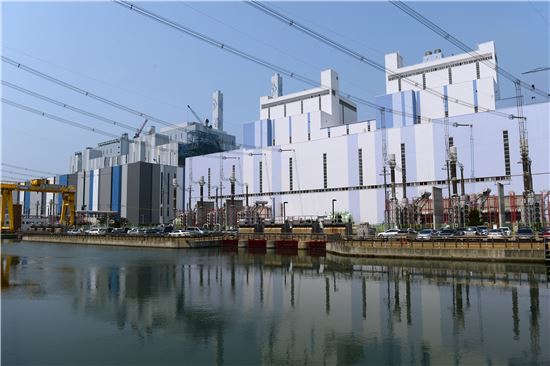 Dangjin Coal-Fired Power Plant Units 9 and 10. (Photo by Provided)
[Asia Economy Reporter Moon Chaeseok] Controversy is rising as the Electricity Industry Infrastructure Fund (Electricity Fund), which has been used according to government policy, is increasingly likely to be utilized for reducing coal-fired power generation (decarbonization of coal). The Electricity Fund is known as a 'quasi-tax' fund, created by deducting 3.7% from electricity bills. Critics argue that using this quasi-tax for government policy compensation costs will increase the burden on the public. It has also been pointed out that under the Moon Jae-in administration, the fund was used to cover costs related to nuclear phase-out and coal phase-out, support new and renewable energy, and establish Korea Electric Power Corporation (KEPCO) University.
According to the government on the 19th, the Ministry of Trade, Industry and Energy re-announced the partial amendment of the Enforcement Decree of the Electricity Business Act on the 14th. In July, the ministry had announced the partial amendment of the decree, adding a legal basis allowing the use of the Electricity Fund to compensate costs that electricity business operators, recognized by the Minister of Trade, Industry and Energy, must bear in relation to the implementation of energy policies such as the early closure of Wolseong Nuclear Power Plant Unit 1. In this re-announcement, the category of electricity business operators was specified as 'power generation operators (including those whose power generation licenses have been canceled or revoked due to energy transition)' and 'power development operators designated for planned power development project areas.'
Furthermore, the bill's purpose was amended to include 'inducing the reduction of the share of nuclear power and coal-fired power generation,' which has become a point of contention. This means that the phrase 'inducing the reduction of nuclear power share' now explicitly includes coal phase-out policy content. In July, there was criticism that Korea Hydro & Nuclear Power (KHNP) had the opportunity to be compensated for costs incurred from equipment improvements at Wolseong Unit 1 and investments in four new nuclear reactors (Cheonji Units 1 and 2, Daejin Units 1 and 2) due to the government's nuclear phase-out policy, which was seen as the government admitting flaws in its nuclear phase-out policy. This time, it was clarified that not only KHNP but also coal-fired power generation operators can receive partial compensation for damages caused by energy transition policies.
The government's management policy of the Electricity Fund has caused much controversy, frequently addressed in past National Assembly audits. The purpose of collecting the Electricity Fund, stated as 'continuous development and foundation of the electricity industry,' is vague, leading to the label of a 'fund collected from the public and used at the government's discretion at any time.' The fund was created in 2001 to compensate for public costs during the attempted privatization of Korea Electric Power Corporation (KEPCO). After the privatization failed, only the fund remained. Under the Moon administration, the fund's justification of 'development of the electricity industry' was used for ▲ compensation for nuclear and coal phase-out ▲ support for new and renewable energy ▲ establishment of KEPCO University, while the original purpose of the system, such as 'supporting electricity supply to rural and fishing villages,' was criticized for being neglected.
The government argues that expenditures are made within spending limits, so no additional losses such as increased electricity bills will occur to the public. However, the fund continues to grow while its uses fail to gain public sympathy. This is why there is criticism that the government treats the resources collected from the public like 'pocket money.' There has also been ongoing debate about the appropriateness of the Electricity Fund's levy rate being excessively high. The fund, which began collecting in 2001, had grown to 4.4714 trillion won by the end of last year. According to Han Mu-kyung, a member of the National Assembly from the People Power Party on the Industry, Trade, Energy, Small and Medium Enterprises Committee, it is expected to increase to about 5.1176 trillion won this year.
© The Asia Business Daily(www.asiae.co.kr). All rights reserved.

![User Who Sold Erroneously Deposited Bitcoins to Repay Debt and Fund Entertainment... What Did the Supreme Court Decide in 2021? [Legal Issue Check]](https://cwcontent.asiae.co.kr/asiaresize/183/2026020910431234020_1770601391.png)













