Over 4,000 Delivery Workers to Strike from the 21st
Concerns Over 'Delivery Crisis' Ahead of Holidays
Civilians Say "Support" vs "Selfish Collective Action"
"Need to Define and Legislate the Concept of Delivery 'Sorting Work'"
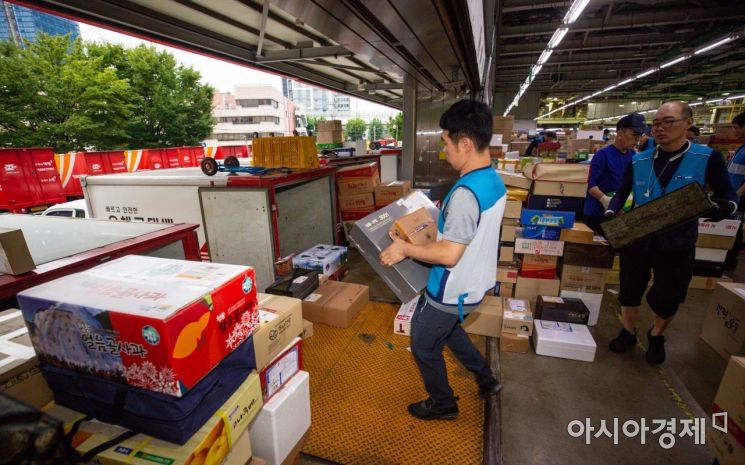 Ahead of the nation's biggest holiday, Chuseok, in 2019, workers are sorting holiday gift parcels at the Dong Seoul Postal Logistics Center in Gwangjin-gu, Seoul. Photo by Jinhyung Kang aymsdream@
[Asia Economy Reporters Han Seung-gon and Kang Joo-hee] Amid the surge in parcel delivery volumes following the government's call for a "contactless Chuseok" due to the impact of the novel coronavirus disease (COVID-19), some delivery workers have announced a strike refusing to perform parcel sorting tasks, sparking controversy.
Opinions among citizens are divided. While some support the strike to improve the working conditions of delivery workers, others view it negatively, accusing them of holding consumers hostage.
Some argue that to resolve such conflicts, fundamental measures are needed to address the sharing of sorting tasks among delivery workers, long working hours, and the issue of death from overwork.
The "Delivery Workers Overwork Death Countermeasure Committee," composed of labor and civic groups, held a press conference at the Korean Confederation of Trade Unions on the 17th, announcing that about 4,000 delivery workers nationwide will begin refusing sorting tasks starting from the 21st.
The committee stated, "Sorting tasks are the core reason why delivery workers have to start work at dawn and deliver until late at night, resulting in long working hours," adding, "They spend half of their 13 to 16-hour workdays on sorting tasks but do not receive a single penny in wages for it."
Parcel sorting refers to the process of categorizing logistics by region before delivery and loading them onto vehicles. Due to the commission-based structure based on the number of deliveries, delivery workers reportedly spend more than half of their working hours on sorting tasks without receiving compensation for this work.
The committee further said, "The entire society is concerned about delivery workers dying from overwork and is demanding the deployment of sorting personnel, but delivery companies are turning a blind eye and deaf ear," adding, "We ask for understanding of our sentiment that no more delivery workers should collapse from overwork. To work without dying, and to deliver not only today but also tomorrow and the day after, we intend to refuse sorting tasks."
With parcel volumes surging due to COVID-19 and the likelihood of this Chuseok being a contactless holiday, if the strike proceeds as planned, disruptions in parcel delivery are expected to be inevitable.
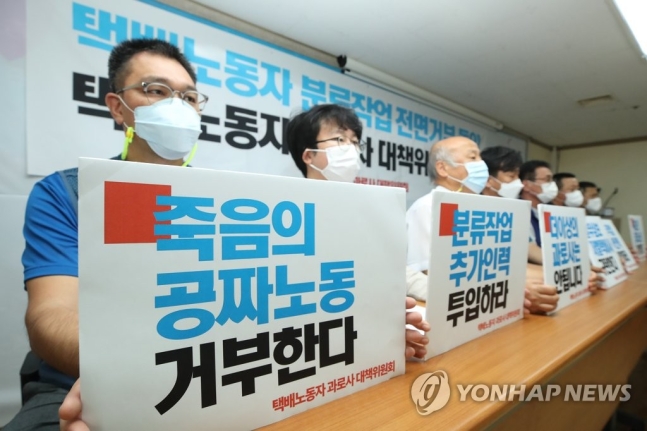 The Committee for Measures Against Overwork Deaths of Delivery Workers held a press conference on the morning of the 17th at the Korean Confederation of Trade Unions in Jung-gu, Seoul, titled "Full Refusal of Sorting Work by Delivery Workers, Statement from the Committee for Measures Against Overwork Deaths of Delivery Workers." Photo by Yonhap News
Public reactions are mixed. A 20-something office worker, Mr. A, said, "Delivery workers are the ones who work hardest during the COVID period. Not paying wages for sorting tasks, which take up half of their working hours, is an unacceptable treatment," adding, "I support the strike in hopes that those who work hard will be compensated fairly. I think we can tolerate some inconvenience from slightly delayed deliveries."
The issue of death from overwork due to the harsh labor of delivery workers has been revealed as serious. According to the "Parcel Logistics Statistics and Delivery Workers' Industrial Accident Status" submitted by the Ministry of Land, Infrastructure and Transport and the Ministry of Employment and Labor to Kim Sung-won, a member of the National Assembly's Environment and Labor Committee from the People Power Party, on the 17th, a total of 19 delivery workers died from industrial accidents between 2016 and June 2020. Nearly 50%, or 9 of them, died from industrial accidents in the first half of this year, with 7 of those deaths attributed to overwork.
As concerns about delivery workers suffering from excessive workloads continued, President Moon Jae-in urged related ministries on the 14th during a senior secretaries and aides meeting to "strengthen labor supervision to prevent delivery workers from suffering excessive labor, increase temporary personnel through on-site inspections, and create a safe working environment."
However, some citizens express negative opinions about the sudden strike announcement. A 33-year-old office worker, Mr. B, said, "Due to the COVID situation, I use parcel delivery for almost all daily necessities, and I have gifts to send to my parents this Chuseok. It is frustrating to hear about the strike suddenly so close to the holiday," adding, "Ultimately, consumers have to bear the inconvenience. Striking at a time when parcel use is high is a selfish collective action."
Post office mail carriers are also opposing the delivery workers' strike, saying that Chuseok parcel volumes will flood the post office.
The National Postal Workers' Union of the Korean Confederation of Trade Unions issued a statement on the 17th, saying, "If the delivery union strikes during the busiest holiday season, all unprocessed parcels will be passed on to mail carriers, increasing their workload excessively and pushing them to the brink," warning, "We will never tolerate the irresponsible behavior of shifting the consequences of the delivery union's strike onto mail carriers. If sacrifices are forced, appropriate responsibility will be demanded."
Following the strike announcement, the Ministry of Land, Infrastructure and Transport and the Ministry of Employment and Labor announced on the 17th that they will deploy an additional 10,000 personnel daily for sorting tasks until the 16th of next month to prevent delivery disruptions during the Chuseok holiday period.
However, experts point out that to solve the chronic problems in the parcel delivery industry, fundamental measures are urgently needed, including addressing unpaid sorting work and deaths from overwork caused by poor working conditions, not just increasing personnel during the holiday period.
Park Sang-hyuk, a member of the National Assembly's Land, Infrastructure and Transport Committee from the Democratic Party, said in an interview with CBS Radio's "Kim Hyun-jung's News Show" on the 18th, "Ultimately, the issue is who will bear the cost of sorting tasks. Under the current structure, even if sorting personnel are deployed, delivery companies do not cover the costs."
Park added, "Recently, the National Assembly has been discussing the Living Logistics Act, which is currently submitted to the Assembly. As the parcel delivery industry is growing rapidly and has unlimited growth potential, it is necessary to clearly define the concept of sorting tasks, cost-sharing, and responsibility."
© The Asia Business Daily(www.asiae.co.kr). All rights reserved.


















