[Kim Min-wook, Editor-in-Chief of Monthly Defense and Technology] The Roh Moo-hyun administration established the "Defense Reform 2020" in September 2005 and legislated it as the "Act on Defense Reform" in December 2006.
This reform plan, named "Defense Reform 2020 for Advanced and Elite National Defense in the 21st Century," was based on the motto of "Fostering an advanced and elite strong military together with the people." It aimed to transform the Korean military's "quantitative structure" into a "qualitative structure," nurturing an advanced information-science military centered on information and knowledge that operates with greater foresight, faster mobility, and more precise strikes, in preparation for the transfer of wartime operational control.
The major difference from previous defense reforms was the legalization of the defense reform implementation plan to ensure consistency and continuity of the reform. Despite efforts by successive administrations to promote defense reform, the reforms were not consistently sustained because there was no legal basis for the reform and the military pursued reforms internally on its own, a perception held by President Roh Moo-hyun.
"Defense Reform 2020" was fully implemented after the "Act on Defense Reform" passed the National Assembly in 2006. According to this act, the basic defense reform plan is to be revised and supplemented every five years at mid-term and completion points, considering changes in the security situation and environmental factors. Accordingly, the Ministry of National Defense announced the "Basic Defense Reform Plan 2012-2030" in 2012 and the "Basic Defense Reform Plan 2014-2030" in 2014.
"Defense Reform 2020" focused on substantial reductions in military personnel, restructuring of forces and unit organization, strengthening the Joint Chiefs of Staff's functions to the level of a theater command, and improving internal military operations. It clearly identified the establishment of surveillance and reconnaissance (SR), precision-guided munitions (PGMs), and command, control, communications, computers, and intelligence (C4I) systems as the core of military power development to prepare for independent operational capabilities after the transfer of wartime operational control. This concept can be seen as a comprehensive outcome of the advanced defense vision inherited and developed through successive administrations since President Roh Tae-woo's 818 Plan.
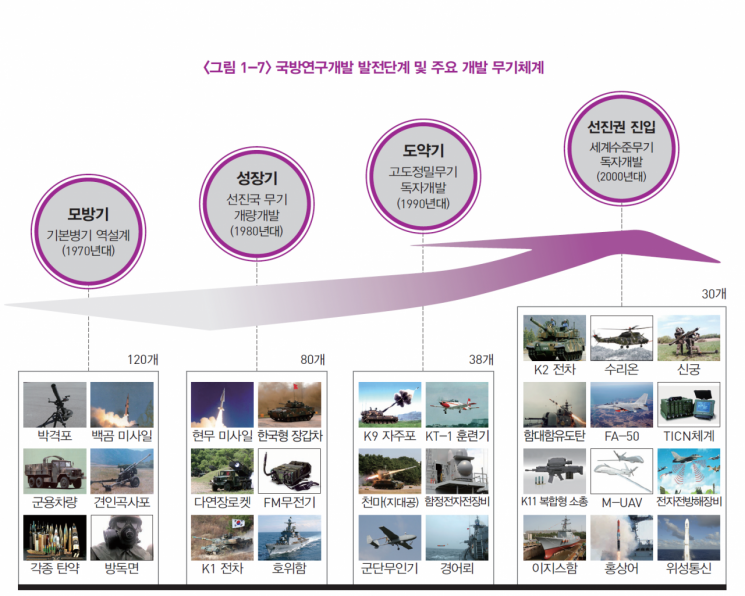
▲ Publication of the first policy document on defense science and technology, the "Defense Science and Technology Promotion Policy" = In October 2007, the Ministry of National Defense published the first policy document on defense science and technology, the "Defense Science and Technology Promotion Policy," presenting the vision of "securing world-class defense science and technology capabilities."
The mid- to long-term goals of the defense science and technology policy were set as entering the advanced tier of "advanced weapon system development technology" during the mid-term period (2010?2014) and securing "independent development capabilities of advanced weapon systems" during the long-term period (2015?2024), aiming to become one of the world's top eight defense science and technology powers and to achieve technological and international competitiveness at the level of the top 10 in arms exports.
The basic directions of the defense science and technology policy are as follows: First, "goal-oriented defense research and development." This means selective and focused development of core technologies centered on NCW (Network-Centric Warfare) and unmanned technologies, as well as technologies necessary to improve the operational efficiency of weapon systems such as software. Second, expanding investment in defense science and technology to raise defense R&D expenditure to about 10% of the defense budget, and actively introducing advanced methods such as ACTD (Advanced Concept Technology Demonstration) and M&S-based R&D [or SBA (Simulation-Based Acquisition)] to improve the efficiency of the defense R&D system.
Third, expanding defense R&D infrastructure. This includes establishing a defense technology planning and evaluation system and securing expertise, strengthening test and evaluation capabilities, conducting advanced research at the Agency for Defense Development, and promoting company-led R&D and performance upgrades. Fourth, promoting defense science and technology development linked with national science and technology, including strengthening civil-military technology cooperation. Fifth, enhancing international cooperation and joint development in defense science and technology.
© The Asia Business Daily(www.asiae.co.kr). All rights reserved.

















