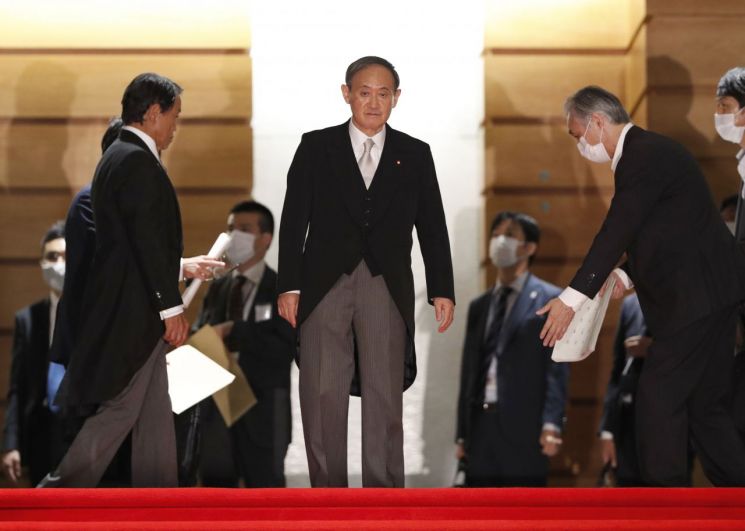
[Asia Economy Reporter Jeong Hyunjin] The Asahi Shimbun, a progressive-leaning Japanese newspaper, has called for dialogue between the South Korean and Japanese governments, urging a reassessment of the 2015 comfort women agreement and its revitalization following the inauguration of the Yoshihide Suga Cabinet. Since his election on the 16th, Prime Minister Suga has made no particular remarks regarding South Korea-Japan relations or President Moon Jae-in's congratulatory message. It appears that Japanese media emphasize the need for dialogue between the two governments to renew the chilly atmosphere.
In an editorial on the 18th, Asahi stated, "The two countries are currently facing the issue of forced labor victims (forced labor victims). It would be effective for both sides to reaffirm the intent of the comfort women agreement to avoid a complex crisis," and suggested, "The Suga administration should initiate new intergovernmental talks to reset the strained relationship."
Asahi also viewed South Korea's situation as an opportunity for intergovernmental dialogue. It pointed out that allegations of poor accounting have emerged concerning comfort women-related organizations such as the Justice and Memory Foundation, and that judicial rulings must be awaited for fact-finding. "Regardless of the truth of the allegations, both the South Korean and Japanese governments should take seriously the phenomenon of renewed attention to the comfort women issue," it noted. Furthermore, it emphasized that the 2015 comfort women agreement has become ineffective and lost its significance, urging the South Korean government to "return to the origin of human rights issues, reassess the agreement, and use this as an opportunity to promote its implementation."
Asahi evaluated that "the Japanese government acknowledged the military's involvement during the war and expressed sincere apologies and remorse under the name of then-Prime Minister Shinzo Abe," while mentioning that criticism grew within South Korea afterward. It added that President Moon unilaterally decided to dissolve the Reconciliation and Healing Foundation, stating that he would respect the wishes of the victims by emphasizing a victim-centered approach, but "no remedial measures have been proposed since the foundation's dissolution."
Asahi stated, "Easing the wounds of the past even slightly is a victim-centered thought," and said, "Considering that the parties involved are elderly, it would be reasonable to expedite relief by utilizing the framework of the already established South Korea-Japan agreement." It further stressed, "For that to happen, the Japanese side must also cooperate and take action," emphasizing that "historical issues cannot be resolved immediately by a single agreement; the consciousness and actions embodied in the agreement must be carried forward into the future," and called for dialogue.
Prime Minister Suga, who served as Chief Cabinet Secretary under the Abe Cabinet, has shown a tough stance on South Korea-Japan relations. In an interview with Japanese media earlier this month, regarding the deterioration of South Korea-Japan relations, he indirectly expressed dissatisfaction with President Moon by saying, "Continuity in diplomacy is very important." This was aimed at the fact that the 2015 comfort women agreement was effectively nullified and the issue of compensation for forced labor was raised under the Moon Jae-in administration.
Foreign Minister Toshimitsu Motegi also reiterated the existing position that South Korea is violating international law concerning the forced labor victim issue the day before.
Meanwhile, Takaya Imai, a key figure in the Prime Minister's Office during the Abe Cabinet and the Prime Minister's aide and secretary who led Japan's strengthened export controls against South Korea last year, retired on this day. The Mainichi Shimbun reported that he will be appointed as an 'advisor' in the Prime Minister's Office under the Suga Cabinet.
© The Asia Business Daily(www.asiae.co.kr). All rights reserved.
![Clutching a Stolen Dior Bag, Saying "I Hate Being Poor but Real"... The Grotesque Con of a "Human Knockoff" [Slate]](https://cwcontent.asiae.co.kr/asiaresize/183/2026021902243444107_1771435474.jpg)
















