Defense Science Research Institute's Defense Strategy Technology - ③ Advanced Technology-Based Individual Combat System
[Agency for Defense Development] Various features once seen only in videos like ‘The Six Million Dollar Man’ and ‘RoboCop’ long ago are now being realized under the name ‘Advanced Technology-Based Individual Combat System.’ The reason for implementing super soldiers based on indigenous technology is to address the major future battlefield challenge of ‘personnel reduction.’ There is an increasing emphasis on preserving human life, and the population cliff is reducing manpower resources. Additionally, with shortened service periods leading to reductions in standing forces and restructuring of unit formations, defense conditions are changing. To respond to this, a foundational system (platform) composed of clothing, gear, and equipment that maximizes the combat capabilities of individual soldiers (warriors) is necessary.
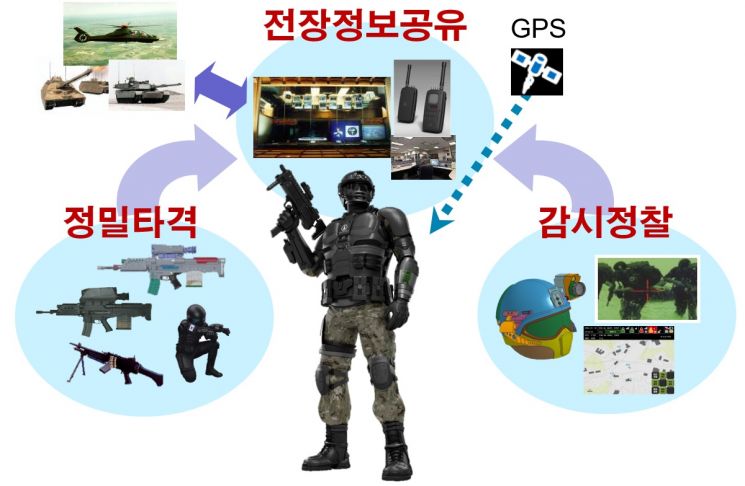
▲ What is the Individual Combat System?= The main integrated weapon system of the warrior platform is the individual combat system. The purpose of the individual combat system is to maximize the soldier’s ability to adapt to the digital battlefield environment and effectively perform missions by linking with small-unit tactical networks. It also aims to enhance survivability, lethality, mobility, and situational awareness to perform reconnaissance and precision strike missions, thereby weaponizing the individual soldier as a unit weapon system. The warrior platform concept is also being pursued by other countries. The United States is known to have fielded ‘Land Warrior’ and ‘Net Warrior’ and is developing the ‘Future Force Warrior.’ France has ‘FELIN,’ Germany has ‘Gladius,’ Russia has ‘Ratnik,’ and Israel has ‘Dominator.’ Each country is conducting research and development for their own systems.
Agency for Defense Development Develops Intelligent Combat Uniform and Integrated Helmet
Capable of Measuring Soldiers’ Heart Rate, Mobility, and Other Biological Signals
Research Underway on Personal Ultra-Small Guided Weapons Capable of Precision Strikes on the Enemy
▲ The greatest welfare benefit for soldiers is survival; personal firearms are fundamental= On the battlefield, threats such as bullets, shrapnel, chemical and biological attacks, and infrared surveillance by the enemy are ever-present, and medical personnel and supplies are critically insufficient. To increase soldier survivability, functions to prevent enemy threats are necessary, and at the same time, objectively assessing the soldier’s health status is important.
Currently, the Agency for Defense Development has developed an intelligent combat uniform and integrated helmet through research optimizing intelligent survival protection functions. This equipment enables analysis of the soldier’s physical and mental state, protection against enemy bullets, chemical and biological facial and body protection, and evasion of enemy infrared detection. The wearable biosignal measurement system can measure biological signals including heart rate, oxygen saturation, respiratory rate, systolic blood pressure, skin temperature, mobility, and mental state. Using this biological information, algorithms based on AI are being developed to assess the soldier’s emergency condition, along with a drug injection system based on microjet technology. The technology readiness level is continuously being improved.
The core of lethality lies in the ability to detect and precisely strike the enemy proactively, day and night, in all weather conditions. Small-caliber personal firearms linked with the individual combat system tend to be procured or developed by specialized companies, while the Agency for Defense Development is researching personal ultra-small guided weapon technology. This technology overcomes the limited range of existing squad weapons and maximizes attack lethality with high hit rates and explosive power. The Agency is enhancing technology readiness through research and development so that smart munitions can autonomously detect and track targets during flight to precisely strike moving targets or detonate in the air to annihilate area targets.
▲ Agile, customized exoskeleton robots= Exoskeleton robot technology supports the weight of advanced equipment and weapons while enabling soldiers to move agilely. Currently, the Agency for Defense Development is focusing on developing exoskeleton robot platform technology specialized for soldier movement. An exoskeleton technology capable of supporting mission equipment weighing over 40kg and allowing walking speeds up to 10 km/h has been developed. Additionally, research is underway to diversify military exoskeleton platforms specialized for missions and to integrate artificial intelligence and biosignals into exoskeleton technology so that the exoskeleton becomes a personalized robot tailored to the wearer’s condition.
▲ Securing rapid and accurate situational awareness= Rapid and accurate situational awareness among individual soldiers or between soldiers is a crucial factor during mission execution. In existing small-unit combat missions, soldiers’ situational awareness and information sharing were limited, and effective and diverse operations through real-time text and battlefield video transmission beyond voice communication were impossible. The Agency for Defense Development is conducting research on integrated tactical information network technology for future soldier systems and developing core technologies to enhance individual soldiers’ situational awareness. Key research areas include helmet-mounted day/night cameras, multi-sensor and display units for battlefield surveillance and situational awareness, real-time high-speed transmission and automatic relay of tactical information among soldiers, and automatic target detection/identification technology based on multi-camera day/night systems.
▲ The dream of the super soldier approaching reality= The individual combat system is a technology field that applies advanced technology to soldiers’ personal firearms, equipment, and clothing based on cutting-edge technology, weaponizing individual soldiers as unit weapon systems to prepare for future force reductions and maximize individual combat capabilities. If South Korea continuously researches and develops this field by converging and integrating its excellent information technology (IT), biotechnology (BT), and nanotechnology (NT) infrastructure into an integrated concept, the battlefield mission performance of soldiers will undoubtedly improve, and it is expected that the dream of ‘The Six Million Dollar Man’ and ‘RoboCop’ can be realized with our indigenous technology.
© The Asia Business Daily(www.asiae.co.kr). All rights reserved.

















