Concerns Over Personal Information Leakage When Filling Out Handwritten Entry Logs
Measures Established to Record Only City, County, and District Names Excluding Full Names
Only 3 Out of 10 Places Comply
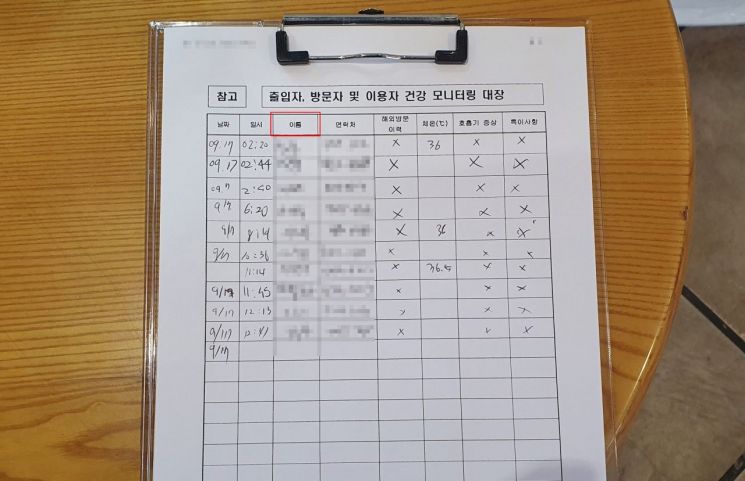
[Asia Economy Reporter Lee Jung-yoon] #Office worker Kim Su-yeon (31, female, pseudonym) feels anxious every time she fills out a handwritten entry log at restaurants or cafes. This is because the entry logs, created to prevent the spread of the novel coronavirus infection (COVID-19), still require not only phone numbers but also names to be recorded. Often, the entry log is left unattended on a table at the entrance, and the store owner is too busy attending to customers to manage the log properly. Kim said, "I feel like I am leaking my personal information every single day."
As concerns over personal information leakage grow, COVID-19 personal information protection enhancement measures have been introduced to exclude names when filling out entry logs. However, some cafes and restaurants still require names to be written, causing ongoing consumer worries.
On the 19th, Asia Economy surveyed 10 cafes and restaurants in Seongdong-gu, Seoul, and found that only 3 places provided handwritten logs without a name field. The other 7 places used handwritten logs requiring addresses, phone numbers, and names. Business owners said in unison, "We were not aware that names did not need to be written in the entry logs," and "We will change the forms after reviewing the related information."
Citizens sensitive to personal information prefer to use electronic entry logs via QR codes. According to the Personal Information Protection Commission (PIPC), the number of uses of QR code-based electronic entry logs increased to 6.01 million in June, 32.54 million in July, and recorded 33.59 million in August.
However, many small businesses have yet to adopt QR code-based electronic entry logs, so there is still a long way to go. Kim Mo (67, female), who runs a restaurant alone, said, "I know what a QR code is, but I don't know how to use it, so I fill out handwritten entry logs," adding, "Since I run the restaurant alone, it would be overwhelming to check each QR code."
In response to the resurgence of COVID-19, the government requires places without electronic entry log systems to have visitors manually write their visit date and time, name, and phone number. However, many logs were carelessly left on counters or cash registers, leading to repeated personal information leaks. A bizarre story of a stranger seeing the 'COVID log' and sending a message saying, "I contacted you because I was lonely," went viral on the internet.
Accordingly, since the 11th, the government has mandated that names be excluded from entry logs, requiring only mobile phone numbers to be recorded. However, this rule is still not being followed, and most establishments place the entry logs at the store entrance where anyone can see them.
According to the Ministry of Health and Welfare’s detailed rules on the placement and management of handwritten logs, when filling out logs, others' personal information must not be visible, and handwritten logs must be stored in a locked place. After four weeks, they must be shredded or incinerated. Failure to comply with disposal measures results in a fine of up to 3 million KRW, and leaking personal information can lead to imprisonment of up to five years or a fine of up to 50 million KRW. A PIPC official stated, "We will conduct on-site inspections together with health authorities and local governments, and actively promote and guide the enhanced personal information protection measures."
© The Asia Business Daily(www.asiae.co.kr). All rights reserved.
![Clutching a Stolen Dior Bag, Saying "I Hate Being Poor but Real"... The Grotesque Con of a "Human Knockoff" [Slate]](https://cwcontent.asiae.co.kr/asiaresize/183/2026021902243444107_1771435474.jpg)
















