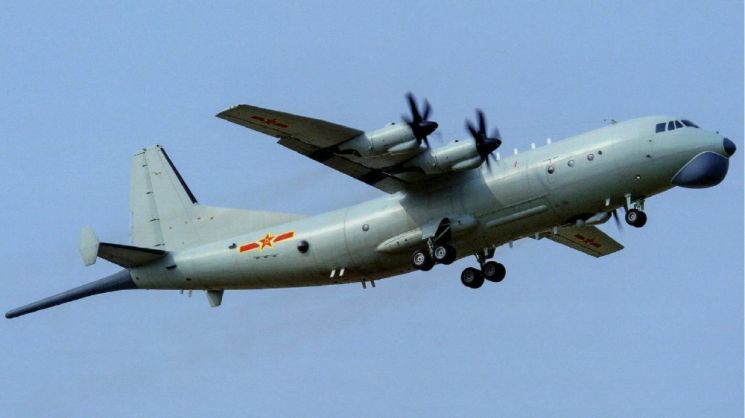
 On September 17, the Chinese Navy's Kongchen-200 anti-submarine ship intruded into Taiwan's Air Defense Identification Zone. Photo by Chinese Ministry of National Defense
[Military Analyst Kim Daeyoung]On the 17th, amid strong Chinese protests over a senior U.S. State Department official's visit to Taiwan, two Kongqian (空潛)-200 maritime patrol aircraft belonging to the Chinese Navy violated Taiwan's Air Defense Identification Zone (ADIZ). In an unusual move, the Taiwanese Air Force promptly released a press statement to the media detailing the flight paths and aircraft types of the intruding Chinese military planes.
This is effectively the first time the Taiwanese military has issued a press release regarding incursions into Taiwan's ADIZ. This announcement also indicates that the intensity of recent Chinese military aircraft incursions into Taiwan's ADIZ is unlike before. The Kongqian-200 maritime patrol aircraft of the Chinese Navy is known as China’s first full-fledged maritime patrol aircraft. Until now, the Chinese Navy had used seaplanes as maritime patrol aircraft. A representative example is the Shuihong (水轟)-5, which China successfully developed based on the Soviet Be-6 seaplane.
The Shuihong-5 seaplane, which first flew on April 3, 1976, was deployed to the Chinese Navy starting in 1986. However, including prototypes, only a few units were produced. Because of this, the Chinese Navy has effectively lacked maritime patrol aircraft capabilities, and the Shuihong-5’s seaplane characteristics made it inadequate for anti-submarine warfare. Consequently, the Chinese Navy began developing a new type of land-based anti-submarine patrol aircraft (反潛巡邏機).
“Anti-submarine patrol aircraft” is the Chinese term for maritime patrol aircraft. The Kongqian-200, developed based on China’s next-generation medium transport aircraft Yun (運)-9, was first revealed on April 25 last year through a special report by China Central Television (CCTV) commemorating the 70th anniversary of the founding of the Chinese Navy. The Kongqian-200 shown in the broadcast resembles maritime patrol aircraft of other countries, featuring weather and navigation radars in the nose and a surface search radar under the nose capable of detecting submarines and various vessels.
Additionally, the rear of the aircraft is equipped with magnetic anomaly detection equipment used for final submarine detection. Inside the aircraft, various equipment consoles and five operators were visible. Beyond the CCTV footage, photos taken by Chinese netizens during test flights of the Kongqian-200 show two internal weapons bays on each side of the fuselage, equipped with six lightweight torpedoes designed to attack submarines underwater. There was also a deployment chute for sonobuoys, the primary detection sensor in airborne anti-submarine warfare.
Among Chinese media and netizens, there are evaluations that the Kongqian-200 surpasses the U.S.-made P-3C maritime patrol aircraft. However, since the exact specifications of the Kongqian-200 have never been officially disclosed, such assessments appear somewhat exaggerated. The Kongqian-200 is also known by the name Gaoxin (高新) 6, and it is reported to be concentrated at bases near the East China Sea, adjacent to the South China Sea and Taiwan Strait, where U.S.-China tensions are severe.
© The Asia Business Daily(www.asiae.co.kr). All rights reserved.

















