Introduction of 'Smart! Math Expedition' for 1st and 2nd Grade Elementary Students
Algorithm Diagnoses Learning
"It is necessary to review the understanding of grouping and partitioning within the range of 9 or less in the first semester, as well as addition and subtraction of single-digit numbers (Unit 3). In particular, additional learning on partitioning and subtraction may be required. Difficulties are expected in learning addition to make 10 and subtraction from 10 (Unit 4), and expressions like some+some=teen numbers, teen numbers-some=some (Unit 6) in the second semester."
[Asia Economy Reporter Hyunju Lee] This is not a consultation with a teacher about math. Nor is it advice from a private academy instructor. It is an analysis derived by artificial intelligence (AI) based on math problems solved by a first-grade elementary school student. This is an example of using 'Smart! Math Expedition,' which is being implemented nationwide for all first and second graders in elementary schools. Math Expedition is the first case of AI technology being introduced into school educational activities.
Through a test applying gamification techniques, when a student solves problems, the algorithm identifies learning gaps or areas needing reinforcement. The student who received the above analysis was diagnosed as needing practice in number size and order, and also required more practice in basic calculations. Based on this, the student's expected achievement for the next semester was predicted. Accordingly, the actual teacher recommends suitable programs or practice activities to the student. Such assistance can also be accessed at home by logging into a smart device and solving the problems.
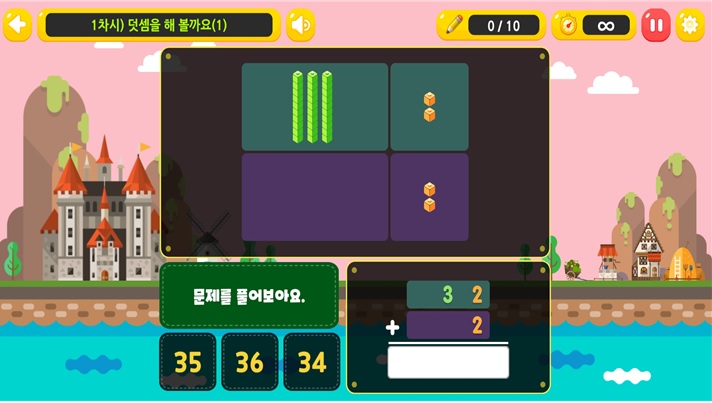 Students can assess their learning level through functional game-based problem solving and receive content to address learning gaps and supplements analyzed by artificial intelligence algorithms. A scene of problem solving on the Math Expedition website. (Provided by the Ministry of Education)
The accumulated learning results can also be utilized in developing future curricula and textbooks. A Ministry of Education official said, "Depending on the results, we plan to add more questions of certain difficulty levels or enrich concept explanations."
From the second semester of next year, high schools will offer AI as an elective subject. 'Introduction to Artificial Intelligence' and 'Mathematics for Artificial Intelligence' will be newly established as elective courses for high school career paths. These courses will be experience-centered, covering basic AI principles and social impacts, and will help students easily understand the mathematics underlying AI, including how math is used in the AI field.
New High School Career Electives Established
Ministry of Education Trains Specialized Teachers
Universities Launch Related Majors One After Another
The Seoul Metropolitan Office of Education will publish textbooks that can be piloted starting this semester, the first in the nation. Approved as an education superintendent-recognized book, 'Artificial Intelligence and Future Society' will be used at Sunrin Internet High School, an AI-specialized high school and pilot school for AI and Internet of Things. This textbook provides basic understanding and ethics of AI and helps students practically implement AI models using programming languages. The Seoul Metropolitan Office of Education stated, "We hope this creates opportunities to discuss ethical and social issues brought by AI as well as fundamental questions about AI itself." In addition to AI, other new subjects related to the 4th industrial revolution such as Data Science (Busan Office of Education), Internet of Things (Daegu Office of Education), and Information Project Research (Gwangju Office of Education) are being prepared for establishment at individual schools through respective education offices.
The Ministry of Education has begun training specialized AI teachers. Starting this month, 5,000 'AI Convergence Education Specialist Teachers' will be trained over five years, with 1,000 trained annually. As part of re-education for current teachers, AI convergence education majors have been established in graduate schools of education through cooperation with metropolitan and provincial education offices. Universities are also newly establishing AI-related departments and actively admitting freshmen. Seoul National University of Science and Technology has newly established the 'Department of AI Applications,' offering four-year scholarships to all freshmen, and Soongsil University has reorganized its Smart System Software Department into the AI Convergence Department. Chung-Ang University has also established an AI department, operating separately from the existing Software Department. Additionally, departments related to AI such as Human Intelligence Information Engineering at Sangmyung University, AI Convergence Department at Sungshin Women's University, AI Department at Sejong University, and Psychological Brain Science at Hanyang University have been created and are recruiting new students.
© The Asia Business Daily(www.asiae.co.kr). All rights reserved.

















