Demolition Companies See Increased Work but Cannot Resell, Only Stockpiling Inventory
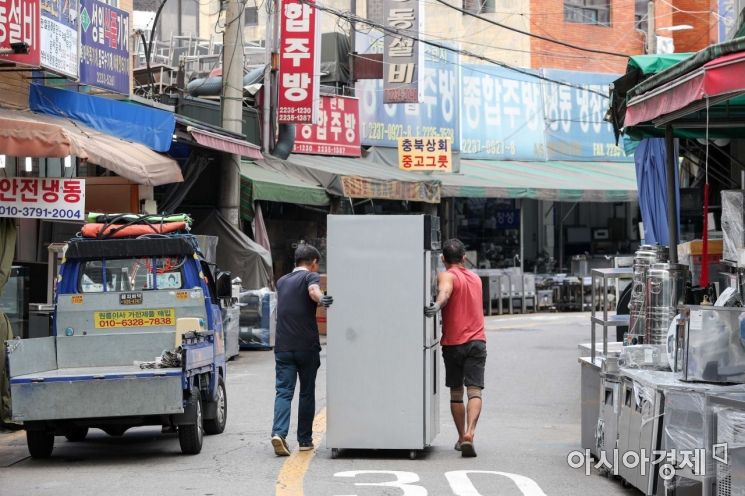 Due to the resurgence of COVID-19 infections, the closure rate of self-employed businesses is increasing. On the 14th, used kitchenware was piled up on the kitchen street in Hwanghak-dong, Jung-gu, Seoul. Photo by Jinhyung Kang aymsdream@
Choi Yunsik (alias), who operated a workshop in Siheung-si, Gyeonggi-do for three years, recently decided to close his business. Dozens of machines and tools in the store are being sold as used items at half their original price. Since early this year, Choi's workshop has seen continuous declines in sales, making it difficult to even pay the monthly rent of 400,000 won. This was unimaginable in the past. Although Choi was only able to open the workshop for seven months last year due to a long-term stay abroad, he still managed to generate sales exceeding 80 million won by the end of the year while working alone. The COVID-19 pandemic changed everything. With social distancing measures in place, all educational programs, which were one of the workshop's income sources, were canceled, causing a significant blow. Despite holding on through indoor wooden interior work and custom furniture orders, he eventually reached his limit.
Due to the sharp decline in sales caused by the prolonged COVID-19 pandemic, an increasing number of small business owners are giving up their businesses and disposing of assets such as equipment and inventory used in their stores. The market is flooded with used goods from closed stores, and demolition companies handling these disposals are also facing growing difficulties.
Park Hoseong (alias), who operated a household goods store in the metropolitan area and decided to close his shop, said, "Handling the remaining inventory is also a headache." Oh Minju (alias), who runs a cafe in Ulsan, had no choice but to opt for a "tearful demolition" as no buyer appeared. Oh, who recently requested store demolition, said, "Due to the impact of COVID-19, I couldn't endure the business and put the store up for sale without asking for key money, planning to transfer equipment and supplies as is, but no buyer appeared. After months of declining sales and losses, I had to at least get the deposit and quickly clear out the store, so despite the cost burden, I had no choice but to entrust the demolition."
A demolition company representative said, "Since the resurgence of COVID-19, inquiries about store demolition have been increasing. We receive at least three inquiries a week, mostly from coffee shops, restaurants, and small academies." He explained, "Although it varies by industry, demolition costs are estimated at 50,000 to 100,000 won per square meter, and many small business owners cannot afford these costs, so they cannot proceed with demolition."
It might seem that with the increase in store closures and demolitions, demolition companies would benefit from more work and higher profits. However, demolition companies say this is not the case under the current COVID-19 situation. As the volume of used assets from closed stores surges, the prices demolition companies pay to purchase these items have relatively dropped, and similarly, it has become difficult to generate profits through resale.
Demolition company A, which has been purchasing commercial used furniture nationwide for eight years, recorded a loss for the first time this year. With monthly expenses including 2.6 million won for warehouse rent and salaries for two employees, the inventory piled up in the warehouse amounts to about 50 million won. The company representative said, "We bought used furniture cheaply, but the demand for resale has significantly decreased, causing difficulties. In previous years, used furniture stored in the warehouse after purchase would be resold quickly, and once the warehouse was emptied, new items would be purchased to replenish stock, enabling fast turnover. But now, not only is resale difficult, but inventory disposal is also challenging."
For companies like A that purchase used furniture through store demolitions, profits are generated through resale only if there is an increase in demand for used furniture, such as from many new (prospective) entrepreneurs opening stores or revitalization of existing stores. However, the startup market is also in a deep freeze due to COVID-19. According to the 'Survey on the Impact of COVID-19 Resurgence on Small Business Owners' released this month by the Small Enterprise and Market Service, 96.4% responded that the impact on small business management activities after the resurgence was negative. When estimating monthly damage amounts at business sites, 'between 5 million and less than 10 million won' was the highest at 31.3%. Regarding future business operation prospects, 50.6% said they 'might consider closure,' and 22.2% said they 'are likely to be closed.'
© The Asia Business Daily(www.asiae.co.kr). All rights reserved.
![Clutching a Stolen Dior Bag, Saying "I Hate Being Poor but Real"... The Grotesque Con of a "Human Knockoff" [Slate]](https://cwcontent.asiae.co.kr/asiaresize/183/2026021902243444107_1771435474.jpg)
















