940,592 Lives Lost Due to COVID-19
High Cases in the US, India, and Others
Europe Also Sees Recent Increase
US COVID-19 Vaccine Launch Sparks Dispute
[Asia Economy Reporter Naju-seok] The global cumulative number of confirmed cases of the novel coronavirus infection (COVID-19) has surpassed 30 million.
On the 16th (local time), the international statistics site Worldometer reported that the global cumulative number of COVID-19 confirmed cases reached 30,036,868, with 945,092 deaths. The numbers of confirmed cases and deaths are increasing moment by moment.
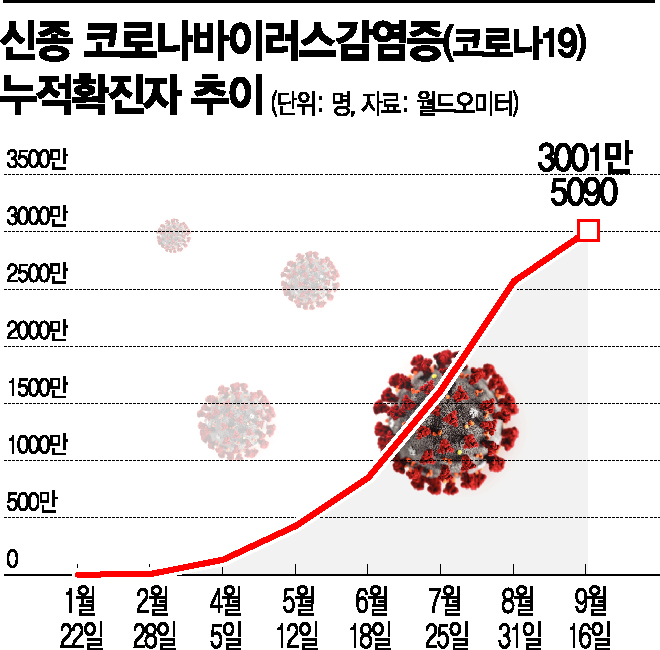
It took 262 days since COVID-19 was reported to the World Health Organization on December 31 last year to exceed 30 million cases. As of January 22 this year, the cumulative confirmed cases were only 580, but the number surged to 86,203 on February 28 and 1,321,343 on April 5. On May 12, it rose to 4,285,122, on June 18 to 8,531,929, on July 25 to 16,172,048, and on August 31 to 25,672,051.
An average of 200,000 to 300,000 new COVID-19 cases have been reported daily.
The country with the highest cumulative number of confirmed cases is the United States, with 6,828,301 infections reported. The U.S., which once had more than 70,000 new cases daily, has recently maintained an average of 30,000 to 40,000 new cases per day. Following the U.S., India shows an increase of 90,000 to 100,000 new cases daily. India's cumulative confirmed cases stand at 5,118,253.
Europe, which was considered the epicenter of COVID-19 after China earlier this year, is seeing a rapid spread of the virus, raising concerns. On this day, Spain reported 11,193 new confirmed cases, a faster increase than during the spring outbreak. France also reported 9,784 new confirmed cases in a single day. However, despite the spread of COVID-19 in Europe, large-scale lockdowns are not expected to be implemented.
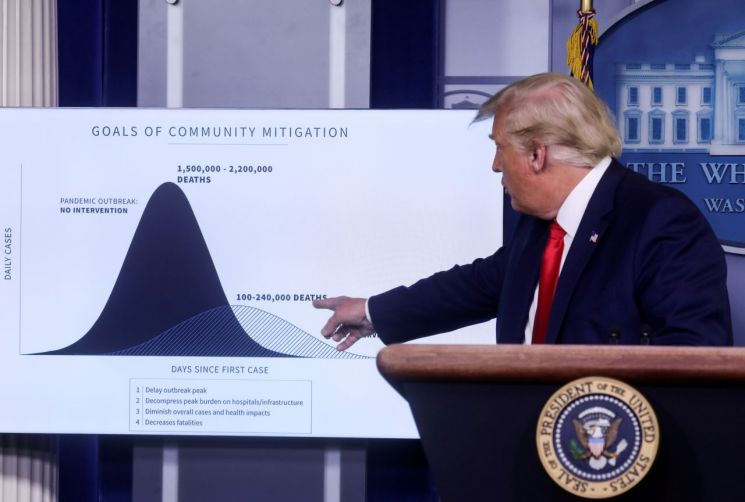 On the 16th (local time), U.S. President Donald Trump explained the U.S. government's response direction by pointing to a chart during a press conference on COVID-19 held at the White House. [Image source=Reuters Yonhap News]
In the United States, there are emerging prospects that a COVID-19 vaccine will be supplied within the year, but conflicting forecasts within the administration have caused confusion.
According to local media including The New York Times on this day, President Donald Trump held an unscheduled COVID-19 briefing at the White House, stating, "We expect to start (vaccinations) from October," adding, "We anticipate mid-October, but it could be later." He further said, "At least 100 million doses of the vaccine will be available by the end of this year," and "Vaccine supply will occur in October or November, but it will not be too late."
President Trump's briefing was prompted by remarks from Robert Redfield, director of the Centers for Disease Control and Prevention (CDC). Redfield appeared at a U.S. Senate hearing on COVID-19 response and said, "COVID-19 vaccinations are expected to begin in November or December, but due to limited supply, healthcare workers and the elderly will be prioritized." He explained that even if vaccine supply is available, the most vulnerable will be vaccinated first, followed by gradual expansion to lower priority groups.
Regarding the timing of vaccine availability for the entire U.S. population, he mentioned, "It will take 6 to 9 months," and "A return to normal life is expected in the third quarter of next year." He explained that even after vaccine approval, there is a time lag before it produces meaningful effects.
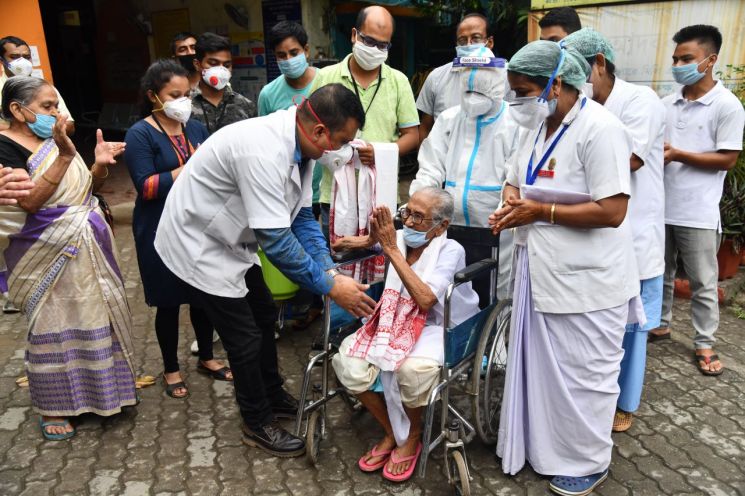 A 100-year-old woman who was infected with COVID-19 in India and has fully recovered is being discharged while expressing gratitude to the medical staff.
 [Image source=EPA Yonhap News]
President Trump's sensitive reaction is closely related to this year's U.S. presidential election. He believes that supplying the COVID-19 vaccine before the election day on November 3 will give him an advantage, but the CDC's pessimistic stance has raised concerns about setbacks in election strategy.
Besides the vaccine supply timeline, President Trump also criticized Director Redfield regarding mask usage. At the hearing, Redfield said, "Masks are the most important and powerful health equipment we have against the COVID-19 pandemic," and "Wearing a mask is a more certain way to protect yourself than getting the COVID-19 vaccine." President Trump responded, "I think Director Redfield made a mistake," and claimed, "Masks can help, but they are not as important as the vaccine."
© The Asia Business Daily(www.asiae.co.kr). All rights reserved.
![Clutching a Stolen Dior Bag, Saying "I Hate Being Poor but Real"... The Grotesque Con of a "Human Knockoff" [Slate]](https://cwcontent.asiae.co.kr/asiaresize/183/2026021902243444107_1771435474.jpg)


















