US "Free Movement with Allies Except China"
China "Data Nationality is Important"
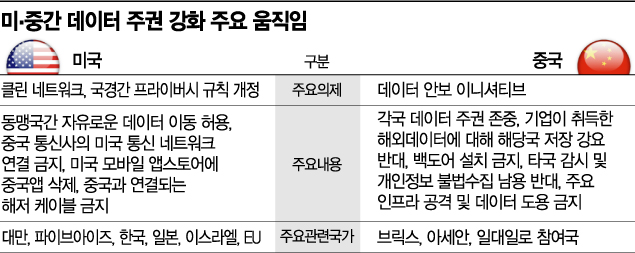
[Asia Economy Reporter Kwon Jae-hee] The data industry, often called the 'crude oil' of the 4th Industrial Revolution era, is entering the realm of trade wars. The United States restricts data movement to its allies, while China also emphasizes data nationality, blocking free movement.
The U.S. data barriers can be seen in the recent proposal to revise the Asia-Pacific Economic Cooperation (APEC) 'Cross-Border Privacy Rules (CBPR).' The CBPR was created to facilitate data flow among APEC member countries, and the revision aims to allow non-APEC countries like Brazil to participate. However, the underlying intention is strongly to exclude China from data distribution. The goal is to exchange data with allies and friendly countries while thoroughly building barriers against adversaries. Previously, in 2011, APEC established the CBPR to enable cross-border data movement, allowing companies certified under this rule to export personal data abroad. Currently, nine countries including the U.S., South Korea, Japan, Mexico, Canada, Singapore, Australia, Taiwan, and the Philippines participate in the CBPR.
The U.S. is generally lenient regarding data movement. The United States-Mexico-Canada Agreement (USMCA) includes provisions for free data movement among the signatory countries, earning it a reputation as the most progressive agreement. This reflects the judgment that opening up is not problematic given the comparative advantage in the information and communication sector. Therefore, the CBPR revision clearly intends to isolate China from the international data market.
Although different from the U.S., China is also passive about data openness. Recently, China introduced the 'Data Security Initiative,' emphasizing data nationality. It stresses that data acquired by Chinese companies overseas must be stored within China.
Wang Yi, China's Foreign Minister, targeted the U.S., which has increased pressure on Chinese IT companies, saying, "Under the pretext of 'security,' they are engaging in global hunting of foreign advanced companies."
The EU also emphasized data sovereignty by terminating the Privacy Shield, a data transfer agreement with the U.S., in July. Citing 'personal data protection,' it ordered that European users' data should not be transferred abroad. As a first measure, earlier this month, it ordered Facebook not to transfer European user data. This clearly signals that it will no longer share data of EU citizens.
© The Asia Business Daily(www.asiae.co.kr). All rights reserved.
![Clutching a Stolen Dior Bag, Saying "I Hate Being Poor but Real"... The Grotesque Con of a "Human Knockoff" [Slate]](https://cwcontent.asiae.co.kr/asiaresize/183/2026021902243444107_1771435474.jpg)
















