Outlook on Managing Non-Living Expense Credit Loans for High-Income Earners
Concerns Over Potential Disruptions in Financial Supply to Small Business Owners and Others
[Asia Economy Reporter Kim Hyo-jin] As the management of rapidly increasing unsecured loans becomes a hot topic in the financial sector, financial authorities are expected to introduce a 'pinpoint regulation' plan as early as next week to curb non-living expense loans for high-income earners. This aims to block high-income and high-credit individuals from raising large sums through unsecured loans for investments in real estate and the stock market following tightened regulations on mortgage loans.
The problem is that if unsecured loans are tightened too much, it could cause side effects such as drying up the funding sources for small business owners and SMEs hit hard by COVID-19. Banks are also growing increasingly concerned. While they are discussing measures such as reducing preferential interest rate margins or lowering unsecured loan limits in response to regulatory pressure, there is a burden that stable profit generation could be hindered.
◆Managing Loans Starting with High-Income, High-Credit Borrowers = Currently, unsecured loans at commercial banks are generally made within 100-150% of annual income. However, special professions including doctors and lawyers can borrow more than 200% of their annual income without much difficulty. For example, if the annual salary is 150 million KRW, one can raise more than 300 million KRW through unsecured loans for stock investments.
In one commercial bank A, the scale of medical staff loans has exceeded 100 billion KRW consecutively over the past three months. Compared to the same period last year, it increased by about 20%. Accordingly, there is a strong expectation that loan limits for these groups will be lowered and various preferential interest rate benefits will be reduced. Some even mention specific criteria such as 'unsecured loan regulations for earners with annual income over 200 million KRW.'
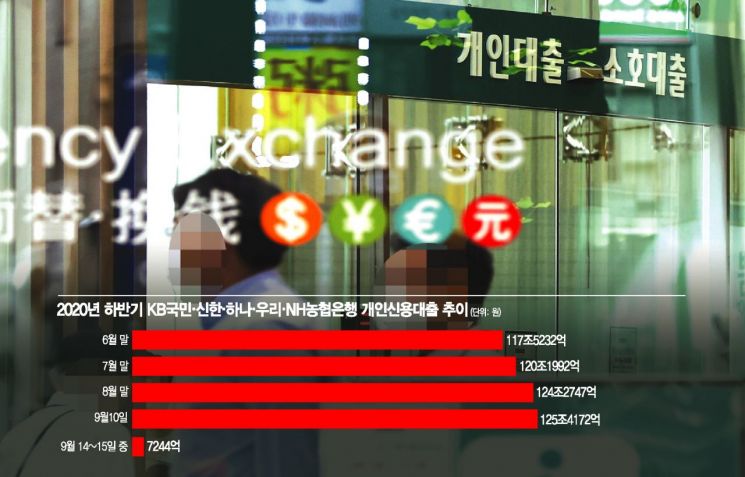
What financial authorities are watching is the fact that bank unsecured loans are supporting real estate panic buying?where people 'pull together every last bit of money' to buy homes?and 'debt investing' where people invest in stocks even by borrowing. At the end of last month, the outstanding unsecured loans of the five major commercial banks?KB Kookmin, Shinhan, Hana, Woori, and NH Nonghyup?increased by 4.0705 trillion KRW (3.38%) from the previous month to 124.2747 trillion KRW, marking the largest monthly increase ever recorded.
Even this month, unsecured loans increased by 1.1425 trillion KRW in just ten days until the 10th. As moves to regulate loans began, many rushed to secure loans before it was too late, causing unsecured loans at the five major banks to increase by 724.4 billion KRW over two days from the 14th to 15th.
A financial authority official said, "It is impossible to perfectly quantify how much of the total loans were used for 'pulling together every last bit' and 'debt investing,'" but added, "We judge that the increase in total loans is driven by high-income earners taking out non-living expense loans worth hundreds of millions of KRW." He also emphasized, "We must not shrink the role of supplying funds to small business owners and SMEs in response to COVID-19."

◆Banks Cautiously Respond with a Sigh = Banks are responding to these moves by reorganizing their systems through strengthening overall unsecured loan screening criteria and preferential interest rate conditions. Commercial bank B lowered the preferential interest rate margin on unsecured loans by 0.2 percentage points earlier this month. Commercial bank C plans to manage by deleting some preferential interest rate items.
A representative from bank C said, "If all conditions are met, preferential interest rates of up to around 1% can be applied," and predicted, "The larger the loan size, the greater the suppressive effect from adjusting preferential interest rates." Banks are preparing plans to manage the total volume of unsecured loans until the end of this year in response to financial authorities' demands. There is also speculation that 1%-level unsecured loan products currently available may disappear once banks begin full-scale management.
While banks empathize with the recognition of the problem of the recent surge in unsecured loans, they are also concerned about side effects that artificial regulations may cause. A credit executive at bank D pointed out, "Loans to high-income earners can be considered high-quality transactions from the bank's perspective," adding, "A virtuous cycle is needed where the increased profitability through these loans is used for living expense loans."
A bank official lamented, "Although official regulations from financial authorities have not been announced, verbal interventions regarding loan regulations have already been made, so banks have no choice but to manage unsecured loans cautiously while watching each other." He also predicted, "If financial authorities push too hard, banks may strictly manage even living expense loans for the lower and middle classes in order to produce results in managing total loan volume."
© The Asia Business Daily(www.asiae.co.kr). All rights reserved.


















