100-Day Business Suspension... Karaoke Owners 'Frustrated'
"Zero Karaoke Infection Cases After Following Quarantine Rules"
Government "Will Provide Disaster Relief Funds to High-Risk Facilities"
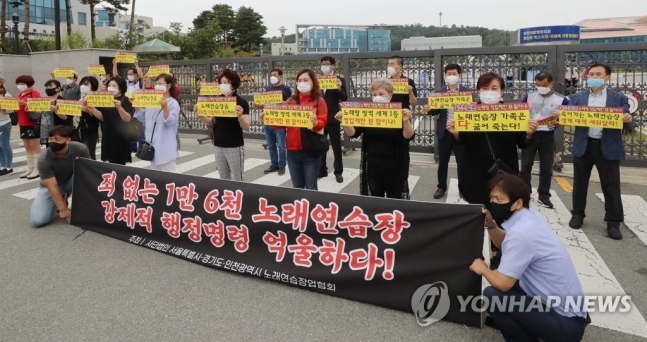 Karaoke business owners, designated as high-risk facilities and unable to operate, held a press conference protesting against the government in front of the Korea Disease Control and Prevention Agency main gate in Osong-eup, Cheongju-si, Chungbuk on the afternoon of the 16th. Photo by Yonhap News
[Asia Economy reporters Han Seung-gon and Kang Joo-hee] As the government eased the social distancing measures in the metropolitan area from level 2.5 to level 2 starting on the 14th, some facilities designated as high-risk, such as singing practice rooms (noraebang), still face a ban on operation, sparking strong opposition from business owners.
With the implementation of level 2 social distancing, cafes, restaurants, bars, and PC rooms, which had previously faced restrictions or bans on operation, have resumed business. However, noraebang, classified as high-risk facilities, remain closed. Noraebang owners argue that restaurants and cafes also pose significant infection risks, so singling out their businesses for continued closure is unfair.
The government announced it would provide economic support, including disaster relief funds, focusing on industries designated as high-risk facilities.
As the number of confirmed COVID-19 cases showed some stabilization, health authorities eased the metropolitan area's social distancing from level 2.5 to level 2 starting on the 14th, after two weeks of the stricter measures.
With the downgrade to level 2, restaurants, coffee shops, small to medium-sized academies, indoor sports facilities, and others that had been subject to operational restrictions or bans were allowed to operate normally while adhering to mandatory quarantine rules. PC rooms, which were classified as high-risk under level 2.5, were excluded from the list under the new measures and can now operate without selling food. This measure will be maintained for two weeks until the 27th.
However, 11 high-risk facilities, including noraebang, remain prohibited from operating. Coin-operated noraebang have been under business suspension for nearly 100 days from March 22 to April 5 (two weeks), May 22 to July 10 (50 days), and from August 19 to today (the 17th). General noraebang have also faced operational disruptions for nearly a month since August 19.
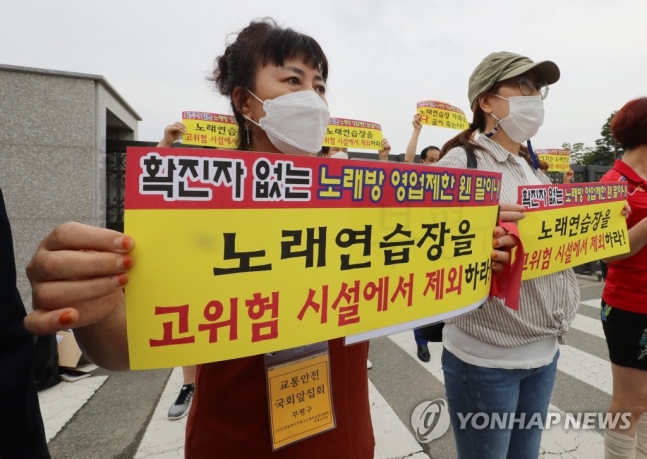 Karaoke business owners are holding a press conference on the afternoon of the 16th in front of the main gate of the Korea Disease Control and Prevention Agency in Osong-eup, Cheongju-si, Chungbuk, protesting the government's business suspension measures. Photo by Yonhap News
As a result, noraebang owners are pleading for the resumption of business, citing enormous economic losses due to the prolonged government ban.
The Metropolitan Area Noraebang Emergency Countermeasures Committee (ECC) held a press conference on the 16th in front of the Korea Disease Control and Prevention Agency in Cheongju, Chungbuk, stating, "(Due to the high-risk facility designation) noraebang have been ordered to suspend operations three times, causing indescribable suffering," and "We are suffering discriminatory damage as we are classified as 'high-risk facilities' without proper compensation," they lamented.
The ECC demanded, "The government must clarify the exact reasons for classifying noraebang as high-risk facilities when no confirmed cases have emerged from them," adding, "After implementing the government's seven major quarantine rules, there have been zero confirmed cases linked to noraebang."
Earlier, in Anyang, Gyeonggi Province, a pair of sisters in their 60s who had operated a noraebang for 25 years attempted suicide due to financial hardship. Their business had been closed since May under a gathering ban administrative order.
Noraebang owners point out that cluster infections have occurred in cafes and religious gatherings as well, so maintaining the gathering ban only on noraebang is unfair.
In a statement released on the 14th, the ECC said, "When infections spread in religious groups or cafes, the bizarre practice of extending the gathering ban on noraebang continues," adding, "The stigmatized businesses are essentially being told to go out of business, so we will return our business licenses. We condemn discriminatory quarantine policies."
They further stated, "Apart from threats of fines if operations are not immediately stopped, the government has taken no responsibility. If a high-ranking official severely infringed on private property through administrative orders, they should be held liable for compensation," and announced plans to file a damage claim against the government.
 Kim Kang-rip, the First Chief Coordinator of the Central Disaster and Safety Countermeasures Headquarters (Vice Minister of Health and Welfare), is announcing the government's position on the status of the novel coronavirus infection at the Ministry of Health and Welfare Government Sejong Complex in August. Photo by Yonhap News
The government stated that the order to suspend operations of high-risk facilities is based on the Infectious Disease Control and Prevention Act and is not subject to compensation. However, it plans to provide economic support in the form of disaster relief funds to industries designated as high-risk facilities.
Kim Kang-rip, chief spokesperson of the Central Disaster and Safety Countermeasures Headquarters, said at a COVID-19 regular briefing held at the government complex in Sejong on the morning of the 16th, "The order to suspend operations of high-risk facilities under social distancing is based on Article 49 of the Infectious Disease Control and Prevention Act, which allows for restrictions or bans on gatherings," adding, "Such measures are not subject to compensation."
He continued, "The government recognizes that there are significant demands for relief and support from noraebang owners and others," and said, "We have submitted a proposal in the fourth supplementary budget to provide a second round of disaster relief funds for high-risk facilities under gathering bans. Although the amount is not sufficient, we will negotiate with the National Assembly and proceed with internal government procedures to provide at least minimal support."
Experts emphasize that infections can occur not only in high-risk facilities like noraebang but also in everyday places such as cafes and restaurants, and that adherence to quarantine guidelines is crucial.
Professor Kim Woo-joo, an infectious disease specialist at Korea University Guro Hospital, said, "Singing produces more droplets than eating or talking, and since noraebang are enclosed spaces, the risk of infection is high if there is a confirmed case," adding, "If noraebang have spacious areas and devices to block risks, that would be fine, but most are enclosed spaces or located underground, so the risk of infection is indeed higher than in restaurants or cafes."
However, Professor Kim noted, "The risk is similarly high in restaurants and cafes, and if we try to determine which is more dangerous, there is no end to it," emphasizing, "Under the current domestic COVID-19 situation, restaurants, cafes, and PC rooms are all risky. It is important to comply with quarantine guidelines wherever you are."
© The Asia Business Daily(www.asiae.co.kr). All rights reserved.
![Clutching a Stolen Dior Bag, Saying "I Hate Being Poor but Real"... The Grotesque Con of a "Human Knockoff" [Slate]](https://cwcontent.asiae.co.kr/asiaresize/183/2026021902243444107_1771435474.jpg)


















