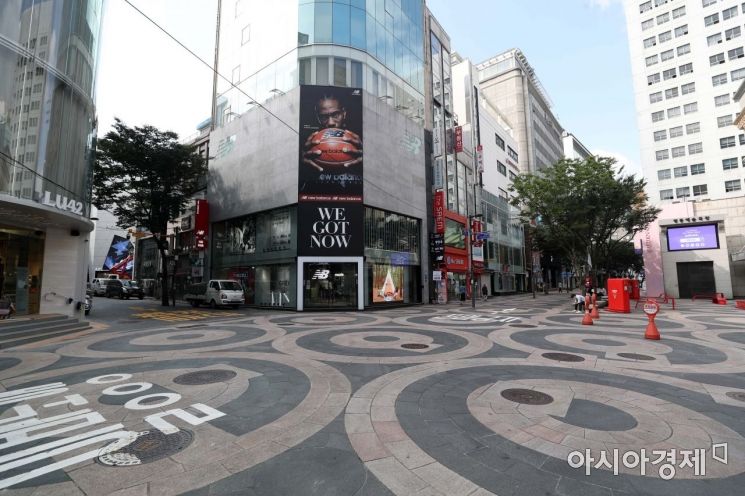
 On the 14th, when social distancing in the Seoul metropolitan area was downgraded from level 2.5 to level 2, the streets of Myeongdong in Seoul were deserted. Photo by Mun Ho-nam munonam@
[Asia Economy Reporter Cho Hyun-ui] The proportion of COVID-19 patients in South Korea whose infection routes are unknown continues to reach new highs every day.
According to the Central Disease Control Headquarters (CDCH) on the 16th, among the 2,055 new confirmed cases reported in the past two weeks (from the 3rd to the 16th), 552 cases are still under investigation for their infection routes, accounting for 25.4% of the total.
This means that more than one in four patients have unknown infection routes. This is the highest rate since the CDCH began tracking the proportion of patients with unclear infection routes in April.
The previous day’s rate of unknown infection routes was recorded at 25.0%, setting a new record, but this record was broken again within a day.
Since the large outbreak in August, the daily number of new confirmed cases, which once exceeded 400, has recently dropped to the 100s. However, cluster infections continue to occur mainly in large hospitals, workplaces, and small gatherings, and as these lead to secondary infections, the proportion of patients with unknown infection routes is expected to remain above 20% for the time being.
Kim Kang-lip, the spokesperson for the Central Disaster and Safety Countermeasures Headquarters (CDSCH), stated, "The number of new confirmed cases is stagnating and not decreasing to double digits, and the proportion of patients whose infection routes or sources are unknown remains well above 20%. We have no choice but to assume that a significant level of latent infections exists within the community."
© The Asia Business Daily(www.asiae.co.kr). All rights reserved.

















