Disruption in Overseas Workforce Supply Due to COVID-19
Reevaluation of Neglected Domestic Talent
Kakao Focuses on Securing Domestic Developers
From 500 Early This Year to 800, a 60% Increase
Naver Joins the Fierce Recruitment Battle
10,000 More Needed by 2022
Salary Premiums Expected to Rise Further
[Asia Economy Reporter Jin-gyu Lee] "The market value of AI developers with five years of experience surpassing 100 million KRW clearly reflects the domestic AI talent shortage. This salary premium phenomenon is expected to continue due to the prolonged COVID-19 pandemic."
Han Jang-hyuk (pseudonym), an AI developer working in the domestic IT industry, said that the market value of AI talent in Korea is rising in tandem with the recruitment difficulties. The salary premium, which had briefly disappeared during the AI boom slowdown in the late 2010s, has recently reemerged as overseas talent recruitment became difficult due to the COVID-19 situation. As a result, the recruitment of AI talent is increasingly concentrated in large companies, deepening polarization.
Kakao AI Workforce Reaches 800... 60% Increase
According to the IT industry on the 16th, Kakao has been making every effort to recruit AI talent, increasing its AI developer headcount from the 500s earlier this year to around 800 recently. An industry insider explained, "The 60% increase in Kakao Enterprise personnel responsible for AI development within Kakao compared to the beginning of the year is thanks to Kakao turning its attention to securing domestic talent instead of overseas talent." The gap caused by the impossibility of recruiting overseas talent due to the COVID-19 pandemic was filled with domestic talent, allowing the organization to grow. To this end, Kakao has been conducting ongoing recruitment targeting AI talent from domestic universities in areas such as AI service planning and development. Naver is doing the same, and the recruitment industry says the AI talent scouting battle between the two companies is fiercely ongoing like a silent war. An AI recruitment industry official said, "Each portal requires hundreds of AI talents, but due to disruptions in overseas AI talent supply caused by the COVID-19 pandemic, they are securing at least domestic university graduates first."
As demand for domestic AI talent grows, their market value is also rising. AI personnel are generally divided into planners, developers, and analysts, and it is only recently that those with five years of experience have surpassed an annual salary of 100 million KRW. An industry insider said, "Planning, development, and analysis ultimately require majors in computer science or software engineering. Since only a few hundred graduates majoring in AI-related fields graduate from prestigious universities nationwide each year, the treatment of domestic AI talent is also improving."
"AI Recruitment Shortage Reflects Salary Premium"
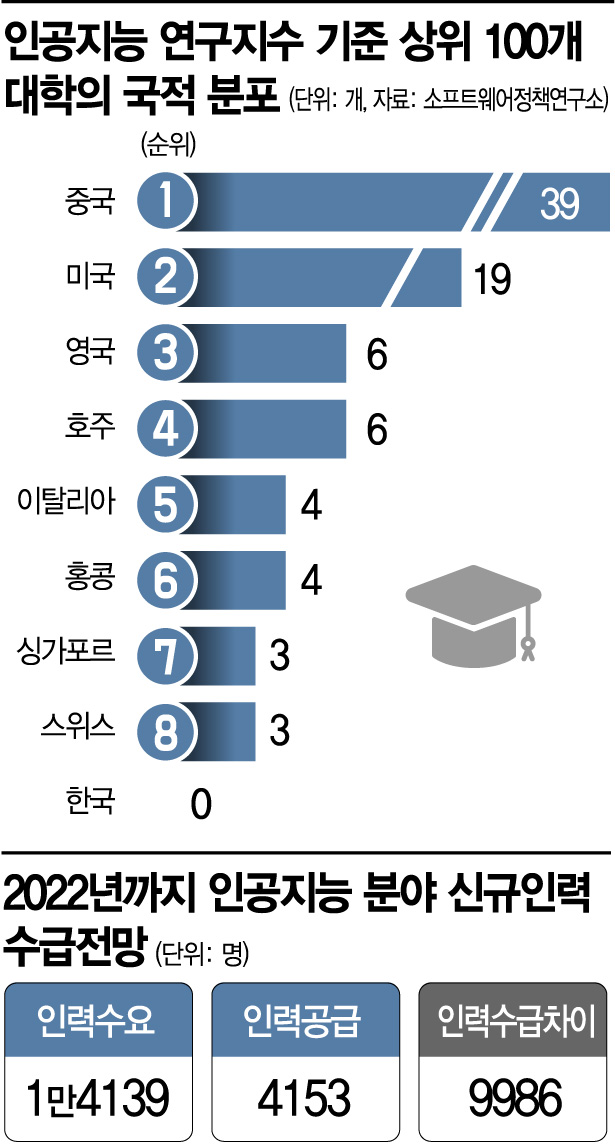
Until now, AI talent from domestic universities have been valued lower than overseas talent. This is because domestic universities’ AI research competitiveness has been considered inferior to that of overseas universities. According to the global best AI university research report based on the AI research index by the Software (SW) Policy Research Institute, no Korean university ranked within the top 100 global AI universities. Consequently, while overseas university graduates had salary contracts based on the 'hundreds of millions' KRW benchmark, domestic graduates found 100 million KRW to be a dream figure even after gaining some experience. In this context, the recent salary premium for domestic university graduates can be interpreted as partly due to supply and demand issues and a reevaluation of domestic talent. An industry insider observed, "The expected demand for AI talent in the domestic IT industry until 2022 exceeds the expected supply by about 10,000, causing a shortage of personnel, so opportunities are arising for domestic AI talent." Another insider explained, "Until recently, domestic AI talent received salaries at the level of the SW industry, but the gap has recently widened. This is partly because the industry is recognizing that AI is a differentiated field from traditional software."
© The Asia Business Daily(www.asiae.co.kr). All rights reserved.

















