[Asia Economy Reporter Park Cheol-eung] Following the Personal Information Data Act, a Digital Transformation Promotion Act utilizing industrial data is being established. For example, it aims to create an institutional foundation that can lead to performance improvements, new product development, unmanned management services, and related financial product development based on data such as automobile parts failures or inspection data.
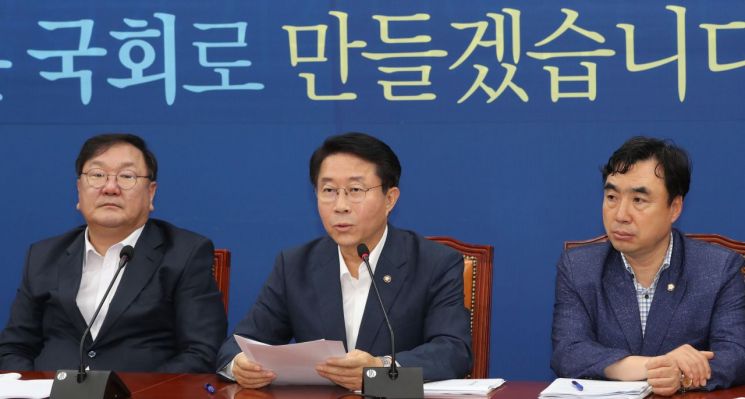
According to the National Assembly on the 16th, Assemblyman Jo Jeong-sik of the Democratic Party recently proposed the "Industrial Digital Transformation Promotion Act." Jo served as the chairman of the party's Policy Committee until the end of last month before the Democratic Party's convention, and this bill is included among the 37 bills jointly promoted by the Democratic Party and the People Power Party.
The purpose is to accelerate the digital transformation applying technologies such as artificial intelligence and big data across industries including manufacturing, with industrial data as the core. Assemblyman Jo stated, "Industrial data has been difficult to utilize due to excessive corporate trade secret protections, diverse forms, and vast scope," adding, "This bill presents principles for the utilization and protection of industrial data not stipulated in existing rights protection laws such as the Personal Information Protection Act."
The bill includes provisions that when new industrial data is generated, the creator has the right to use and profit from it, and that infringing on others' industrial data rights through unfair trade practices or methods contrary to competitive order is prohibited.
The government will ensure reasonable distribution and fair transactions of industrial data and provide necessary support to activate utilization by companies and others. To promote overall industrial digital transformation, the Minister of Trade, Industry and Energy will establish a comprehensive plan every three years, and an Industrial Digital Transformation Committee will also be formed.
Last month, the Ministry of Trade, Industry and Energy announced the "Digital-Based Industrial Innovation Growth Strategy," emphasizing timely and appropriate support for data acquisition.
Using the electric vehicle industry as an example, it cited cases of collecting individual vehicle operation data, industrial parts failure and inspection data, and public weather and environmental data. Through this, it is possible to improve the performance of electric vehicle parts such as batteries, motors, sensors, and braking systems. Additionally, on the service side, effects such as pre-management of parts failures, unmanned management, car sharing, and development of insurance and financial products are expected.
In fact, GE equips one aircraft engine with 250 sensors and analyzes data collected during takeoff and landing to predict engine failure and replacement timing. This improved engine failure detection accuracy by 10%, reduced flight cancellations, and reportedly generated over $175 million in customer benefits.
Assemblyman Jo emphasized, "Seizing the flow of change as a major shift in traditional production and consumption methods, it is a very important task of the era to promote digital transformation across industries by leveraging our strengths in key industries and information and communication technology competitiveness," adding, "It is urgent to establish a new legal framework to fundamentally enhance industrial competitiveness."
© The Asia Business Daily(www.asiae.co.kr). All rights reserved.

















