Major Shift in Hiring Culture Due to COVID-19
Key Trends in Large Corporations' Hiring: 'Abolition of Open Recruitment, Increased Proportion of Rolling and Experienced Hiring, Untact'
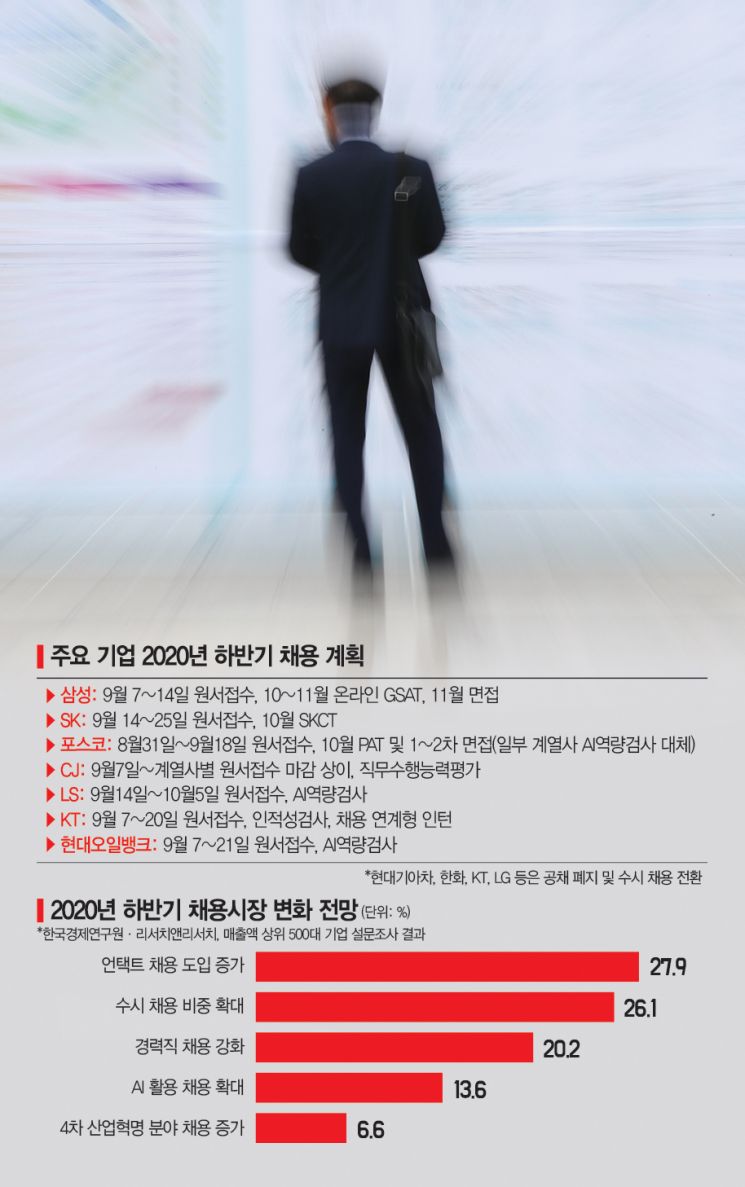
[Asia Economy Reporters Hyewon Kim and Gimin Lee] The keyword that encapsulates the changing recruitment culture of major domestic conglomerates amid the COVID-19 pandemic is summarized as 'abolishment of open recruitment, expansion of irregular and experienced hiring, and Untact (non-face-to-face) processes.' The traditional open recruitment, which hired hundreds to thousands of employees at once, is gradually disappearing, with irregular hiring that prioritizes experienced candidates who can be immediately deployed becoming the prevailing trend. Instead of hiring inexperienced college graduates through open recruitment to 'nurture promising talent,' there is a growing tendency to select 'Doelnomdoel (those who will succeed will succeed)' through internships in the field. This shift after COVID-19 has made the employment door for new college graduates even narrower. Another characteristic born from COVID-19 is that recruitment processes are increasingly conducted entirely through Untact methods from start to finish.
Gradual Abolishment of Open Recruitment for New College Graduates and Introduction of Irregular Hiring
According to the business community on the 15th, among major groups, only Samsung, POSCO, Lotte, CJ, and LS Group still maintain open recruitment for new college graduates. They are accepting applications and planning to hire at levels similar to previous years. The problem is that these groups will find it difficult to continue going against global recruitment trends.
In the business sector, Hyundai-Kia Motors attracted attention by abolishing open recruitment and introducing irregular hiring even before the COVID-19 outbreak last year. Now in its second year, internal satisfaction with flexible hiring is reportedly quite high. Following this, Hanwha and LG Group abolished open recruitment this year, and SK Group announced a phased reduction and complete abolition by the end of 2022. KT eliminated its biannual regular open recruitment and instead established an irregular internship hiring system where interns are hired as full-time employees after completing their internships.
Choo Kwang-ho, Director of Economic Policy at the Korea Economic Research Institute, said, "From a corporate perspective, during the COVID-19 economic crisis, hiring many people at a specific time through open recruitment is considered inefficient in terms of operations," adding, "It is more efficient for the responsible departments to directly hire the necessary personnel at the right place and time." Regarding concerns that the large corporations' employment market is shifting toward experienced hiring, leaving little room for new college graduates, he advised, "Looking at advanced countries overseas, few insist on the open recruitment system. If irregular or experienced hiring becomes the norm, job seekers should find ways to showcase their experience by working at small and medium enterprises and achieving results or utilizing internships."
Jeon In-sik, Head of Employment Policy at the Korea Chamber of Commerce and Industry, also noted, "After COVID-19, there is a strong trend of companies shifting from open recruitment to irregular hiring," and added, "In the era of the Fourth Industrial Revolution, where technological change is rapid and technology is a company's competitive edge, companies may prefer one smart person over 100 hired through open recruitment."
Online and Non-Face-to-Face Recruitment Methods Prevail from A to Z
Even companies that maintain open recruitment are gradually changing their recruitment methods. Samsung Group is steadily implementing plans to publicly recruit about 10,000 people annually across 20 affiliates including Samsung Electronics, and has fully transitioned the Job Aptitude Test (GSAT) to an online format. Considering the preference for Untact, they are also reviewing making this a permanent measure. POSCO has decided to determine whether to conduct aptitude tests online depending on the COVID-19 spread. A distinctive feature of LS Group's open recruitment is the introduction of Ontact recruitment methods, which go beyond Untact to actively communicate online. Recruitment counseling, AI competency tests, and practical interviews are all conducted online.
If asked to name the most significant change in recruitment culture before and after COVID-19, it is undoubtedly Untact. Not only written tests and interviews but also job fairs are now routinely held online and non-face-to-face. Hyundai Motor Group held its first online job fair from the 7th for three weeks, involving about 280 parts suppliers to prevent COVID-19 infection. After the online fair, Hyundai Motor Group plans to partially renovate the website to continuously provide year-round recruitment information for parts companies and other automotive-related firms to job seekers. This is expected to establish a new recruitment trend in the automotive industry in the COVID-19 era.
© The Asia Business Daily(www.asiae.co.kr). All rights reserved.

















