Countries on Alert Over Historic Shift Reshaping Europe's Economic and Security Landscape
US and Ukraine Welcome Amid Business Suspension Risks
Gazprom and German-Russian Investors Express Concern
[Asia Economy Reporter Naju-seok] As the issue of Russian opposition activist Alexei Navalny's poisoning incident spreads to the controversy over the natural gas pipeline project between Russia and Germany, the international community is paying close attention to whether Germany will suspend the Nord Stream 2 project. This is because it is likely to become a catalyst for changes in the political and economic security landscape within Europe, not just a matter of transporting natural gas. In particular, Ukraine and the United States, which have each taken opposing stances on natural gas transportation and defense spending issues with Russia and Germany, are showing keen interest in this matter.
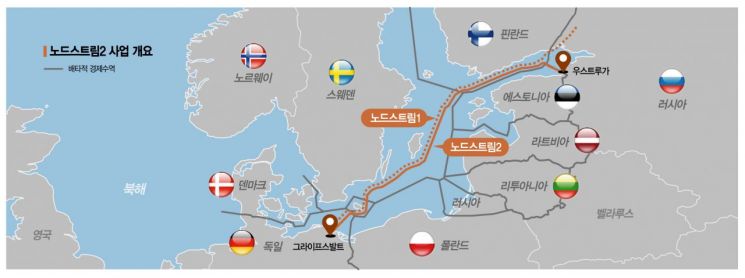
The Nord Stream 2 project aims to double the volume of natural gas supplied directly from Russia to Germany by connecting a 1,230 km long underwater natural gas pipeline between Russia and Germany. Once completed, Russia will be able to transport 110 billion cubic meters of natural gas annually directly to Germany, twice the current capacity. The Nord Stream 2 pipeline, with a construction cost of 9.5 billion euros (approximately 13.33 trillion won), is wholly owned by Russia's Gazprom, with European companies participating through investments, including German trading company Uniper, Wintershall (a subsidiary of BASF), and French energy company Engie.
However, recently, the German government announced the possibility of suspending the Nord Stream 2 project as part of sanctions against Russia, citing Navalny's poisoning incident. This has put not only European countries but also the United States across the Atlantic on high alert. For Germany, completing Nord Stream 2 would not only enable it to serve as a European natural gas hub but also reduce natural gas costs; however, pressuring Russia has become more important at this time.
This project holds significance beyond a simple business deal between Germany and Russia. Because it could change the geopolitical landscape of Europe, the United States has imposed economic sanctions despite Germany being an ally involved in the project. The most sensitive country is Ukraine, but the country voicing its concerns is Poland. Poland, a member of the European Union (EU), has argued that the Nord Stream 2 project must be halted for the sake of Ukraine.
Polish Prime Minister Mateusz Morawiecki recently stated on public radio, "The Nord Stream 2 project must be stopped for European energy solidarity," adding, "We must prevent Ukraine and Belarus from becoming more dependent on Russia." This implies that if Germany and Russia strengthen cooperation on natural gas, Eastern European countries could suffer relatively. Especially, Prime Minister Morawiecki recalled that Germany and Russia allied to invade Poland during World War II and insisted, "We must ensure that Germany and Russia never form an alliance."
Ukraine plays the role of gatekeeper for natural gas transportation between Russia and Europe. Russian natural gas must pass through pipelines crossing Ukraine to reach Europe. Ukraine earns between 2 to 3 billion dollars annually as fees for using the pipelines. If Russia stops using Ukraine's natural gas pipelines, it is pointed out that Ukraine's gross domestic product (GDP) could decrease by more than 3%.
The United States is also closely watching whether Germany will suspend the Nord Stream 2 project. The U.S. has been sensitive to Nord Stream 2. In 2018, John Bolton, then White House National Security Council (NSC) advisor, during a visit to Ukraine, cited remarks by U.S. President Donald Trump, emphasizing "dependency on Russian energy resources and the increasing monopoly of the supplier (Russia)."
Additionally, the U.S. has expressed dissatisfaction with Germany's insufficient defense spending. The view of the Nord Stream 2 project is far from favorable. Of course, there are also claims that behind this is the U.S. desire to find markets for the vast amounts of natural gas produced domestically due to the shale revolution. Russia, aware of this, has argued that "(U.S. sanctions) use political pressure for unfair competition" and that it is "an attempt to make Europeans buy more expensive (U.S.) gas under unfavorable conditions."
However, opinions differ on whether Germany can actually suspend the Nord Stream 2 project solely based on political will. Since the Navalny incident occurred in Russia, it is difficult to ascertain the truth, making it hard to justify sanctions. Even if Germany confirms Russia's involvement, it is pointed out that bearing the political and economic burdens would be difficult. Russia could retaliate by raising natural gas prices, among other measures. Moreover, damages to Western European companies invested in the project and ensuing lawsuits are inevitable. Some argue that Germany can endure the damages even if it suspends the project. German investment bank Berenberg Bank stated, "Due to the economic impact of COVID-19, GDP will only recover to previous levels by 2022, so there is time to diversify natural gas supply sources even if Russia retaliates."
© The Asia Business Daily(www.asiae.co.kr). All rights reserved.

















