Landlord Extends Lease by 2 Years with 5% Cap... Raises Jeonse Price in Advance
Monthly Rent Listings Surpass Jeonse Listings... New Small Jeonse in Gangnam Soars Over 1 Billion Won
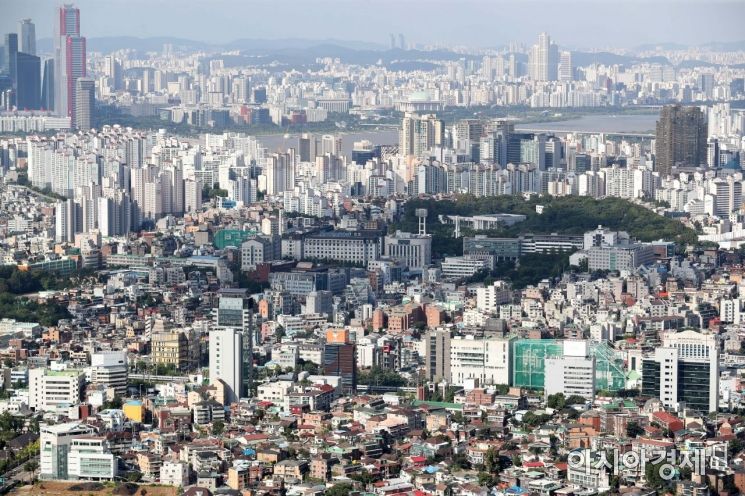 Due to the revision of the Lease Protection Act and other factors, the supply of jeonse properties has decreased, causing the rise in jeonse prices in Seoul to continue unabated. A view of the downtown area from Namsan, Seoul, on the 8th. Photo by Moon Honam munonam@
[Asia Economy Reporter Kim Yuri] The implementation of the Housing Lease Protection Act (hereinafter Lease Act 2), which includes the cap on jeonse (long-term deposit lease) prices and the right to request contract renewal, has now affected newly occupied apartments in the Gangnam area of Seoul. As jeonse prices soar, even small apartments have surpassed 1 billion KRW in jeonse prices, and landlords renting out their properties as monthly rent instead of jeonse have increased. Due to Lease Act 2, the 'new apartment effect,' where tenants could find jeonse or monthly lease properties at prices lower than market value because a large volume of listings flooded the market in a short period, has disappeared.
◆ "The notion that new apartments have cheap jeonse is a thing of the past"
According to the real estate industry on the 15th, the jeonse market price for a 59㎡ unit (exclusive area) at Gaepo Raemian Forest in Gaepo-dong, Gangnam-gu, Seoul, which is scheduled to welcome residents at the end of this month, is forming around 1 to 1.1 billion KRW. Nearby brokerage offices explained that prices have risen by 200 to 250 million KRW in just over two months. A representative from real estate agency A in the area said, "In July, when jeonse listings first appeared, the 59㎡ jeonse price was around 800 to 850 million KRW," adding, "Prices surged sharply as listings decreased and landlords raised asking prices significantly due to the implementation of Lease Act 2." The jeonse market price for the 84㎡ unit in this apartment also rose by up to 250 million KRW compared to 1.2 to 1.25 billion KRW two months ago, now standing at 1.3 to 1.5 billion KRW. This price level is comparable to the Daechi-dong area, known as the 'number one school district.' The jeonse price for a 59㎡ unit in Raemian Daechi Palace 1 Complex in Daechi-dong is around 1.15 to 1.25 billion KRW.
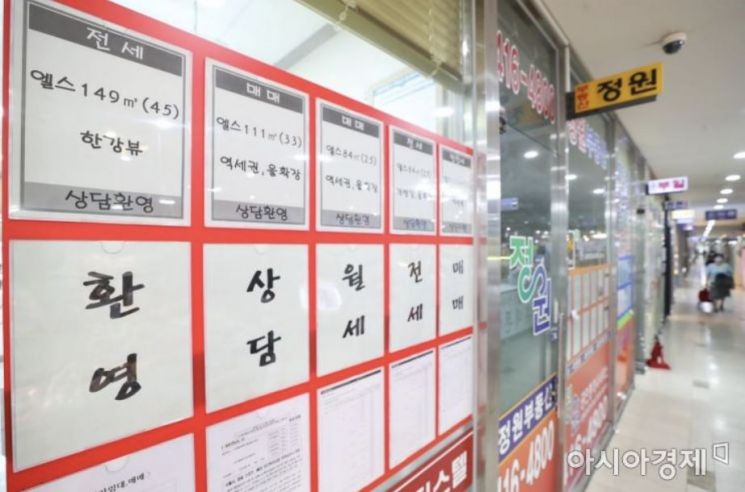
Despite being a large complex with a total of 2,296 households, jeonse listings are also rapidly decreasing. There are only about 40 jeonse listings for the 59㎡ size, which is just 5% of the total 782 households of that size. Particularly for the popular 84㎡ units, monthly rent listings such as half-jeonse (deposit plus monthly rent) are twice as many as jeonse listings. While jeonse listings number around 25 to 30, monthly rent listings reach about 50.
The surge in jeonse prices and the spread of monthly rent have also been confirmed in other large complexes in Gangnam. The 59㎡ jeonse price at Raemian Leaders One in Seocho-dong, Seocho-gu, which is also scheduled for occupancy at the end of this month with 1,317 households, is around 1.1 to 1.2 billion KRW. The 84㎡ unit recently rose to 1.35 to 1.5 billion KRW. For the 84㎡ size, the jeonse price is even higher than that of the similarly sized Raemian Seocho ST located right next door. This complex also has more monthly rent listings than jeonse. A representative from nearby real estate agency C said, "The 84㎡ jeonse price, which was originally 1.2 billion KRW, has risen by about 200 million KRW." He added that many tenants who cannot afford the soaring jeonse prices are forced to sign monthly rent contracts.
◆ Lease Act 2 and increased property tax burden... worsening tenant cost transfer
The upward trend in jeonse prices has been ongoing due to subscription demand following last year's announcement of the private land price ceiling system, loan restrictions from the December 16 measures, and has intensified recently with the implementation of Lease Act 2. Landlords are preemptively raising jeonse prices in anticipation of the '2-year extension' and '5% cap.' Additionally, the government's significant increase in property tax burdens on high-priced homes through rising official property prices, adjustment of official price realization rates, and increased comprehensive real estate tax rates is directly and indirectly impacting tenants. A representative from real estate agency B in Gaepo-dong explained, "The increase in monthly rent listings is due to tax issues such as property tax and comprehensive real estate tax," adding, "From the landlord's perspective, there is a tendency to convert a significant portion of the deposit into monthly rent to cover the sharply increased property taxes." The government's policy, which claims to stabilize housing prices and protect tenants, is leading to the feared phenomenon of tax burden being transferred to tenants in the market.
◆ Concerns over vicious cycle of shortage of listings and price increases
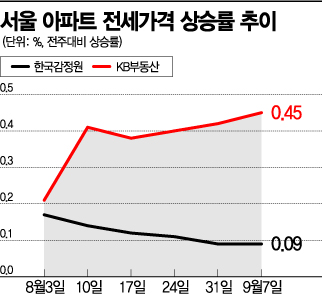
According to the Korea Real Estate Agency, Seoul's jeonse prices have continued to rise for 63 consecutive weeks as of the latest survey (last week). KB Real Estate Live On's data shows that the recent rate of increase is steepening. Since the second week of August, the weekly increase rate has been around 0.4%, expanding to 0.45% last week. Due to the high jeonse prices, the average jeonse price of apartments in Seocho-gu and Gangnam-gu exceeded 900 million KRW last month, recording 925.7 million KRW and 903.3 million KRW, respectively. The average jeonse price for apartments in Seoul is 511.13 million KRW, rising by more than 10 million KRW in two months.
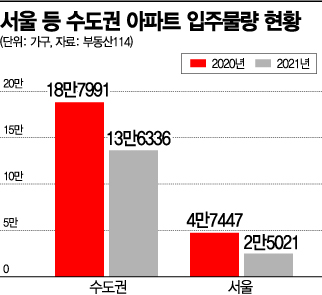
The industry expects the vicious cycle of rising prices and decreasing listings in the jeonse and monthly rent market to continue for the time being. Jeonse demand is increasing while supply is decreasing. With subscription demand expected to continue for the next 2 to 4 years, including public sales in the 3rd new towns and private 'lottery sales,' the supply of new apartments next year will be halved, and existing apartment landlords are increasingly demanding actual residence. According to Real Estate 114, the number of apartment units scheduled for occupancy in Seoul next year is 25,021, about half of this year's 47,447 units. For the entire metropolitan area, the number is expected to decrease from 187,991 units this year to 136,336 units next year, a reduction of over 50,000 units. Ham Young-jin, head of Zigbang Big Data Lab, said, "With subscription demand and reduced supply next year, the rise in jeonse prices and shortage of listings are expected to continue for the time being."
© The Asia Business Daily(www.asiae.co.kr). All rights reserved.



















