[Planning] 20s Presidential Election D-1 Year 6 Months, President and Second-in-Command... Ruling Party Lee Nak-yeon vs. Lee Jae-myung Competition, Variable in Moon President's Governance
[Asia Economy Reporter Ryu Jeong-min]
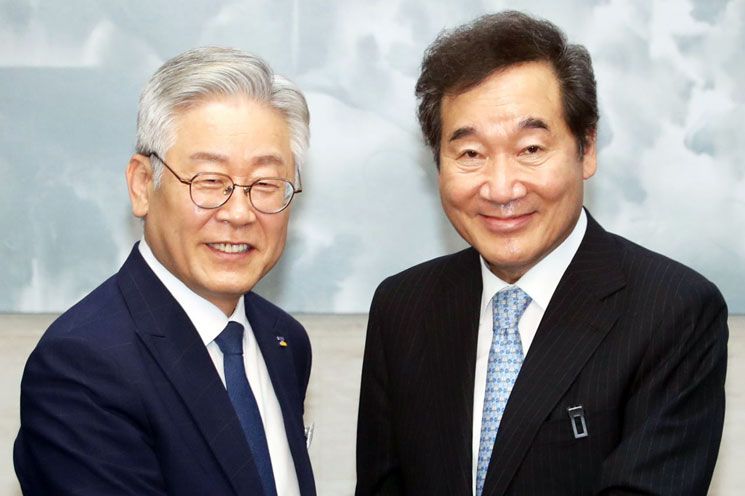
"The incumbent president has the power to eliminate a strong presidential candidate." This saying in Yeouido politics symbolizes the relationship between the president and the 'ruling party's second-in-command (presidential candidate).' In Korea's five-year single-term political system, the power dynamics change as the president's term nears its end. The president's control over state affairs weakens, and political focus shifts toward the second-in-command. This is the so-called relationship between the 'setting sun' and the 'rising sun.'
However, in Korean politics, the president holds such overwhelming authority that the position is often called 'imperial.' While the president may not be able to freely decide on regime continuation, they do have the power to deliver a decisive blow to those who fall out of favor. This political principle also applies to the 2022 presidential election dynamics.
The ruling party's presidential race is a two-horse race between Lee Nak-yeon, leader of the Democratic Party, and Lee Jae-myung, governor of Gyeonggi Province. According to a Gallup Korea survey conducted from the 8th to the 10th among 1,002 adults nationwide aged 18 and over on 'preferred next political leader,' Governor Lee and Leader Lee showed support rates of 22% and 21%, respectively.
Figures mentioned as opposition presidential candidates, such as Prosecutor General Yoon Seok-youl, former Liberty Korea Party leader Hong Joon-pyo, and People's Party leader Ahn Cheol-soo, each recorded 3%. For detailed information, refer to the Central Election Survey Deliberation Commission website.
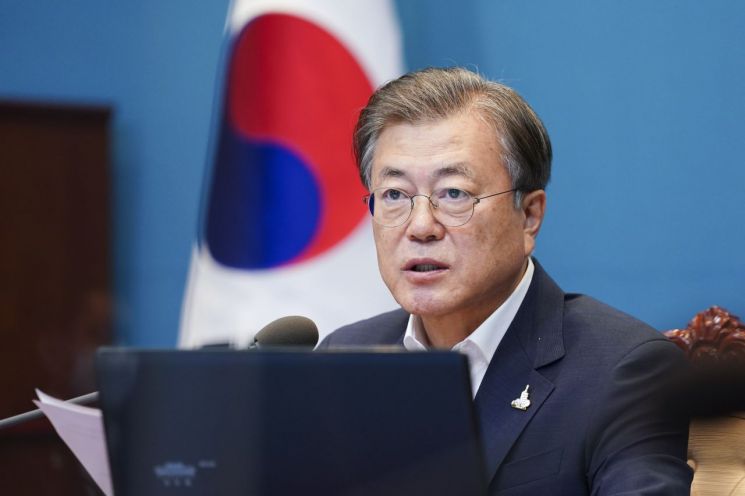
The political world is focused on whether President Moon Jae-in will empower a specific candidate and when that might happen.
Recently, Governor Lee's social network service (SNS) has become the center of attention for this reason. On the 6th, Governor Lee posted on Facebook, "I clearly see the resentment and sense of betrayal toward the Moon Jae-in administration, the Democratic Party, and even the nation and community spreading like wildfire." There was even speculation that Governor Lee had begun to differentiate himself from President Moon. This was a variable that could shake the ruling party's political dynamics.
Some in political circles prematurely speculated that Governor Lee acted after sensing President Moon's support leaning toward Leader Lee. This is the so-called view that Moon's heart (Munshim) has chosen a direction. However, political experts' analyses differ. It is also worth noting that Governor Lee plays the role of a 'political complement,' showing strength among people in their 20s, a weak link for the Democratic Party.
Um Kyung-young, director of the Era Spirit Research Institute, said, "If President Moon supports a specific candidate, other candidates will accelerate differentiation, which could lead to a lame-duck period. President Moon will manage both candidates until the end, pursuing balance and national stability simultaneously," he predicted.
It is politically advantageous for a healthy competition to continue rather than power concentrating on either Governor Lee or Leader Lee. In fact, on the 7th, President Moon said at the Blue House senior secretaries and aides meeting, "There is merit in the opinion to provide disaster relief funds to all citizens, even if the amount is small." This was a way to give meaning to Governor Lee's claim and defuse political controversy.
© The Asia Business Daily(www.asiae.co.kr). All rights reserved.
![Clutching a Stolen Dior Bag, Saying "I Hate Being Poor but Real"... The Grotesque Con of a "Human Knockoff" [Slate]](https://cwcontent.asiae.co.kr/asiaresize/183/2026021902243444107_1771435474.jpg)

















