Power Generation from New and Renewable Energy at 22.8%... Wind Power Share Stagnant for 3 Years
Excluding Waste, It Decreases Further... Dual-Track Strategy of Speed Control and Structural Improvement Urgently Needed
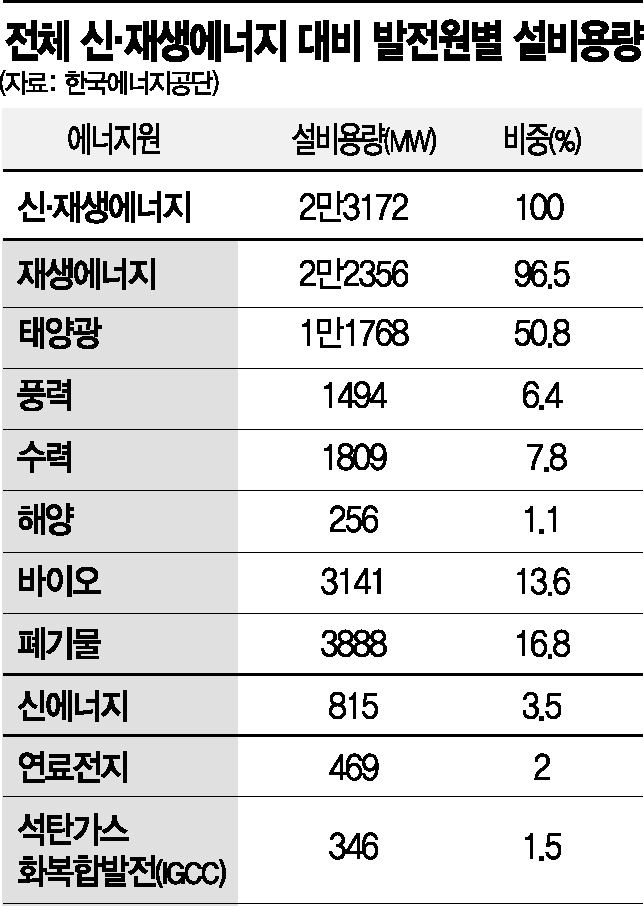
[Asia Economy Reporter Moon Chaeseok] Thanks to the government's energy transition policy, the share of solar power in the total renewable energy installed capacity exceeded 50% last year. However, based on power generation, it accounted for only 22.8%, revealing a significant drop in generation efficiency relative to installed capacity. When excluding waste power generation, the share of renewable energy in the country's total energy supply also significantly decreases. There are concerns that the government's Green New Deal plan to expand renewable energy distribution centered on solar power may remain only as equipment and blueprints.
According to the "2019 Renewable Energy Distribution Statistics Preliminary Figures" prepared by the Korea Energy Agency on the 14th, solar power installed capacity reached 11,768 MW last year, surpassing 10,000 MW for the first time. Solar power accounted for 50.8% of the total renewable energy installed capacity, more than half. This is double the 26.3% recorded in 2015, achieved in just four years.
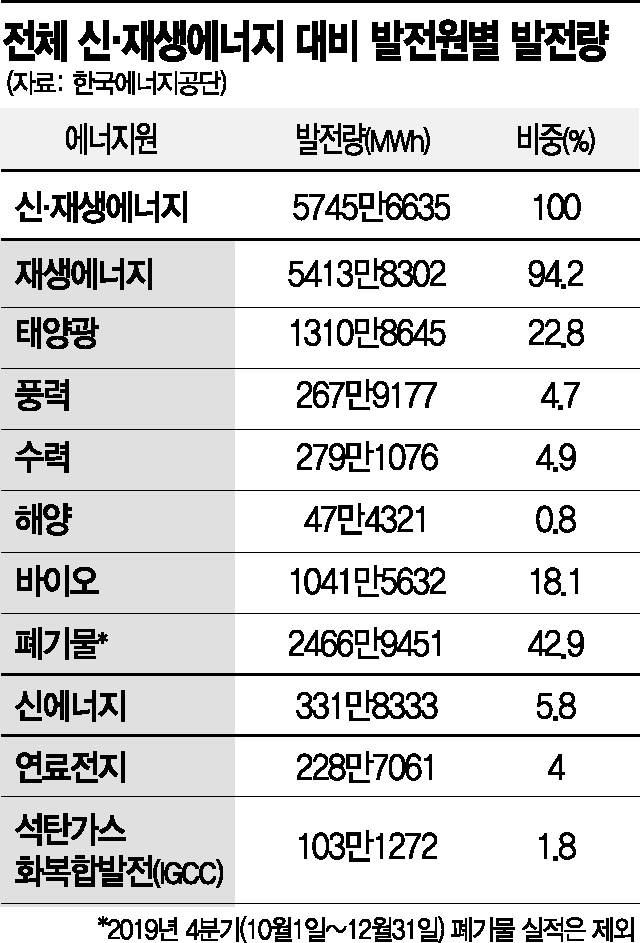
This increase is the result of expanding solar power facilities nationwide in forestlands, mountainous areas, and apartments. However, actual solar power generation last year was 13,108,645 MWh, accounting for only 22.8% of total renewable energy. Although this doubled from 10.7% in 2015, it remains low compared to the share of solar power in total renewable energy installed capacity.
Wind power, considered a core energy source of the Green New Deal policy alongside solar power, recorded 2,679,177 MWh last year, an increase of only 8.7% compared to 2018. Its share of total renewable energy generation remained at 4.7%, marking three consecutive years of stagnation.
Given these circumstances, the overall growth rate of renewable energy generation is falling short of expectations. Last year, renewable energy (57,456,635 MWh) accounted for 9.77% of the national energy supply (588,095,999 MWh), an increase of only 0.89% from the previous year.
Excluding waste, the share of renewable energy drops further. Waste energy accounts for the largest portion of renewable energy, reaching 42.9% (24,669,451 MWh) of the total. Based on preliminary figures, excluding waste last year reduces renewable energy generation to 32,787,184 MWh. Accordingly, the share of renewable energy in the national energy supply falls to 5.6%.
Waste power generation utilizes combustible waste such as Refuse-Derived Fuel (RDF), waste oil, and other flammable waste generated at workplaces or homes, which has been criticized for not being considered clean energy. The government plans to exclude waste energy from the finalized 2019 renewable energy distribution statistics to be announced in November.
In this case, achieving the government's renewable energy targets becomes even more challenging. The government has set a goal through the "Renewable Energy 3020" plan to meet 20% of the country's energy demand with renewable energy by 2030.
Recently, the government has been accelerating solar and wind power generation. Through the Green New Deal policy, it plans to increase solar and wind power facilities to 42.7 GW by 2025. This aims to secure 2.7 times the preliminary 15.8 GW of solar and wind power distribution recorded last year within five years. There are even concerns that solar power facilities might cover the entire national territory. It is anticipated that the "5th Basic Plan for Renewable Energy," scheduled to be prepared by the government at the end of the year, may present different targets.
Experts point out the need for a two-track strategy involving adjusting the pace of nuclear and coal phase-out policies and improving the industrial structure of renewable energy such as solar power. Criticism also arises that the Green New Deal policy of installing solar panels on building exteriors, windows, and school rooftops is insufficient to improve solar power generation efficiency.
Professor Lee Deokhwan, Emeritus Professor of Chemistry and Science Communication at Sogang University, said, "There is a possibility that building multiple small-scale solar facilities in various locations will lead to poor grid connection and lower power productivity. There is also a risk of moral hazard where high-quality panels are not properly installed." He warned, "Small-scale operators who borrow hundreds of millions of won from financial institutions may increasingly prefer low-cost Chinese panels to compensate for reduced profitability caused by the decline in Renewable Energy Certificate (REC) spot prices, weakening the momentum of the solar power industry, which is the core of renewable energy."
© The Asia Business Daily(www.asiae.co.kr). All rights reserved.

![Clutching a Stolen Dior Bag, Saying "I Hate Being Poor but Real"... The Grotesque Con of a "Human Knockoff" [Slate]](https://cwcontent.asiae.co.kr/asiaresize/183/2026021902243444107_1771435474.jpg)















