Trends in the International Financial and Foreign Exchange Markets Since August
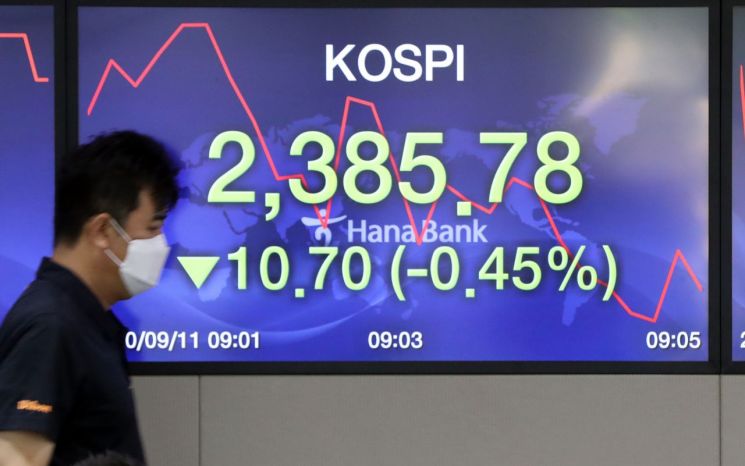
[Asia Economy Reporter Eunbyeol Kim] Last month, foreign investors' stock investment funds turned to net outflow after a month. After continuing to sell following the spread of the novel coronavirus infection (COVID-19), the trend turned to net inflow in July, but last month it appears that profits were realized through selling.
According to the Bank of Korea's 'International Financial and Foreign Exchange Market Trends since August' on the 11th, foreign stock investment funds recorded a net outflow of $890 million in August. From February, when COVID-19 began spreading domestically, net outflows continued for six months, turning to net inflow in July (+$1.39 billion), but turned back to net outflow after just one month.
In the case of bond funds, 6.7 trillion KRW flowed in. However, compared to the inflow amount in July ($3.01 billion), the net inflow of investment funds significantly decreased.
A Bank of Korea official stated, "Stock funds turned to net outflow due to profit-taking sales in some sectors," and "In the case of bond funds, the scale of inflows centered on private funds shrank due to weakened incentives for arbitrage trading."
The total foreign securities investment funds, combining stocks and bonds, recorded a net outflow of $220 million in August. This marks a return to net outflow after three months following June (+$2.48 billion) and July (+$4.39 billion).
The credit default swap (CDS) premium for the 5-year Korean government bond (Foreign Exchange Stabilization Fund bond) averaged 22 basis points (1bp = 0.01 percentage points) last month. This is below the July average (25bp) and even lower than February (26bp), before the full impact of COVID-19 was felt.
CDS is a type of financial derivative product that acts like insurance, compensating for losses when the issuing country or company defaults. Generally, if the economic risk of the country increases, the premium also rises.
At the end of August in the foreign exchange market, the KRW/USD exchange rate was 1,187.8 won, down 3.5 won from the end of July (1,191.3 won). The daily fluctuation range of the KRW/USD exchange rate averaged 2.2 won, less than July's 2.9 won.
© The Asia Business Daily(www.asiae.co.kr). All rights reserved.
![Clutching a Stolen Dior Bag, Saying "I Hate Being Poor but Real"... The Grotesque Con of a "Human Knockoff" [Slate]](https://cwcontent.asiae.co.kr/asiaresize/183/2026021902243444107_1771435474.jpg)











