Bundang CHA Hospital, Severance Hospital, Samsung Seoul Hospital Joint Research
1 in 10 Liver Cancer Patients Shows 'Hyperprogression' After Immunotherapy
Prognosis Poor with Survival Period of Only 59 Days After Treatment
Effectiveness of Immunotherapy Can Be Predicted Through Blood Tests
 The first case of arm transplantation surgery was reported in Korea. (The photo is unrelated to the above article) Photo by Asia Economy DB
[Asia Economy Reporter Hwang Junho] A study has revealed that immuno-oncology treatment, widely known as the method used to treat former U.S. President Jimmy Carter’s terminal melanoma that had metastasized to his liver and brain at the age of 90, should be selectively applied depending on the patient. Analyzing the effects of immuno-oncology treatment on liver cancer patients, the second leading cause of cancer death in Korea, it was found that 1 in 10 patients experienced an acute progression phenomenon where the cancer growth rate accelerated by four times after treatment. This acute progression is influenced by the neutrophil-to-lymphocyte ratio in the blood, and the study suggests that selective application is possible through blood tests conducted before immuno-oncology treatment.
1 in 10 Liver Cancer Patients Worsen After Immuno-Oncology Treatment
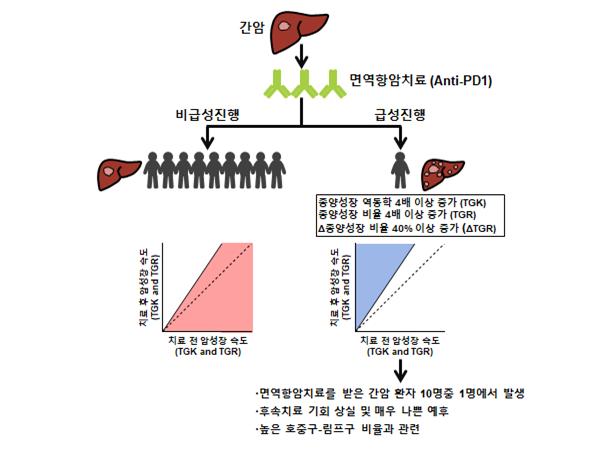
The National Research Foundation of Korea announced on the 13th that research results by Professor Jeon Hongjae and Professor Kim Chan from CHA University Bundang CHA Hospital, along with teams from Severance Hospital and Samsung Seoul Hospital, were recently published in the European Liver Society’s journal, the Journal of Hepatology.
The research team clarified whether acute progression occurs after immuno-oncology treatment in liver cancer patients, what clinical characteristics are associated with it, and which groups of liver cancer patients are at risk of acute progression.
First, the team identified the incidence rate of acute progression in liver cancer patients who received immuno-oncology treatment. They compared domestic liver cancer patients who received immuno-oncology drugs, targeted therapies, and no treatment. Among 189 patients treated with immuno-oncology drugs, 24 patients?about 1 in 10 (12.6%)?experienced acute progression. Moreover, acute progression was found only in liver cancer patients treated with immuno-oncology drugs.
In patients who experienced acute progression, both the tumor growth rate and tumor growth kinetics increased more than fourfold before and after immuno-oncology treatment. As a result, patients with acute progression survived an average of about 59 days from the start of immuno-oncology treatment until death.
Blood Tests Can Detect Acute Progression
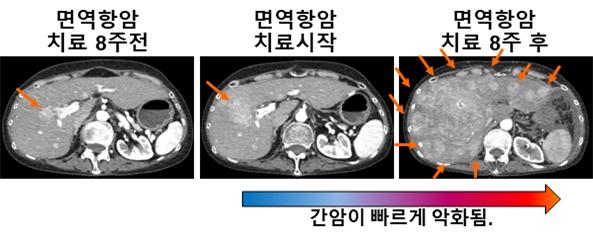
The research team stated that acute progression can be predicted through routine blood tests. The higher the neutrophil-to-lymphocyte ratio (NLR) in blood tests conducted immediately before starting immuno-oncology treatment, the more sharply the treatment response rate decreased. Conversely, the probability of acute progression surged. When NLR was below 2, the acute progression rate was 0%, but if NLR exceeded 6, the acute progression rate soared to 46%.
The neutrophil-to-lymphocyte ratio refers to the relative proportion of neutrophils and lymphocytes, which are types of white blood cells important for immune response. It can be easily checked through routine blood tests.
The research team said, "We expect these results to provide a foundation for optimizing immuno-oncology treatment for liver cancer." They added, "We are conducting follow-up studies to more precisely profile the blood of patients with acute progression and to identify factors related to resistance to immuno-oncology treatment."
© The Asia Business Daily(www.asiae.co.kr). All rights reserved.
![Clutching a Stolen Dior Bag, Saying "I Hate Being Poor but Real"... The Grotesque Con of a "Human Knockoff" [Slate]](https://cwcontent.asiae.co.kr/asiaresize/183/2026021902243444107_1771435474.jpg)

















