Under Creditors' Management After 6 Years... Subsidiary Restructuring and Business Reorganization Begin in Earnest
"A 'New Megi' Needed to Change Organizational Culture," Some Argue
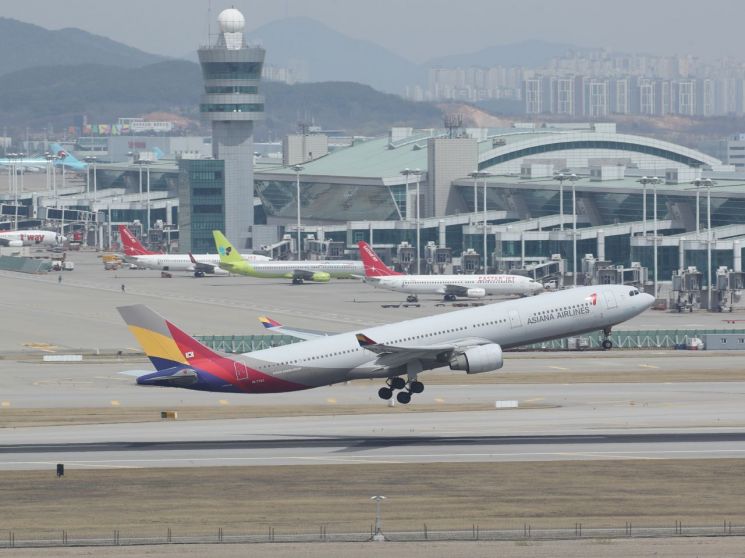
[Asia Economy Reporter Yoo Je-hoon] After an approximately 18-month-long merger and acquisition (M&A) process ended with a no deal result, Asiana Airlines is facing a harsh season of restructuring. Amid severe management difficulties compounded by the prolonged COVID-19 pandemic, industry insiders agree that Asiana Airlines requires not just simple restructuring but a transformative overhaul of its organizational structure.
On the 11th, the government decided at the Industrial Competitiveness Enhancement Ministerial Meeting to notify Kumho Industrial, the seller, and Asiana Airlines of contract termination and confirmed that Asiana Airlines will enter creditor management. This marks the airline’s return to creditor management after six years, as it strives to survive under this system.
As of the second quarter, Asiana Airlines’ debt ratio stood at 2291.3%, and its capital erosion rate was 49.8%, sharply rising from the end of last year (1386.7% and 18.6%, respectively). If its credit rating (currently BBB-) falls by just one notch, it will plunge into speculative grade, triggering early redemption clauses on asset-backed securities (ABS), which would be the worst-case scenario. To prevent liquidity issues, creditors plan to inject emergency funds from the Industrial Fund and later execute capital reduction targeting existing major shareholders such as Kumho Industrial. It is widely expected that the creditors will convert 800 billion KRW of perpetual bonds (hybrid capital securities) invested in Asiana Airlines into equity, becoming the largest shareholder with about 37% ownership.
◆Back under creditor management after six years... Focus on management stabilization
After extinguishing the immediate crisis, full-scale restructuring is inevitable. Among various options, large-scale restructuring of business units or workforce is unlikely except for some reductions in aircraft and routes. The Industrial Fund injection requires maintaining at least 90% of existing employment for six months after the agreement.
Therefore, creditors are expected to secure financial soundness first by separating and selling subsidiaries rather than selling Asiana Airlines as a whole. The subsidiaries likely to be sold first are IT-related companies such as Asiana IDT and Asiana Sabre, which have a higher chance of being sold quickly in the market. Additionally, Kumho Resort, which is not a direct subsidiary but has assets worth around 450 billion KRW, may also be put up for sale.
On the other hand, Air Busan and Air Seoul are generally considered difficult to sell immediately due to the worsening business conditions caused by COVID-19, similar to the cases of their parent companies and Eastar Jet. Given the Industrial Fund support conditions, support from the parent company is unlikely, so individual normalization followed by separate sale or liquidation is possible. An industry insider said, "While reducing aircraft might be considered, considering future competitiveness during recovery, it is expected that only some older aircraft will be retired or leased aircraft nearing the end of their lease will be returned early." He added, "The two low-cost carriers (LCCs) currently compete even on domestic routes, so it is hard to say they create synergy with their parent company Asiana Airlines, making separate sales inevitable."
◆Limits of downsizing... Painful structural reform needed
However, some argue that restructuring under creditor management should not be limited to mere downsizing. Experts point out that Asiana Airlines needs to endure painful structural reform to fundamentally improve its condition. Professor Heo Hee-young of Korea Aerospace University said, "Strictly speaking, Asiana Airlines’ crisis began even before COVID-19. Simple cost-cutting will only lead to repeated situations after the pandemic, so comprehensive structural reform including business restructuring is necessary."
Industry insiders see the main cause of Asiana Airlines’ crisis as being used as a treasury for group reconstruction, but also note changes in the business environment such as LCC expansion and increased foreign airline entry. A former senior official of a national airline said, "Asiana Airlines’ pricing policy had been moving closer to LCCs, while maintaining the quantity and quality of service at the level of a full-service carrier (FSC), creating a sandwich-like situation. Finding a new business model is necessary but will not be easy."
Some also advocate for a "catfish effect." Given the complexity of Asiana Airlines’ situation, bringing in external talent to transform the organizational culture is seen as necessary. Professor Yoon Moon-gil of Korea Aerospace University said, "Like Kazuo Inamori, the founder of Kyocera who revived the bankrupt Japan Airlines (JAL), Asiana Airlines needs a catfish to bring fresh wind from outside." He added, "The government should not be afraid because of employment issues but should boldly lead industrial restructuring."
© The Asia Business Daily(www.asiae.co.kr). All rights reserved.
![Clutching a Stolen Dior Bag, Saying "I Hate Being Poor but Real"... The Grotesque Con of a "Human Knockoff" [Slate]](https://cwcontent.asiae.co.kr/asiaresize/183/2026021902243444107_1771435474.jpg)
















