Ambiguity in Total Traffic Volume Standards
Legal Enforcement of Network Management Obligations
Controversy Over Infringement on Contract and Business Freedom
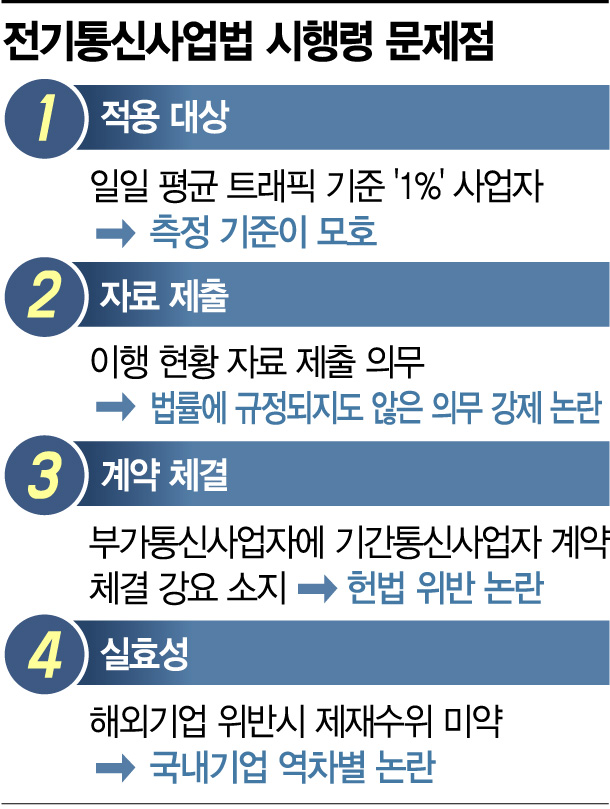
[Asia Economy Reporter Boo Aeri] The amendment to the Enforcement Decree of the Telecommunications Business Act, dubbed the 'Netflix Free-Riding Prevention Act,' has sparked controversy. Although it was created to curb the tyranny of global companies, it is being criticized for actually hindering domestic operators. Industry experts point out four main issues: ambiguous criteria, provisions exceeding the scope of legal delegation, potential constitutional violations, and discrimination against domestic companies.
According to the Ministry of Science and ICT on the 9th, the core of this enforcement decree is to mandate content providers (CPs) to take measures to ensure network quality and service stability. Accordingly, operators such as Netflix, Google (YouTube), Facebook, Naver, and Kakao must implement technical measures to provide stable services and consult in advance with telecom companies (network providers) if traffic surges.
Ambiguous Scope of Application and Conflicts with Higher Laws
The first issue raised by the industry is the ambiguity of the enforcement decree's scope of application. The Ministry of Science and ICT defines the applicable operators as those with over 1 million daily users and daily traffic exceeding 1% of the domestic total volume. However, operators have no way to verify whether their services exceed the government's defined 1% threshold of domestic total traffic. The government states that measurements will be made through the three major telecom companies, but clear standards on who judges the traffic and how it is disclosed have not been provided.
An internet company official said, "Predictability is paramount for operators," adding, "We already pay network usage fees, so having legal obligations based on unknown criteria is a significant burden for companies."
The second issue is that the enforcement decree includes provisions not stipulated in the higher law. The government has also mandated the submission of related implementation status data by the end of January each year, covering server capacity, smooth internet connectivity, and traffic route management. However, the Telecommunications Business Act does not contain any clauses requiring such provisions to be set by the enforcement decree. A representative from the Korea Internet Corporations Association pointed out, "There should be clauses in the Telecommunications Business Act mandating 'actual condition surveys,' but since such provisions are absent in the law, the enforcement decree imposes excessive obligations."
The third issue concerns the enforcement decree potentially infringing on constitutional fundamental rights such as freedom of contract and freedom of business. For example, service quality can vary depending on devices or the pricing plans of the three major telecom companies, but if Naver and Kakao are held responsible for this, they may effectively be forced to contract with all incumbent telecom operators. An internet industry official expressed concern, saying, "There is no way to guarantee the stability of users of telecom operators with whom we have no direct contracts," and added, "Without contracting with all telecom companies, it will be impossible to avoid responsibility."

Allowing Global Companies to Go Free While Targeting Domestic Companies
The fourth issue is the concern that this enforcement decree will fail to curb the unfair practices of global companies and instead damage the competitiveness of domestic companies. According to the National Assembly's Science, Technology, Information and Broadcasting Committee, Google accounts for about 25.8% of total traffic on the networks of the three major domestic telecom companies, while Naver accounts for only 2.5% and Kakao 1.8%. Considering that absolute traffic is generated by overseas services, there is inevitable criticism that the government is aiming at the wrong target.
The enforcement decree includes punitive provisions such as designating a domestic agent and imposing fines of up to 20 million won, but it is uncertain whether these will actually be enforced against foreign companies. Professor Kim Hyun-kyung of the IT Policy Graduate School at Seoul National University of Science and Technology criticized, "Even if Netflix violates this law and resists, can the government take strong measures like blocking access? Ultimately, only domestic operators will be regulated, resulting in overseas operators gaining a competitive advantage."
In response, Minister Choi Ki-young of the Ministry of Science and ICT drew a line on the discrimination controversy, stating, "We will take measures to resolve issues through domestic agents when problems arise with overseas operators, which will be helpful."
© The Asia Business Daily(www.asiae.co.kr). All rights reserved.


















