Ministry of SMEs and Startups Selects 6 Outstanding Works
[Asia Economy Reporter Kim Daeseop] The Ministry of SMEs and Startups announced on the 9th that six outstanding works were selected through the finals of the '2020 Regulatory Sandbox Idea Contest.'
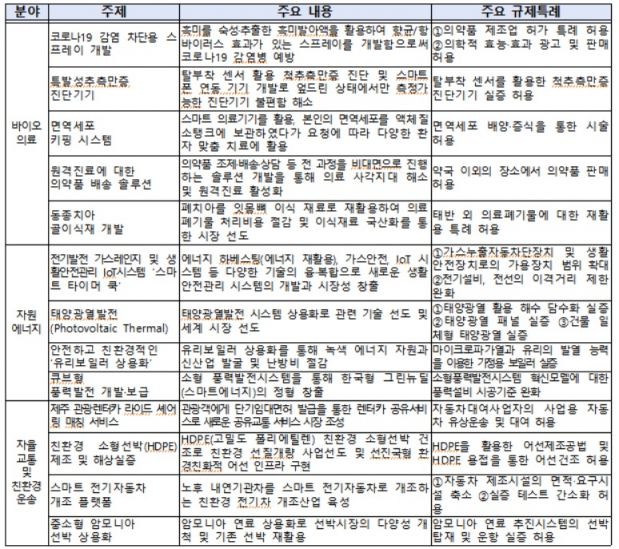
In this contest, the prestigious Grand Prize, the Minister of SMEs and Startups Award, was awarded to the 'Pharmaceutical Safe Delivery Solution.' This system develops a non-face-to-face (untact) process covering the entire procedure from drug preparation to delivery and medication guidance, aiming to eliminate medical blind spots for patients or regions with restricted hospital visits. It was highly evaluated for clarity in regulatory exemptions and expected effects.
The Excellence Award went to the 'Development and Demonstration of Homologous Tooth Bone Graft Material.' This project involves recycling discarded teeth from wisdom tooth extractions as gum bone graft materials, which are expected to have fewer rejection reactions and faster adaptation compared to other grafts. It was highly praised for its novelty in regulatory exemptions and detailed description of industrial and economic effects leading new markets.
Additionally, the Merit Award was given to the 'Smart Electric Vehicle Conversion Platform.' This project simplifies standards and demonstration tests for facilities converting internal combustion engine vehicles into electric vehicles. It presented regional infrastructure and specific regulatory exemptions, receiving recognition for its innovative approach to building a platform for converting old internal combustion vehicles into electric cars.
The Encouragement Awards were given to three projects: 'Development and Distribution of Cube-type Wind Power Generation,' 'Jeju Tourism Rental Car Ride Sharing,' and 'Commercialization of Glass Boilers.'
The Cube-type Wind Power Generation project involves developing a small wind power system in the shape of a square cube that can be installed in ordinary households. The Jeju Tourism Rental Car Ride Sharing project involves issuing temporary licenses to tourists in Jeju Island to transport other tourists, facilitating vehicle sharing among tourists.
This contest was held for the first time this year to discover ideas for regulatory improvements related to new technologies and new businesses in regulatory sandbox zones and to increase public participation and interest in the sandbox system. A total of 39 entries were received from June 22 to July 22, and 13 finalists (individuals or teams) were selected through the first document screening.
Participants from various fields, ranging from CEOs currently running companies to startups and prospective entrepreneurs, showed high interest in regulatory improvements. The 13 projects selected from diverse fields through the first screening received expert consultations for one month to refine their proposals.
The judging was conducted by seven judges, experts in regulatory sandbox zones including the sandbox ombudsman, who listened to the participants' presentations and evaluated them based on four criteria. To assess the connection to sandbox projects from a field perspective, officials from 14 local governments observed in real-time and voted on outstanding ideas, with their scores reflected as additional points.
Through the final judging of the contest, six outstanding works were selected. The final judging was originally scheduled to be held on-site as a side event of the Regulatory Sandbox Expo, but was conducted online in an untact manner to actively participate in social distancing to prevent COVID-19.
The Ministry of SMEs and Startups plans to support the matching of interested local governments with project planners and experts from the contest to help develop the projects into actual sandbox plans.
The Regulatory Sandbox is a system that relaxes regulations that hinder companies from applying new technologies and commercializing them as a package. In designated zones, new technologies can be developed without regulatory constraints, and budgets are supported for research and development and infrastructure for demonstration projects.
From July last year to July this year, through the first to third designations, a total of 21 regulatory sandbox zones were selected in 14 local governments outside the metropolitan area. So far, the first and second designated zones have contributed to regional balanced development by producing tangible results such as attracting 316.9 billion KRW in investment and 100 company relocations.
Kim Heecheon, head of the Regulatory Sandbox Planning Team at the Ministry of SMEs and Startups, said, "This idea contest is meaningful in that the public directly participates in proposing regulatory innovation measures for regulatory difficulties in the industrial field," adding, "We will continue to make efforts so that the public's innovative ideas are actually reflected in sandbox plans and projects can be realized."
© The Asia Business Daily(www.asiae.co.kr). All rights reserved.

















