All Self-Employed Workers Affected by Gathering Bans and Business Restrictions Eligible for Support
Selection Criteria May Spark Controversy...Challenges in Proving Sharp Sales Decline
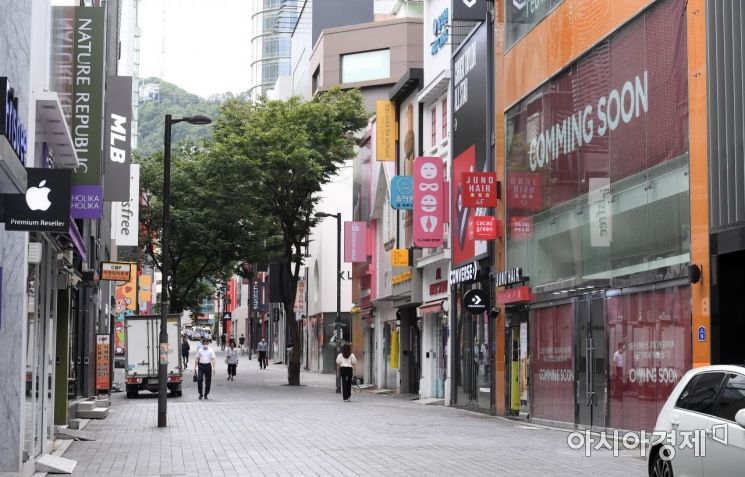 With the resurgence of COVID-19, government quarantine measures have been strengthened, and citizens' consumption activities have even contracted, intensifying the hardships faced by self-employed business owners. On the 31st, the streets of Myeongdong in Jung-gu, Seoul, where restaurants and various shops are concentrated, appeared quiet. Photo by Hyunmin Kim kimhyun81@
[Asia Economy Reporters Kim Hyunjung and Jang Sehee] The government plans to provide a uniform payment of at least 1 million won to small business owners and self-employed individuals severely affected by the COVID-19 pandemic, instead of differentiated payments based on sales. There are calls for detailed and clear criteria to minimize public disagreement and for thorough investigations of various cases to prevent any blind spots in support.
According to government officials on the 7th, the ruling party and government agreed not to limit the Small Business New Hope Fund support to the 12 high-risk facilities subject to closure orders but to provide a uniform payment of "1 million won + α" to self-employed individuals who suffered sales losses due to recent social distancing level upgrades. A government official explained, "Support will be provided uniformly (if conditions are met), rather than differentiated based on sales."
Following a high-level ruling party-government meeting the previous day, they agreed to push for a 7 trillion won fourth supplementary budget to selectively support vulnerable employment groups, small business owners, and low-income groups. The fourth supplementary budget includes the Small Business New Hope Fund for small business owners and self-employed individuals, emergency employment stabilization funds for vulnerable employment groups such as workers in special employment types (SEWs), emergency living expenses for low-income groups, special childcare coupons, and telecommunications cost support.
The Small Business New Hope Fund support targets all self-employed and small business owners who could not operate properly due to social distancing level upgrades. This includes the 12 high-risk industries such as karaoke rooms and PC rooms that were ordered to close, as well as bakeries and beverage specialty stores, which are expected to be eligible to apply. The government plans to limit eligibility to self-employed individuals who prove damage based on quarterly or semi-annual sales but will provide the same amount uniformly. It is expected that the Ministry of SMEs and Startups will comprehensively review data they have built and sales reports filed with the National Tax Service to make judgments.
However, experts point out that those seeking the New Hope Fund and employment stabilization funds must directly prove the extent of their damage, which may be difficult for small-scale operators. Ahn Jin-geol, director of the People's Economy Research Institute, said, "Self-employed individuals who operate cash businesses find it difficult to prove sales one by one, so assessing damage solely based on sales has limitations," adding, "If someone narrowly misses the criteria, dissatisfaction will arise."
There are also cases where proof is impossible. For example, those who opened their businesses around the time COVID-19 spread and barely operated cannot estimate the level of sales damage, or those who postponed opening for a long time due to the pandemic and suffered losses without even starting business. Additionally, many have already closed their businesses due to COVID-19, leading to calls for strengthening re-startup programs compared to existing similar programs. Furthermore, some freelancers in special employment types have irregular work and income, and their labor environment is so poor that collecting proof documents is problematic.
There are also criticisms that the system should have been prepared to cope with the current situation since the initial spread of COVID-19. Choi Hyun-soo, a research fellow at the Korea Institute for Health and Social Affairs, said, "Despite experiencing confusion in April, no preparations were made, and to expedite payments before Chuseok, an administratively convenient and seemingly easy path was chosen from the supplier's perspective," adding, "Controversies over selective criteria and a confusing process of application, investigation, proof, and verification await."
Choi further explained, "The income and asset situations of self-employed and small business owners vary greatly, and transparency and reliability of sales information are important, but trust in this has not been established."
After selective payments, social issues such as increased conflicts between classes or weakened solidarity to jointly respond to COVID-19 are also identified as challenges the government must address.
Gyeonggi Province Governor Lee Jae-myung, who has advocated for universal disaster relief payments, posted on his Facebook the previous day, "The results of the second selective payment, which differ from the first, such as public dissatisfaction, conflicts, and damage to solidarity, could be much more serious and dangerous than policymakers think," emphasizing, "Therefore, numerous scenarios and alternatives must be carefully and meticulously considered."
© The Asia Business Daily(www.asiae.co.kr). All rights reserved.
![Clutching a Stolen Dior Bag, Saying "I Hate Being Poor but Real"... The Grotesque Con of a "Human Knockoff" [Slate]](https://cwcontent.asiae.co.kr/asiaresize/183/2026021902243444107_1771435474.jpg)
















