Controversy Over Digital Prison Criminal Identity Disclosure
"Indiscriminate Leakage of Personal Information" vs "Would It Have Been Created If Criminals Were Properly Punished?"
Experts Say "Need for Social Discussion on Criticism Methods and Severity"
 A website that discloses personal information of sex offenders and others, 'Digital Prison' / Photo by Digital Prison homepage screen capture
[Asia Economy Reporters Seunggon Han and Juhee Kang] Amid the occurrence of an incident where a university student whose face and name were exposed on the website 'Digital Prison,' which publicly reveals personal information of presumed sex offenders, took an extreme measure, the controversy over the existence of the site has reignited.
While there are calls to shut down the site due to side effects such as the disclosure of personal information of individuals whose criminal status has not been clearly confirmed, some argue that the Digital Prison is necessary for the public good unless the judiciary strengthens punishment for sex offenders.
Experts point out that the method of disclosing others' personal information is not a justifiable act and suggest that there needs to be a discussion about the methods and limits of criticism that society permits. They also emphasize the need for appropriate judicial punishment to prevent the recurrence of sex crimes.
In July, Digital Prison disclosed photos, phone numbers, school, and department information of a university student A (20) under the charge of 'humiliating an acquaintance' by synthesizing a friend's face onto obscene material.
Afterward, A denied the crime in a post on the university's online community, stating, "The photo, phone number, and name are correct. However, everything else is absolutely not true. It seems my phone number was hacked." Nevertheless, Digital Prison maintained the disclosure of A's personal information, citing evidence that he was the perpetrator. A was found dead at his home on the 3rd.
Following the revelation of these facts, voices expressing concern about the side effects of Digital Prison's disclosure of personal information have grown on social networking services (SNS) and online communities. It is pointed out that disclosing personal information of others without legal grounds, especially in cases where no guilty verdict has been rendered or the case is under investigation, is clearly illegal.
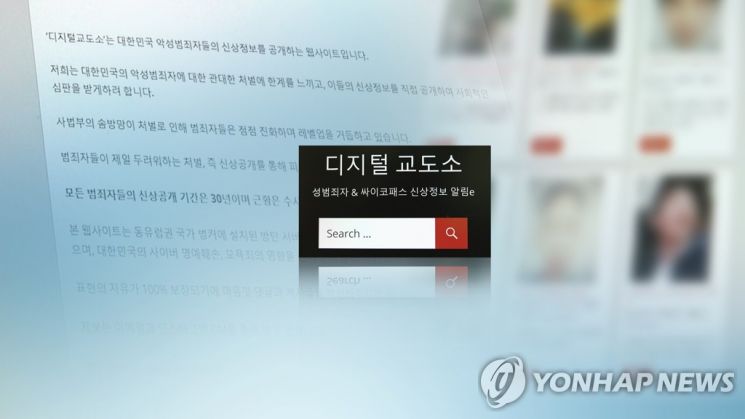 The controversy over the existence of the 'Digital Prison' website, which discloses personal information of sex offenders and others, is reigniting. Photo by Yonhap News
One netizen stated, "If we accept the act of individuals disclosing and judging others' personal information based on unverified reports, the country will turn into a lawless zone," adding, "Even if someone commits a crime, unless the judiciary delivers a guilty verdict based on solid evidence, labeling others as criminals should not be condoned."
Earlier, Digital Prison had disclosed and then deleted and apologized for releasing information of a namesake unrelated to the Miryang sexual assault case in August. As side effects such as innocent victims and extreme measures continue to occur due to the disclosure of personal information, there are calls to shut down Digital Prison.
On the other hand, there are also many claims that Digital Prison is necessary for the public good. It is pointed out that the judiciary has not sufficiently punished sexual violence, being passive in disclosing sex offenders' personal information or imposing lenient punishments.
According to the '2020 Sex Crime White Paper' released by the Ministry of Justice, among 74,956 sex crime trials conducted over ten years from 2008 to 2018,
only 19,567 cases (26.1%) resulted in imprisonment. Nearly half, 31,006 cases (41.4%), received suspended sentences, and 22,669 cases (30.2%) were fined.
Furthermore, the judiciary sparked public outrage by repeatedly issuing rulings that did not align with public sentiment, such as refusing to disclose the identities of some perpetrators deeply involved in the 'Nth Room case' and denying the extradition of Son Jung-woo, the operator of the world's largest child sexual exploitation site 'Welcome to Video,' to the United States.

As a result, citizens' anger over light punishments for sex crime cases is growing stronger.
Office worker A (28) said, "These sites exist because there are many unjust victims," adding, "I have seen many times where perpetrators live more comfortably and are more favored than victims. Child sex offender Jo Doo-soon is scheduled to be released this December. If proper punishment had been imposed on sex offenders from the start, Digital Prison would not have been created."
Experts suggest that the method of disclosing others' personal information is not a justifiable act and that there needs to be a discussion about the methods and limits of criticism that society permits. They also emphasize the need for appropriate judicial punishment to prevent the recurrence of sex crimes.
Attorney Eun-ui Lee (Eun-ui Lee Law Office) said, "The criticism that judicial punishment is weak is not new. It is true that Korea generally imposes low levels of punishment for violent crimes," but added, "However, third parties do not have the right to disclose others' personal information without verifying the facts or going through a proper verification process."
Lee said, "Even when state judicial authority is exercised, judgments are applied after careful consideration based on the law. Therefore, it is inappropriate for private individuals who do not meet such qualifications to disclose others' personal information," adding, "I understand the purpose and intent of operating Digital Prison, but there may be innocent people among those whose personal information is disclosed. Even if someone committed a crime, it is difficult to justify such private revenge methods."
He continued, "We need to actively discuss and reflect in laws and education the methods and degrees of criticism that society can permit. Also, laws related to crimes occurring in the internet environment, which are currently insufficient, need to be supplemented."
Attorney Lee also said, "The reason Digital Prison was created is mainly because the groups exposed to harm feel that punishment is weak. Appropriate punishment for victims must be imposed," adding, "Especially in cases of digital sex crimes, there is less awareness that they are serious crimes compared to direct and physical sex crimes. When the level of punishment increases, awareness that it is a crime also rises. Education on preventing sex crimes at schools and workplaces, especially on the dangers of digital sex crimes, is necessary. When sex education and punishment levels rise together, these social problems can ultimately be improved."
© The Asia Business Daily(www.asiae.co.kr). All rights reserved.



















