[Asia Economy Reporter Seulgina Jo] Following Apple, Google has also decided to raise application transaction fees to 30%, strengthening calls for fostering 'native platforms' to counter foreign platforms. Domestic developers, unable to endure the monopolistic practices of app market giants, have begun knocking on the door of 'One Store,' a platform jointly launched by the three major telecom companies and Naver. There are increasing calls for urgent policy support for domestic app markets to prevent the outflow of digital content revenue overseas and digital colonization.
◆ Developers Seeking One Store for Lower Fees
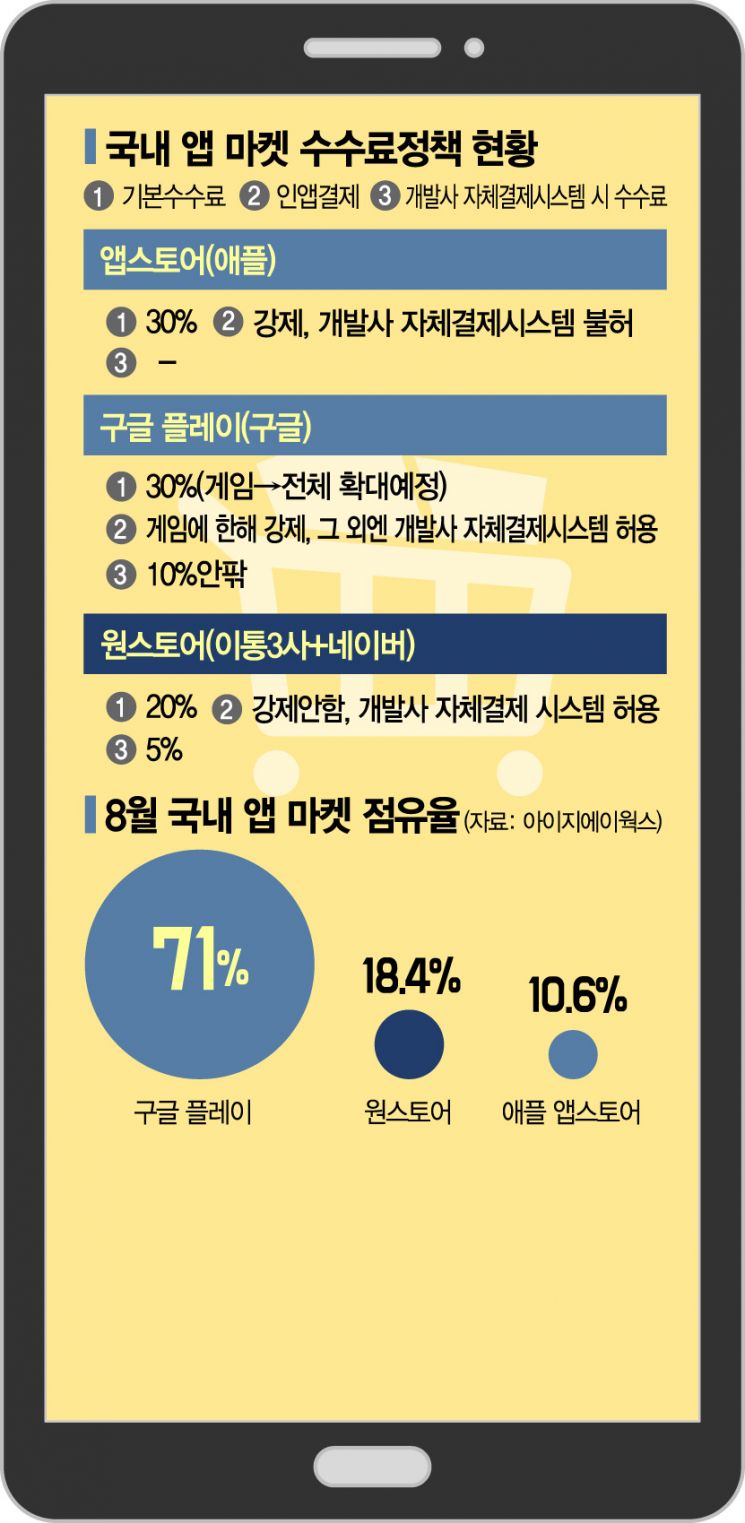
According to industry sources on the 7th, as the 30% commission policy of Google and Apple, known as the 'app toll,' has become controversial, inquiries from companies considering the native platform One Store as an alternative have surged significantly. As of the end of August, One Store's market share soared to a record high of 18.4%. During the same period, Google Play held 71.0%, and Apple App Store 10.6%.
One Store's market share, which was in the low teens at the beginning of the year, has sharply increased in the second half of this year as the app fee controversy spread domestically. Developers who had previously hesitated to oppose Google and Apple for fear of retaliation have started to turn their attention following Google's commission rate hike. Google is currently pushing to apply the 30% commission, previously only applied to game apps, to all apps, just like Apple.
Launched in 2016, One Store's app commission is 20%, much lower than Apple and Google. It also does not force in-app payments, which have become an industry norm. Rather, it implements a groundbreaking policy that reduces the commission to 5% if developers use their own payment systems. This is in stark contrast to the recent legal battle where Apple expelled game company Epic Games from the App Store for building its own payment system. A developer representative lamented, "It is unfair for Google and Apple to monopolize the market by forcing only in-app payments and imposing a 30% commission."
A One Store official explained, "Since July 2018, we have lowered the 30% app market commission, which was treated as an unspoken rule in the industry," adding, "This was based on the judgment that coexistence with developers is necessary." Through this, the total commission saved by developers entering One Store over the past two years amounts to 60 billion KRW. Following this, developer support has continued, and One Store has recorded transaction growth for eight consecutive quarters. The coexistence between developers and the app market platform has created a 'win-win' effect and established a virtuous ecosystem.
 One Store logo
◆ Growing Concerns Over Digital Colonization
The app toll controversy confirms that platform companies in dominant market positions can shake the industry ecosystem simply by changing policies, raising industry concerns. More than six out of ten domestic content companies are classified as small businesses with low operating profits, making them vulnerable to the commission policies of app market giants.
Concerns about digital colonization are also mounting. Currently, the domestic sales of foreign platforms reach about 1.8 trillion KRW, accounting for 30% of the domestic game market. Voices criticizing the outflow of domestic industry revenue overseas due to the app toll are growing louder. If native platform development does not occur, there is an increasing sense of crisis that the domestic content industry could become dependent in the future.
The National Assembly and related ministries are focusing on the unfair practices of Google and Apple. Assemblyman Junho Han of the Democratic Party pointed out, "(Google) implicitly sanctions small and medium-sized game companies by limiting the exposure of Google Play's first-page recommendations (featured) when developers simultaneously list on Google Play and domestic app markets," adding, "They forcibly impose a 30% in-app payment commission."
The Korea Communications Commission and related ministries are currently investigating whether app market commissions violate laws. Professor Jeonghwan Kim of Pukyong National University's Department of Journalism and Broadcasting expressed concern about consumer harm, stating, "There is a 100% possibility that the commission imposed on content providers will be passed on directly to users."
© The Asia Business Daily(www.asiae.co.kr). All rights reserved.
![Clutching a Stolen Dior Bag, Saying "I Hate Being Poor but Real"... The Grotesque Con of a "Human Knockoff" [Slate]](https://cwcontent.asiae.co.kr/asiaresize/183/2026021902243444107_1771435474.jpg)
















