[Asia Economy Reporter Seulgina Jo] To prevent the recurrence of the Nth Room incident that shocked the entire nation, it has been pointed out that a new punishable offense should be established from the so-called ‘Grooming’ stage, where children and adolescents are lured and groomed for sexual exploitation. It was also suggested that warning messages be inserted into applications frequently used for inducing prostitution and that immediate reporting be enabled, while undercover investigation techniques should be utilized for platforms like Telegram that are based on anonymity.
According to the National Assembly Legislative Research Office on the 5th, the report titled “Current Status and Tasks for Improving the System to Eradicate Digital Child and Adolescent Sexual Exploitation,” published the day before, stated that follow-up tasks and issue reviews are necessary in the 21st National Assembly to eradicate child and adolescent sexual exploitation crimes and ensure effectiveness. Previously, when the Telegram Nth Room case became a social issue, the 20th National Assembly enacted related legislation, including strengthening punishments for illegal filming, production, distribution, and possession of child and adolescent sexual exploitation materials.
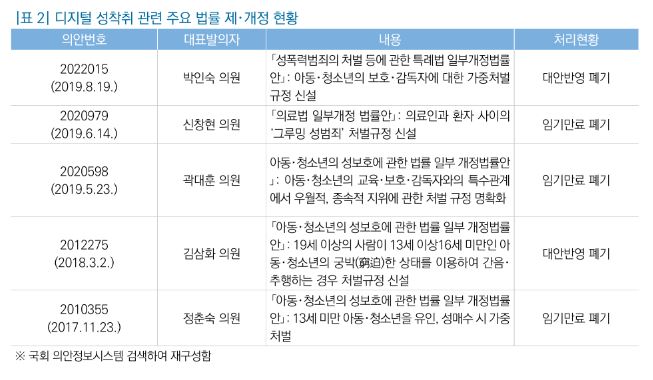
◆"Sexual inducement using psychological dependency should also be punishable"
The Legislative Research Office suggested that in the 21st National Assembly, various countermeasures should be devised along with issue reviews on establishing a regulatory system for child and adolescent grooming, undercover investigation systems for sexual exploitation crimes, and independent confiscation and forfeiture systems for the production, trade, and distribution of sexual exploitation materials.
Currently, there are no provisions in the law regarding grooming sexual crimes that exploit the psychological dependency of children and adolescents, leading to ongoing debates about the definition, criminal elements, and scope of grooming. According to the “2019 Prostitution Survey” conducted by the Korea Institute of Criminology and Justice under the Ministry of Gender Equality and Family last year, 11.1% of adolescents experienced unwanted sexual inducement via the internet in the past three years. The Legislative Research Office reported that there is a demand for a system that can intervene, detect, and track digital sexual exploitation crimes at the pre-crime stage, citing cases of sexual violence in special relationships such as therapeutic or religious contexts.
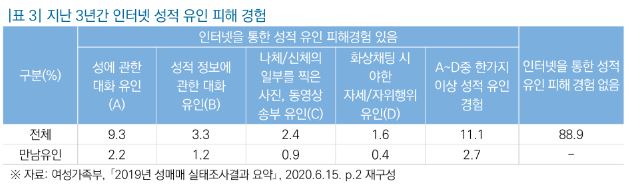
Recently, sexual inducement and prostitution mediation through internet-based smartphone chats and SNS have frequently occurred, leading to sexual exploitation crimes against children and adolescents. However, there has been no regulation on this, highlighting the need for countermeasures. The Legislative Research Office stated, "A system must be established to detect and punish sexual inducement and solicitation targeting children and adolescents via information and communication networks," and emphasized the need for legal and institutional improvements to insert warning messages into chat apps and other applications and to establish systems that allow immediate reporting when online sexual exploitation is experienced or attempted."
◆"Undercover investigation techniques should be utilized like overseas... Independent confiscation and forfeiture systems should also be introduced"
The necessity of so-called undercover investigations was also raised. Since platforms like Telegram and the dark web are based on anonymity and are difficult to access publicly, it was explained that identifying criminals through undercover and covert investigations could be effective. Major foreign countries practically use undercover investigation techniques for drug, substance, and sexual exploitation crimes, but South Korea currently lacks clear regulations on undercover investigations. The government is also currently promoting the introduction of undercover investigations.
Additionally, the introduction of independent confiscation and forfeiture systems was mentioned for cases involving the production, trade, or distribution of digital sexual exploitation videos. The Legislative Research Office added that even when the perpetrator is unidentified or the criminal has fled abroad or died, and the prosecutor cannot file charges, it is necessary to confiscate the proceeds from crimes subject to criminal proceeds recovery. In the 20th National Assembly, Representative Song Kiheon’s bill (Bill No. 2024864) and Representative Han Jeongae’s bill (Bill No. 2024852), which included provisions to ease the burden of proof and allow independent confiscation even if prosecution does not proceed for crimes involving online trading and distribution of sexual exploitation videos, were proposed but discarded due to the expiration of the term.
Along with this, the Legislative Research Office recommended that the National Police Agency establish a dedicated window for continuous reporting, reception, and investigation of female and child sexual exploitation materials, and set up a separate dedicated organization. Currently, when a third party discovers child and adolescent sexual exploitation videos, deletion requires a report or request from a guardian or family member, but it was argued that active measures are needed to allow the relevant agency to delete the material immediately upon discovery even without such requests.
Jeon Yoonjung, the legislative researcher who wrote the report, stated, "With the revision of the Telecommunications Business Act as a countermeasure against the Telegram ‘Nth Room’ case, telecommunications service providers and information network operators have been given responsibilities to prevent the distribution of sexual crime materials. It is necessary to explore cooperation methods between private companies such as internet service providers and platform operators and the government," and suggested, "Active international cooperation measures should also be devised."
© The Asia Business Daily(www.asiae.co.kr). All rights reserved.


















