Multi-use Facilities like Cafes and Bakeries in the Capital Area Must Keep Visitor Logs
Concerns over False Information and Personal Data Leakage
Experts "Need to Implement Electronic Entry Log System Using QR Codes"
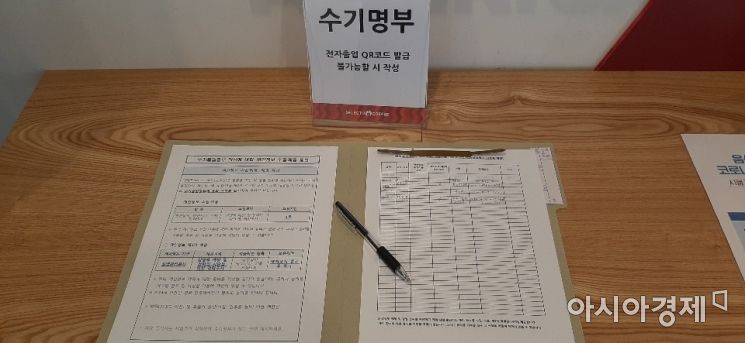 At the entrance of a cafe in Jongno-gu, Seoul, a sign-in sheet that customers must fill out is placed. The photo is unrelated to specific expressions in the article. Photo by Han Seung-gon hsg@asiae.co.kr
[Asia Economy Reporter Heo Midam] "I know it's a necessary measure, but it feels uncomfortable.", "It seems like an excessive invasion of privacy."
As more places have introduced handwritten entry logs to prevent COVID-19, citizens continue to express concerns about personal information leaks. Due to inadequate management of the logs inside stores, there are criticisms that many unspecified people can see visitors' names, contact information, and other personal data.
Some have even written false information on handwritten logs out of fear of personal information leakage. Experts emphasize the need to adopt an electronic entry log system using QR codes.
Since the 30th of last month, social distancing level 2.5 measures have been implemented in Seoul and the metropolitan area. As a result, all restaurants including cafes, bakeries, and bars require visitors to fill out either an electronic or handwritten entry log. Currently, based on metropolitan area standards, 288,858 general restaurants, 82,707 snack bars, and 8,840 bakeries are collecting visitor personal information.
The problem is that handwritten entry logs are not properly managed. Unlike the encrypted QR code method, handwritten logs where personal information is written directly on paper have a high possibility of exposure not only to owners or staff but also to other visitors.
Initially, health authorities recommended using QR code-based electronic logs first, citing better privacy protection compared to handwritten logs. However, if conditions do not permit, handwritten logs are allowed.
Handwritten logs must include the minimum information necessary for quarantine: ▲visit date ▲visit time ▲name ▲contact number, and must comply with the collection, retention, management, and destruction procedures stipulated by the Personal Information Protection Act.
However, visitors find it difficult to verify whether handwritten logs are actually destroyed, and there are ongoing concerns that owners might use the logs for marketing purposes.
Office worker Kim (27) said, "The management of the logs is very poor. Staff only ask to fill it out when entering the store, and after that, they don't seem to pay much attention to the logs."
He added, "Since the logs are mostly placed at the store entrance, the staff inside the store don't seem to pay much attention. I'm uncomfortable thinking other customers might see my personal information while filling out the log. Also, if the log is lost, it could be misused for crimes. Because of these reasons, I feel uneasy every time I write my personal information."
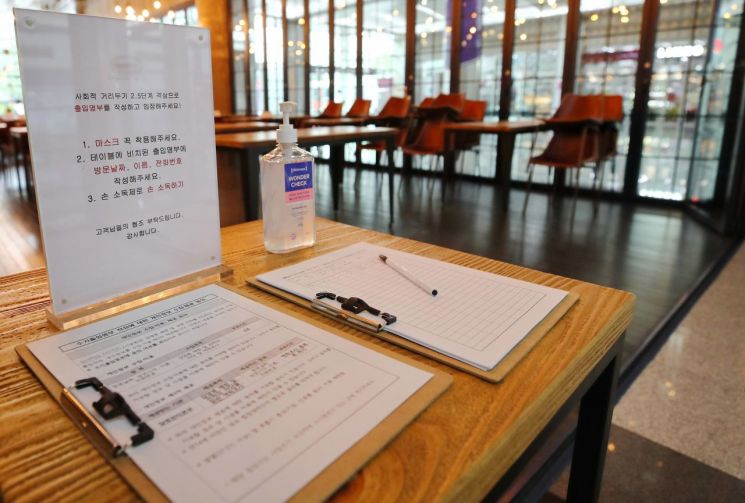 On the 31st of last month, when social distancing level 2.5 was in effect, a sign-in sheet that customers must fill out was placed at the entrance of a cafe in Gangnam-gu, Seoul. The photo is not related to any specific expression in the article. [Image source=Yonhap News]
Owners are supposed to check visitors' IDs to verify the accuracy of handwritten logs, but in practice, the handwritten method is mostly left to individual discretion because verifying IDs one by one is cumbersome.
Some citizens have exploited this by deliberately writing false information or making their handwriting difficult to read.
University student Lee (25) said, "I know we have to fill out the logs for quarantine, but I'm afraid my personal information might be exposed. So sometimes I deliberately write illegibly so others can't read it."
He added, "If there is no clear management method for the logs, I wish all stores would use QR codes. Using QR codes would eliminate the anxiety that someone is looking at my information."
However, self-employed business owners also struggle with managing the logs. A self-employed person in Yangcheon-gu, Seoul, said, "When we ask customers to scan QR codes, older customers or those unfamiliar with smartphones tend to go to other restaurants. Customers prefer handwritten logs more," adding, "We want to manage the logs properly, but how can we do that while customers keep coming in?"
Experts recommend adopting an electronic entry log system using QR codes rather than handwritten logs.
Professor Eom Jung-sik, an infectious disease specialist at Gachon University Gil Medical Center, said, "If entry logs are handwritten, false personal information will inevitably continue to be written," emphasizing, "There needs to be ongoing discussion on how to ensure that lists helpful for quarantine are created."
He continued, "For now, we have no choice but to maximize the use of QR codes. However, due to cost issues, it is difficult to install QR code systems in all establishments," adding, "While entry logs are necessary for quarantine, the burden of managing them is significant for businesses. Government support is also needed to reduce this burden."
© The Asia Business Daily(www.asiae.co.kr). All rights reserved.


















