Ministry of Employment Holds 'Employment Crisis Response Team' Meeting with Related Ministries on the 4th
"680,000 Temporary Leave Workers May Shift to Unemployed or Inactive Population"
Four Measures Promoted: Employment Retention, Remote Work, Family Care, Public Jobs
[Asia Economy Reporter Kim Bo-kyung] The employment market in the second half of the year appears unstable, as if walking on thin ice, due to the prolonged COVID-19 pandemic.
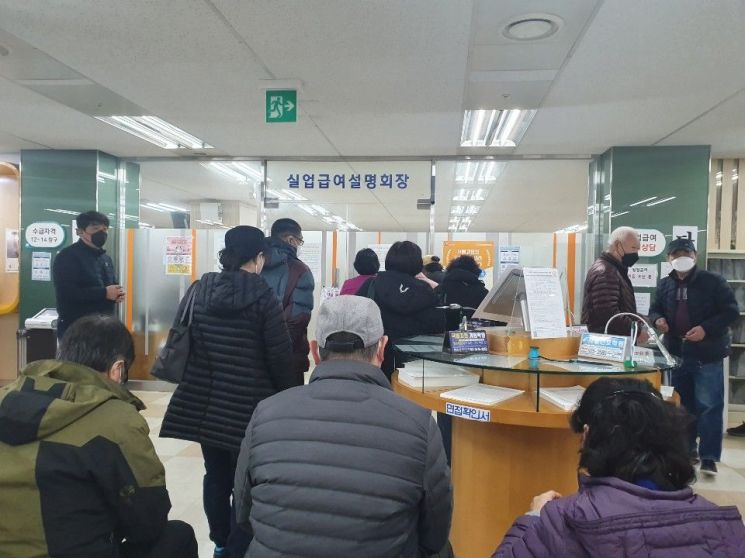
Approximately 680,000 temporarily furloughed workers are at risk of becoming unemployed, and difficulties in employment in face-to-face service industries, manufacturing, and construction are expected to continue in the second half of the year. The government plans to minimize unemployment by implementing employment retention measures and providing public jobs.
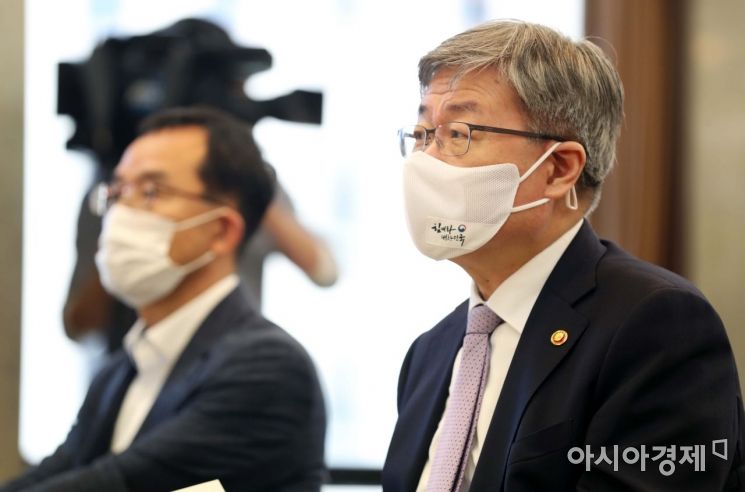
On the 4th, the government held the 10th Employment Crisis Response Team meeting and the 2nd Korean New Deal Safety Net Enhancement Team meeting at the Seoul Employment and Labor Office, chaired by Minister Lee Jae-gap of the Ministry of Employment and Labor, where 12 ministries discussed employment outlooks and response strategies together.
At the meeting, Minister Lee warned, "Due to the resurgence of COVID-19, employment improvement in face-to-face service industries is expected to be delayed in the second half of the year, and the sluggish conditions in manufacturing and construction sectors are likely to persist. If companies that have been holding on through shutdowns or furloughs reach their limits, the job shock could become even greater in this serious situation."
He added, "In July, the number of temporarily furloughed workers was 680,000, which is 280,000 more than the average over the past two years. If the economic downturn prolongs, there is a high possibility that temporarily furloughed workers will rapidly transition into unemployed or economically inactive populations."
Recently, with the resurgence of COVID-19 and strengthened social distancing measures, workplace shutdowns have increased and consumer sentiment has weakened, raising concerns about worsening job conditions.
Accordingly, the government plans to respond with four main policies to minimize the shock to the employment market: ▲ employment retention support ▲ activation of telecommuting ▲ response to family care demands ▲ provision of public jobs for vulnerable groups.
First, for eight special employment support industries such as travel and tourism, the designation period has been extended until the end of March next year, and the employment retention subsidy period has been increased from a maximum of 180 days to 240 days.
For general industries, the government is monitoring workplaces where employment retention subsidy payments are about to end, while maximizing support for employment retention by utilizing unpaid leave/furlough support funds and wage support projects under employment agreements. The government is in the process of revising the enforcement decree to relax the eligibility criteria for unpaid leave/furlough employment retention subsidies (from unpaid leave of 90 days or more to 30 days or more).
To minimize employment shocks, the government supports companies in transitioning their work methods, such as telecommuting. A comprehensive manual for introducing telecommuting will be distributed, and consulting will be provided to small and medium-sized enterprises (SMEs). Minister Lee emphasized, "Telecommuting is a solution that can simultaneously achieve the effects of social distancing and normal business operations."
The Ministry of SMEs and Startups plans to build a non-face-to-face service platform and provide vouchers worth up to 4 million KRW to 80,000 SMEs and startups this year, enabling them to use video conferencing and telecommuting services.
To prevent care gaps, a bill to expand the family care leave period (currently up to 10 days per year) is under discussion in the National Assembly. Minister Lee stated, "In preparation for the expansion of family care leave, we will strengthen workplace publicity and support on-site settlement through workplace guidance and inspections using anonymous reporting centers."
Finally, the government plans to expand job opportunities for vulnerable groups. Minister Lee said, "We will continue to provide job opportunities and income support through public jobs targeted at low-income vulnerable groups," and added, "We will discuss participation plans for job projects that minimize infection risks, such as non-face-to-face work, with relevant ministries."
The Ministry of Health and Welfare's 'Customized Care Service for the Elderly' has shifted its work methods to non-face-to-face formats such as phone and video consultations. The Ministry of Culture, Sports and Tourism's 'Support for Life Sports Instructor Activities' project is also operating additional online non-face-to-face education.
Minister Lee expressed his determination, saying, "If project execution becomes difficult, we will adjust job supply plans by project to ensure timely budget execution where needed," and emphasized, "We cannot neglect jobs even for a moment while strengthening quarantine measures."
© The Asia Business Daily(www.asiae.co.kr). All rights reserved.


















