As the recession deepens, consumer trends are also changing. Recently, as the economic downturn continues due to the impact of COVID-19, changes are occurring in consumers' spending patterns and psychology.
Paradoxically, people tend to pay more attention to small luxuries during a recession. This is known as small luxury consumption, where consumers do not hesitate to spend money on areas they care about. In particular, recently, a trend of small luxury in 'experience consumption' has attracted attention.
Futurist Thomas Frey declared, “As society, economy, and culture develop, people desire richer experiences rather than owning more things,” adding, “The so-called ‘experience economy’ era is coming.”
In the past, small luxury consumption was focused on owning specific items, but now it is enjoyed for special experiences. A representative example is travel.
Consumers seeking taste experiences do not hesitate to visit distant famous restaurants and readily purchase 40,000 to 50,000 KRW shaved ice desserts sold at luxury hotels. They pay tens of thousands of won for a day that includes eating breakfast early in the morning, swimming in an infinity pool, and enjoying Netflix while lying in bed at night.
As the form of ‘experience consumption’ that spares no expense for special experiences spreads, luxury hotels are gaining indirect benefits. Demand has surged for experiencing the services and amenities of luxury hotels that are not easily accessible in everyday life, causing room reservation rates to soar.
According to the hotel industry, Hanwha Resort’s general room reservation rate for July to August this year is around 80%, while the more expensive suite room reservation rate reaches 90 to 95%. The Signiel Seoul, a top-tier hotel operated by Lotte Hotel in Jamsil, Seoul, recently reported weekend occupancy rates exceeding 90%.
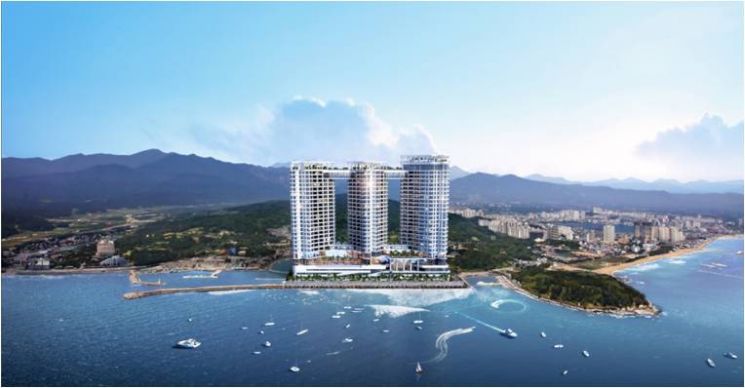
Meanwhile, the ‘Cassia’ brand hotel of the Banyan Tree Group, which was previously only found in Southeast Asian resorts, is making its debut in Sokcho.
In July, Banyan Tree Group signed a business agreement with Mastern No. 88 Sokcho PFV Co., Ltd. for the consignment operation of ‘Cassia Sokcho.’ Through this agreement, Banyan Tree Group will provide technology, design, service, and operational systems for product development of the Cassia hotel brand and will also take charge of consignment operation.
‘Cassia,’ introduced for the first time domestically, is a residence hotel brand with a modern and unique concept for consumers seeking stylish villas. Although the name is unfamiliar, it belongs to the Banyan Tree Group and is well known as a place where one can experience the dignity and top-notch service of premium hotels and resorts.
‘Cassia Sokcho’ plans to feature an infinity pool with a sandy beach, a library lounge by the world-renowned art book publisher ‘Assouline,’ a luxury spa and sauna using underground mineral water from 1,000 meters below, and a 400-seat banquet hall suitable for international conferences and business events.
Meanwhile, Mastern No. 88 Sokcho PFV Co., Ltd. signed a construction contract for the new ‘Cassia Sokcho’ project with Hanwha Construction on the 28th of last month. Hanwha Construction has experience completing premium marine marina resorts such as ‘Hanwha Resort Geoje Belvedere,’ a 5-star hotel in Seoul called ‘The Plaza,’ with a total floor area of 91,919㎡ (27,800 pyeong) and a project cost exceeding 270 billion KRW.
With Hanwha Construction’s responsible completion and Banyan Tree Group’s consignment operation ensuring project stability, ‘Cassia Sokcho’ will be built on 937 Daepo-dong, Sokcho-si, Gangwon-do, with a total floor area of 120,560㎡, 2 basement floors to 26 above-ground floors, and a total of 717 rooms. A VIP lounge is currently operated at 85-4 Cheongdam-dong, Gangnam-gu, Seoul, and the VIP lounge operates on a 100% reservation basis.
An industry expert said, “Currently, there is only one first-class hotel in Sokcho, so the demand for premium hotels is very high,” adding, “If various premium hotel brands emerge, it can provide customers with diverse satisfaction, and overall, it adds another tourism content to Sokcho.”
- Banyan Tree Group’s ‘Cassia’ Hotel Debuts Domestically
‘Cassia,’ introduced for the first time domestically, is a residence hotel brand with a modern and unique concept for consumers seeking stylish villas. Currently, Cassia is only available in Bintan, Indonesia, and Phuket, Thailand, but plans to expand to Jeju, Manila, China, and other regions starting with Sokcho.
Although the name is unfamiliar, it is a brand under the Banyan Tree Group, known for offering the dignity and ultra-luxury service of premium hotels and resorts. Since its establishment in 1987, Banyan Tree Group has positioned itself as a ‘sanctuary for weary souls,’ operating 47 hotels and resorts and 60 spas in 24 countries worldwide, providing the best relaxation to global opinion leaders.
‘Cassia Sokcho’ operates on an ownership system through individual registration. Generally, memberships operated by luxury hotels make it difficult to book on desired dates such as peak seasons and weekends, or require additional fees for stays.
However, Cassia Sokcho allows contract holders to use the property anytime they want for 30 days a year (7 days in peak season, 7 days on weekends, and 16 weekdays). The remaining 335 days are consigned to Banyan Tree Group for operation, and the contract holders receive dividends from the profits, making it a valuable investment.
Special benefits are also provided. Contract holders of Banyan Tree Group’s ‘Cassia Sokcho’ receive membership privileges for The Sanctuary Club. The Sanctuary Club offers discounts on spa, restaurants, and golf (in Phuket, Bintan, Langkawi) at hotels and resorts worldwide that are part of The Sanctuary Club network, along with early check-in, late check-out, and airport and ferry transfer services as part of the ownership service.
They can also use the exclusive exchange program (The Exchange Programme) unique to Banyan Tree Group. This program, available only to owners of Banyan Tree, Angsana, Cassia, and Laguna, allows owners to deposit 15 of their 30 annual usage days into the exchange pool, which is converted into currency value based on the average rate of the past year and can be used to book hotels and resorts participating in the program within the Banyan Tree Group.
Currently, the exchange program is available at Banyan Tree hotels and resorts in Indonesia, Mexico, Thailand, Vietnam, and China, and will soon be available at Angsana and Cassia properties opening in Penang, Malaysia; Gold Coast, Australia; and Lijiang, China.
Cassia Sokcho currently operates a VIP lounge at a designer building located in Cheongdam-dong, which is run on a 100% reservation basis.
© The Asia Business Daily(www.asiae.co.kr). All rights reserved.

















