Sales of New Cars by Three Major Makers Including Toyota All Decline
Moody's "Automobile Exports Account for 20% of Japan's Total Exports... Highest in the World"
Impact Extends to Related Industries Such as Steel, Chemicals, and Parts
30 out of 32 Auto Parts Companies Report Losses
[Asia Economy Reporter Kwon Jae-hee] As a red light is flashing for Japan's automobile industry, which is known for its 'quality,' concerns are growing that the Japanese economy itself could falter. With new car sales plummeting due to the COVID-19 pandemic, the Japanese economy, which heavily depends on the automobile industry, is inevitably facing a blow. In particular, Japan's automobile industry has an integrated production system with material companies such as chemical firms, raising worries that the ripple effects will spread throughout related industries. In this regard, the Japanese industrial sector is anticipating this to be the biggest immediate challenge following the launch of the next cabinet.
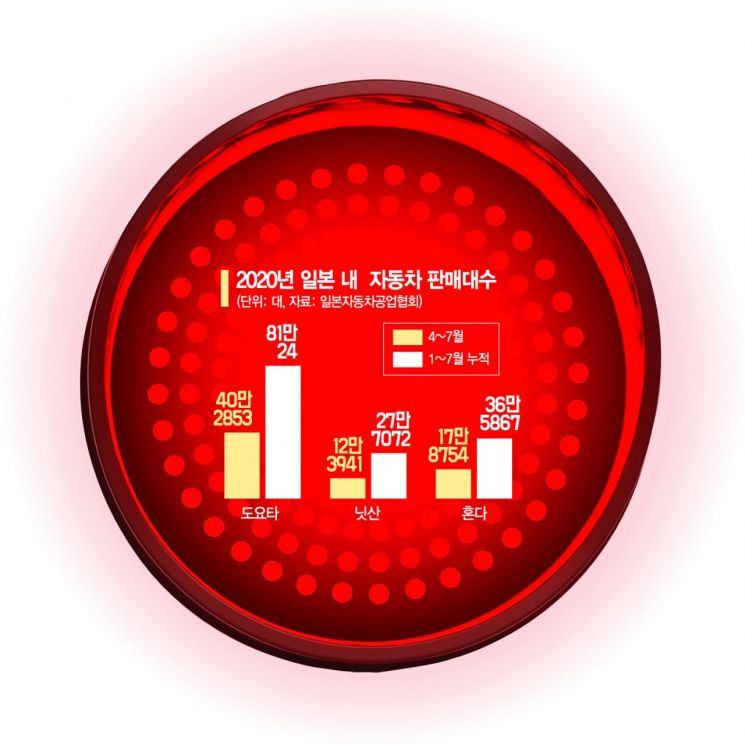
According to the Japan Automobile Manufacturers Association on the 2nd, new car sales of the three major makers?Toyota, Honda, and Nissan?declined simultaneously in the second quarter (April to June) of this year. Toyota sold 277,919 units during this period, about 100,000 fewer than the same period last year, while Honda managed only 126,100 units. Nissan sold 126,444 units in the second quarter of last year, but this year, over three months, sales dropped to 83,834 units, falling below 100,000. Accordingly, Toyota recorded a net profit of 158.8 billion yen (approximately 1.78 trillion KRW), but Honda and Nissan posted losses of 80.8 billion yen (about 91 billion KRW) and 285.5 billion yen (about 3.2 trillion KRW), respectively. Toyota's net profit also decreased by 74.3% compared to the same period last year.
The problem is that the slump in Japan's finished car industry has a significant impact on the Japanese economy. The automobile supply chain includes steel, glass, electronic equipment, chemicals, auto parts, tires, and logistics. AGC, the top supplier of automotive glass, derives 26% of its sales from the automobile sector, and Sumitomo Electric, which supplies parts, has 54% of its sales related to automobiles.
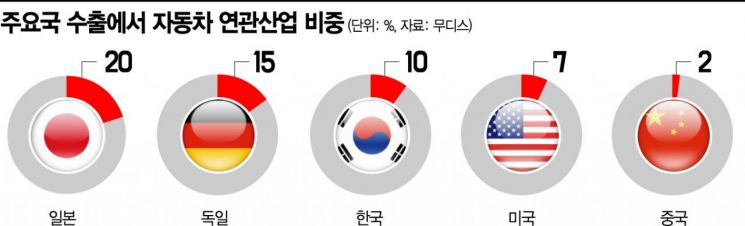
Japan also has a higher proportion of automobile exports compared to other countries. Moody's recently reported that Japan's automobile industry accounts for 20% of its national exports, the highest in the world. Germany, a strong automobile nation, has an automobile export ratio of 15%, and South Korea stands at about 10%. The United States, the largest automobile consumer, has an automobile export ratio of only 7%. Japan recorded a trade deficit of 2.2395 trillion yen (approximately 251.2 trillion KRW) in the first half of this year (January to June), largely due to a halving (49.9%) of automobile exports, its main export item, compared to the same period last year.
As the finished car industry wavers, subcontracted parts suppliers are also facing a crisis. According to the Nihon Keizai Shimbun, 30 out of 32 Japanese auto parts companies turned to losses in the second quarter of this year. Unipres, a company supplying presses for automobiles, relies on Nissan for about 80% of its transactions. With Nissan turning to losses, Unipres also recorded an 8.6 billion yen loss in the second quarter.
Because of this, finished car manufacturers have started requesting price adjustments from parts suppliers. Toyota sent a letter to subcontractors in July asking for a reduction in parts prices. The Nihon Keizai Shimbun evaluated that Toyota usually adjusts parts prices with subcontractors twice a year, in April and October, and that requesting an additional price cut outside the regular adjustment period was unusual.
The crisis in the automobile industry is shaking regional economies as well. Especially, Shizuoka, Aichi, and Gunma prefectures, where finished car and parts manufacturers are concentrated, have been hit hard. In Aichi Prefecture, home to Toyota and Mitsubishi factories, 54% of manufacturing workers are related to the automobile industry. Shizuoka, where Toyota and Honda factories are located, has 25%, and Gunma, home to Subaru factories affiliated with Fuji Heavy Industries, has 23% of manufacturing personnel working in the automobile sector.
The crisis in the automobile industry is expected to be a burden for the next Japanese cabinet, which will be launched this month. According to a survey by the Nihon Keizai Shimbun targeting the business community, the next administration is being urged to prioritize reviving the economy, which has been depressed by COVID-19, and to implement support measures for the automobile industry.
Hiroaki Tsukada, chief researcher at Mitsubishi UFJ Research & Consulting, said, "No administration can ignore the Japanese automobile industry," adding, "The next cabinet should devise measures to respond to the automobile industry alongside COVID-19 countermeasures."
© The Asia Business Daily(www.asiae.co.kr). All rights reserved.

![Clutching a Stolen Dior Bag, Saying "I Hate Being Poor but Real"... The Grotesque Con of a "Human Knockoff" [Slate]](https://cwcontent.asiae.co.kr/asiaresize/183/2026021902243444107_1771435474.jpg)















