Sung Yun-mo, Minister of Industry, Holds 'Green New Deal Policy Meeting'... Discusses Support Measures for RE100 Implementation
Establishes Renewable Energy Purchase Options Including Third-Party PPA... Some Concern Over Industrial Electricity Rate Hikes
Announces Solar R&D Innovation Strategy... Government and Companies Sign MOU for 'Solar Joint Research Center'
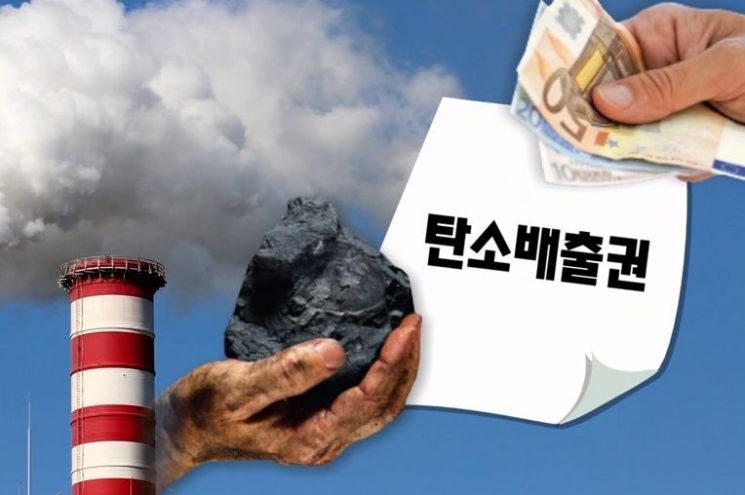
[Asia Economy Reporter Moon Chaeseok] Starting next year, five methods for purchasing and using renewable energy, including the '3rd Power Purchase Agreement (PPA)' between solar power operators and demand companies, will be implemented. Companies that purchase renewable energy through these five methods will have their greenhouse gas reduction achievements recognized, allowing them to avoid purchasing emission permits equivalent to the reduced amount. The government plans to establish and announce a detailed system for recognizing greenhouse gas reductions within this year. This aims to encourage domestic companies to participate in the RE100 campaign (procuring 100% of electricity from renewable energy by 2050).
The Ministry of Trade, Industry and Energy (MOTIE) announced that on the 2nd at 2 p.m., Minister Sung Yun-mo will preside over an 'Online Green New Deal Policy Meeting' at the Government Complex Sejong to discuss support measures for corporate RE100 implementation and innovation strategies for solar power R&D, as well as institutional innovations in the renewable energy sector. Attendees include Minister Sung and officials from MOTIE and the Office for Government Policy Coordination (both government), private companies such as Samsung Electronics, SK Hynix, LG Chem, LG Electronics, Hanwha Solutions, Sinsung ENG, Hyundai Energy Solutions, Jusung Engineering, Daewoo Electronic Materials, public enterprises like Korea Electric Power Corporation (KEPCO), public institutions such as Korea Energy Agency and Korea Institute of Energy Technology Evaluation and Planning, and private non-profit organizations including the Carbon Disclosure Project (CDP) Korea Committee.
Five Corporate Renewable Energy Purchasing Methods Established from Next Year... Encouraging RE100 Participation
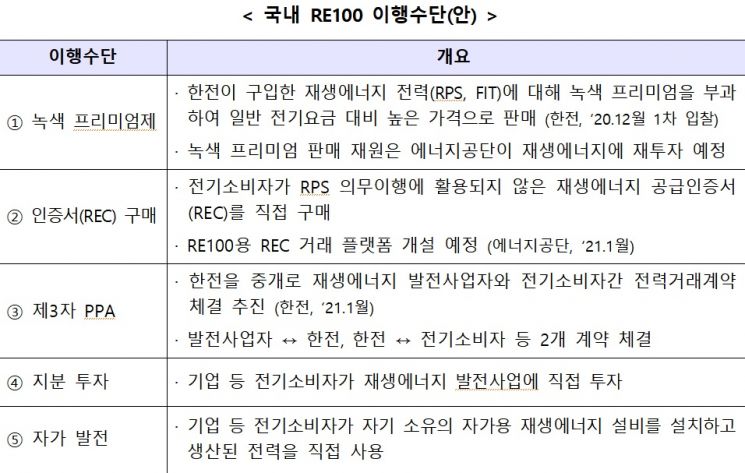
The government plans to introduce five selective methods for companies to purchase renewable energy, encouraging their participation in RE100. Domestic companies are being requested to use renewable energy by 242 overseas companies participating in RE100, such as Apple and Google, but have struggled due to the lack of a proper renewable energy purchasing system. According to Article 7 of the Electricity Business Act, demand companies cannot engage in 'direct transactions' with renewable energy power plants and must purchase renewable energy mixed with other power sources like coal and nuclear from KEPCO. There is no proper way to purchase 'pure renewable energy.'
From next year, companies will be able to purchase renewable energy through five methods: third-party PPA, green premium system, purchase of Renewable Energy Certificates (REC), equity investment, and self-generation. The Energy Agency will establish a system to track and verify renewable energy purchase and usage records. An online briefing session will be held for companies and public institutions around mid-month, and related regulations will be revised in the second half of the year for full implementation starting next year. A voluntary participation plan for public institutions in RE100 will also be prepared.
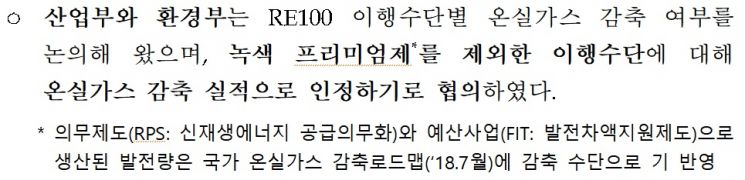
When companies purchase renewable energy through these methods, their greenhouse gas reduction achievements will be recognized. A MOTIE official stated, "We have agreed with the Ministry of Environment to recognize four implementation methods, excluding the green premium system, as greenhouse gas reduction achievements," adding, "We plan to announce specific procedures and detailed recognition methods in consultation with the Ministry of Environment by the end of this year."
Accordingly, the system is likely to operate by reducing the cost of greenhouse gas emission permits in proportion to the amount of renewable energy purchased by companies. Under the emission trading scheme, companies that emit more greenhouse gases than their allowance must trade emission permits with other companies. MOTIE emphasized, "Domestic companies can now simultaneously fulfill RE100 commitments and reduce greenhouse gas emissions."
However, concerns have been raised that the rise in industrial electricity prices may increase the burden on companies. Professor Jeong Dong-wook of Chung-Ang University's Department of Energy Systems Engineering said, "When purchasing industrial electricity from KEPCO, the cost is about 90 KRW per kWh, but the solar power price including REC costs is about 120-130 KRW per kWh, so the new system may increase companies' electricity expenses," adding, "We need to observe the government's detailed greenhouse gas reduction recognition methods."
190 Billion KRW Investment over 5 Years in Tandem Solar Cell Development... "Two Years Ahead of Overseas"
The government will also present three 'Solar Power R&D Innovation Strategies' at the meeting. Acknowledging the reality of being outpaced by China’s economies of scale, the government aims to refine the R&D system to focus investments on solar silicon, cells, and modules. Additionally, it plans to increase government R&D participation rates among large cell and module companies and improve the R&D system concentrated in universities and research institutes to raise commercialization rates.
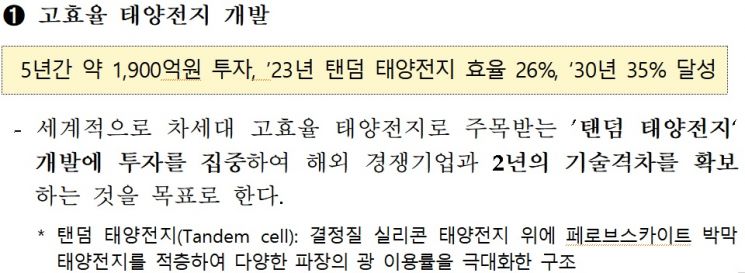
Investment will focus on three major process technology areas: specifically, ▲development of high-efficiency solar cells (approximately 190 billion KRW investment over 5 years), ▲creation of new markets and services (approximately 98 billion KRW investment over 5 years), and ▲development of low-cost process technologies (approximately 42 billion KRW investment over 5 years). The core focus is on developing 'tandem solar cells,' recognized globally as next-generation high-efficiency solar cells. The goal is to secure a two-year technological lead over overseas competitors. Support will be provided to endure market transitions, and high-efficiency silicon cell technology development will be pursued concurrently to maximize tandem cell efficiency.
Other initiatives include ▲flagship R&D involving material, parts, and equipment companies (over 20 billion KRW investment over 3 years), ▲relaxation of government R&D participation conditions for large cell and module companies through the 'Industrial Technology R&D Innovation Plan' announced this month, and ▲establishment of joint corporate research centers (applications for local governments and lead institutions have been open since last month).
Minister Sung Yun-mo of MOTIE stated, "With various methods for purchasing renewable energy now in place, we hope domestic companies will actively participate in the RE100 campaign," emphasizing, "If the government and companies cooperate to secure world-class technology and expand renewable energy utilization, South Korea can lead the Green New Deal."
Public-Private 100MW-Class Solar Power Joint R&D Center Agreement
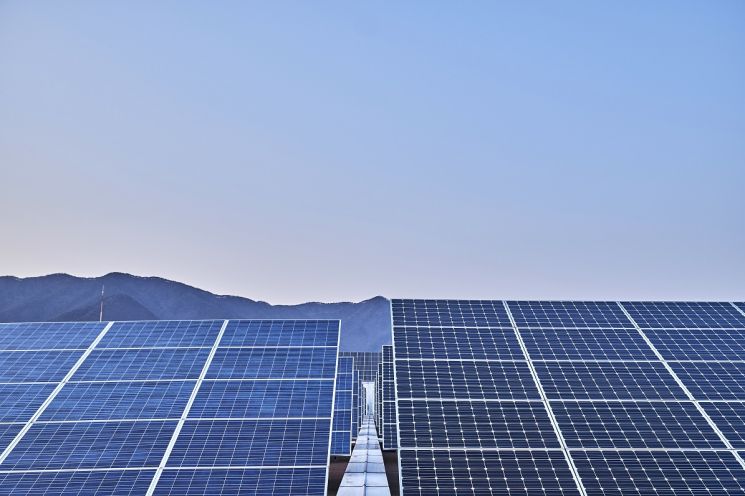 Solar power plant installed on the rooftop of Shinsung ENG's solar panel manufacturing factory. (Photo by Shinsung ENG)
Meanwhile, at the meeting, the government signed a Memorandum of Understanding (MOU) for a '100MW-Class Solar Power Joint R&D Center.' This project will invest 25.3 billion KRW by 2022. The agreement covers cooperation plans among the government, companies, and R&D agencies regarding research center design, equipment selection, and operation organization. Participating companies include Hanwha Solutions, LG Electronics, Hyundai Energy Solutions, Sinsung ENG, Jusung Engineering, and Daewoo Electronic Materials.
Minister Sung said, "Technology development is crucial to securing the future competitiveness of the solar power industry," adding, "We expect that through this MOU, the public and private sectors will unite to secure next-generation technologies early and that our companies will lead the global solar power market, which is expected to grow significantly after the COVID-19 pandemic."
© The Asia Business Daily(www.asiae.co.kr). All rights reserved.



















