Legislative Research Office Publishes Report Analyzing EU B2B Unfair Trade Regulation Legislation
"Considering Legislation Allowing Large Retailers to Share Labor Costs for Directly Employed Workers"
[Asia Economy Reporter Moon Chaeseok] The National Assembly Legislative Research Office announced on the 2nd that it has published a report titled 'Foreign Legislative Trends and Analysis,' which deals with the European Union (EU)'s first legislative case regulating unfair B2B (business-to-business) transactions.
The report includes the 'Fairness Directive on Agricultural and Food Distribution Transactions' applied by the EU last year.
According to the Legislative Research Office, the agricultural and food distribution market is characterized by short shelf life and high supply-demand instability, resulting in small-scale farmers being highly dependent on large-scale buyers for transactions.
Because of this, unfair trade practices are widespread. The EU prepared the directive in response to the need to establish unified norms to eradicate unfair trade practices.
On April 30th last year, the '2019 EU Directive on the Regulation of Unfair Trading Practices in Agricultural and Food Distribution' (Fairness Directive on Agricultural and Food Distribution Transactions) was enacted. Each member state must incorporate the directive's contents into their domestic laws by May 1st next year.
The directive applies to agricultural, livestock, and fishery products and their processed foods. A total of 15 types of unfair trading practices are prohibited.
The fully prohibited acts (Black List) include nine types such as delayed payment and unilateral changes to transaction conditions. Acts allowed only with prior agreement (Gray List) include six types such as sharing advertising and promotional costs.
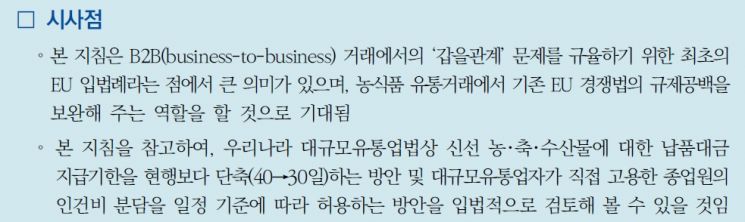
The Legislative Research Office evaluated that the directive is significant as the EU's first legislative case regulating the 'gap-eul relationship' issue in B2B transactions.
The Legislative Research Office suggested that, referring to the EU's directive, South Korea could consider shortening the payment deadline for delivery of fresh agricultural, livestock, and fishery products under the Large-scale Distribution Business Act from the current 40 days to 30 days.
They also mentioned that legislatively considering allowing large-scale distributors to share labor costs for employees directly hired by them according to certain standards is worth considering.
© The Asia Business Daily(www.asiae.co.kr). All rights reserved.

















