[Asia Economy Reporter Kim Eunbyeol] Seven out of ten domestic economic experts analyzed that the government's 'Lease 3 Acts' are likely to increase the burden on tenants. The Lease 3 Acts refer to the right to request contract renewal, the cap on monthly rent increases, and the monthly rent reporting system. They pointed out that to stabilize housing prices, supply must be increased, and the government should aim for housing stability for low-income and young people.
The Korean Economic Association disclosed the results of an economic discussion held on the government's real estate policy on the 31st. Between 35 and 37 participants responded to each question in this survey.
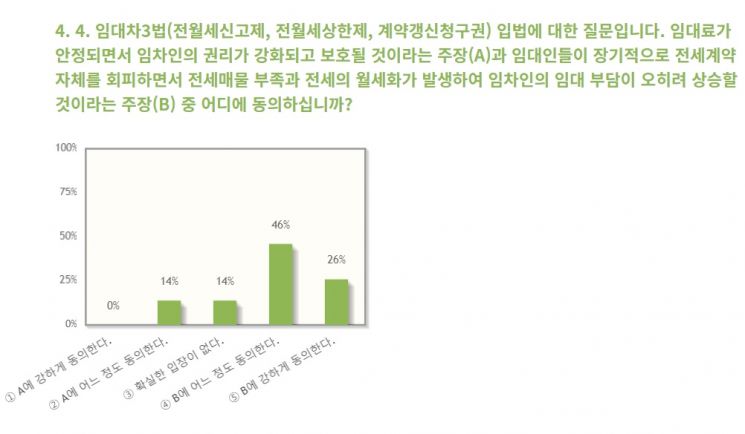
First, 26% of economists 'strongly agreed' with the claim that 'landlords will avoid long-term monthly rent contracts, causing a shortage of monthly rental listings and the conversion of monthly rent to monthly lease, which will actually increase the rental burden on tenants.' About half (46%) 'somewhat agreed.' It can be interpreted that over 70% of respondents believed the Lease 3 Acts would rather increase the burden on tenants.
When asked about their thoughts on bills strengthening acquisition tax, property tax, and capital gains tax, more than half (57%) answered that 'property tax should be strengthened, but acquisition tax and capital gains tax should be eased.' Only 3% agreed with the current policy.
Regarding whether the surge in housing prices in the metropolitan area is due to supply shortages caused by reconstruction restrictions and a decrease in listings due to capital gains tax surcharges, 30% of respondents 'strongly agreed,' and 46% 'somewhat agreed.' Only 16% 'disagreed,' and 8% had 'no opinion.'
As a policy to stabilize housing prices, 78% of economists chose 'supply measures.' No economist selected loan regulations. Eleven percent responded to strengthening property taxes such as comprehensive real estate tax.
As the most appropriate goal of the government's real estate policy, 54% chose 'housing stability for low-income and young people.' The next most common answer (23%) was 'housing price stabilization.'
The Korean Economic Association's 'Economic Discussion' is modeled after the IGM Forum at the University of Chicago in the United States, providing a platform for economic experts to share views on Korean economic issues. Surveys have been conducted so far on emergency disaster relief funds, the necessity of employment insurance, and more.
© The Asia Business Daily(www.asiae.co.kr). All rights reserved.


















