Government Announces Draft of 300 Standard English Translations for Korean Traditional Music Terms
English Descriptions Added Indicating Term Attributes Based on Korean Romanization
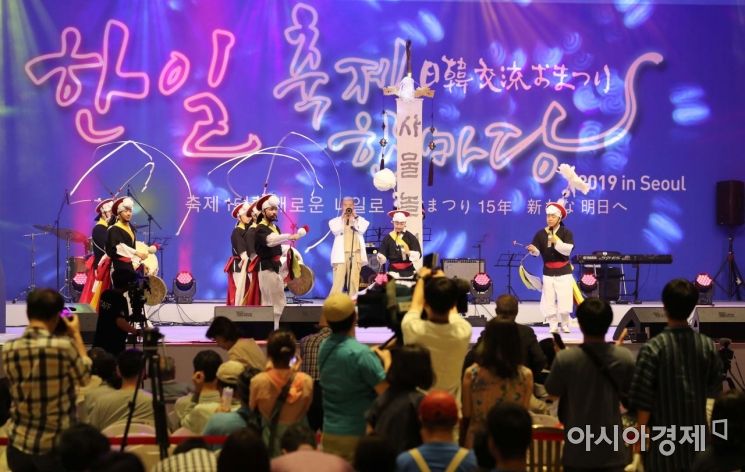 On the 1st, a Korean Samulnori performance is taking place at the Korea-Japan Festival Hanmadang held at COEX in Gangnam-gu, Seoul. Photo by Mun Ho-nam munonam@
The Ministry of Culture, Sports and Tourism, the National Gugak Center, and the National Institute of Korean Language announced a draft of standardized English translations for 300 gugak (traditional Korean music) terms on the 31st. They unified the scattered and inconsistent English terms to make it easier and more convenient for foreigners to use gugak terminology. They plan to finalize the standard translation draft by collecting public opinions until next month and distribute it to gugak performance venues both domestically and internationally.
The standard translation draft follows the basic principle of writing according to the Romanization of the Korean language, followed by an English description indicating the term’s attribute. For example, for Samulnori, the Romanized form ‘Samullori’ is combined with the English attribute ‘Instrumental Music’ to translate it as ‘Samullori Instrumental Music.’ Gayageum is defined by combining ‘Gayageum’ with ‘Zither (a flat string instrument without a neck)’ to form ‘Gayageum Zither.’
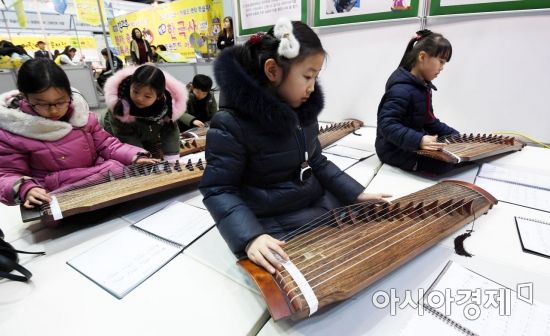 Students visiting the '2018 Korea Education Expo' held on the 24th at COEX in Samseong-dong, Gangnam-gu, Seoul, are experiencing playing the gayageum./Photo by Hyunmin Kim kimhyun81@
An official from the Ministry of Culture stated, “This is consistent with the translation and notation principles for natural place names and cultural assets set forth in the ‘Guidelines for Foreign Language Translation and Notation of Public Terms.’” They explained, “This principle considers the fact that gugak terms are less known to foreigners,” and added, “The preference for this notation method was highest in surveys conducted among public term translation experts and foreigners visiting Korea.”
However, terms designated as UNESCO Intangible Cultural Heritage such as Pansori, Gagok, Nongak, Cheoyongmu, Ganggangsullae, and Arirang, as well as Uigwe, designated as a UNESCO Memory of the World, are transcribed only by their Korean pronunciation in Roman letters. The terms Sijo, included in the globally recognized Merriam-Webster dictionary, and Daechwita, widely known since May through BTS member Suga’s song, also do not have additional attribute descriptions attached.
© The Asia Business Daily(www.asiae.co.kr). All rights reserved.

















