"Misunderstanding, error, and ignorance do not necessarily pertain to the act of adultery itself"
[Asia Economy Reporter Choi Seok-jin] The scope of punishment for the crime of "sexual intercourse with minors or others under mental incapacity"?which is established when a minor or a person with mental disabilities is deceived and sexually assaulted?has been significantly expanded.
Previously, the Supreme Court strictly interpreted the requirement of "sexual intercourse by deception," recognizing the crime only when the victim's misunderstanding or mistake was necessarily about the sexual act itself. However, it is now possible to punish cases where the error concerns other conditions unrelated inseparably to the sexual act itself.
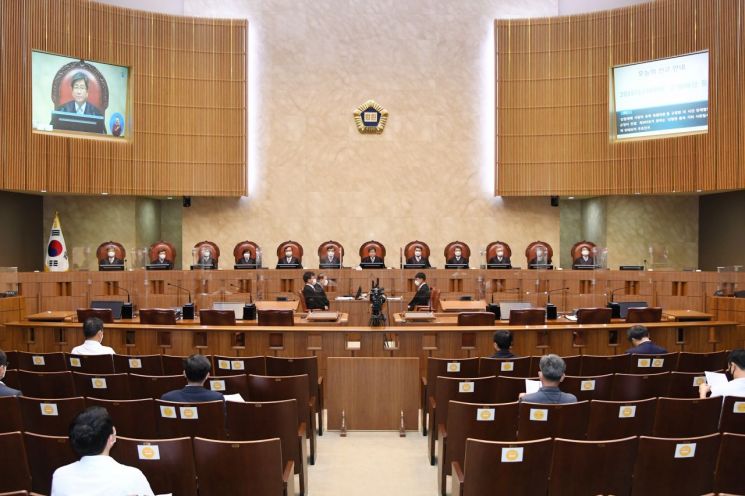
The Supreme Court's Grand Bench (Presiding Justice Min Yoo-sook) overturned the lower court's acquittal of A (36), who was indicted for violating the Act on the Protection of Children and Juveniles Against Sexual Abuse (sexual intercourse by deception), and remanded the case to the Gwangju High Court on the 27th.
The court stated, "The victim was deceived by the defendant into having sexual intercourse, and the victim's mistaken situation was an important motive for deciding to engage in the sexual act. It is difficult to view this as a voluntary and sincere exercise of sexual self-determination."
Furthermore, the court explained, "If the perpetrator caused the victim to have misunderstanding, mistake, or ignorance for the purpose of sexual intercourse and used the victim's mental state to achieve the sexual act, a causal relationship between deception and the sexual act can be recognized, thus constituting the crime of sexual intercourse by deception. The lower court erred in its legal interpretation regarding this crime."
The court added, "Contrary to previous Supreme Court precedents, which held that the misunderstanding, mistake, or ignorance caused by the perpetrator for the purpose of sexual intercourse must be about the sexual act itself, and not about other conditions unrelated inseparably to the sexual act, all such precedents are hereby changed."
The court clarified, "For this crime to be established, the content of the deceptive conduct must include circumstances that constitute an important motive for the victim to decide to engage in sexual activity, such that the victim's voluntary exercise of sexual self-determination is absent."
It further stated, "When determining whether the deception is causally related to the sexual act, the victim's position and perspective in the specific circumstances of the crime must be fully considered."
In mid-July 2014, A approached B (14), a minor, through a smartphone chat application, pretending to be Kim, a high school sophomore.
After deciding to date B, in August of the same year, A lied to B, saying, "There is a woman stalking me because she likes me, and she is so obsessed that it is very difficult. I want to die. Shall we just break up?" He suggested that to get rid of the stalking woman, B should have sexual intercourse with his senior.
Fearing a breakup with Kim (actually A), B agreed to A's proposal, and A deceived B by pretending to be the senior Kim mentioned and had sexual intercourse with her.
After the crime was revealed, the prosecution indicted A for sexual intercourse by force under the Youth Protection Act, but the first trial court acquitted A, judging that there was no use of force.
Later, in the second trial, the prosecution changed the charge to "sexual intercourse by deception," but A was again acquitted, on the grounds that A could not be seen as having deceived B about the sexual act itself.
This conclusion in the second trial was in line with the previous Supreme Court stance.
Article 302 of the Criminal Act (Sexual Intercourse with Minors, etc.) states, "A person who has sexual intercourse or commits indecent acts with a minor or a person with mental incapacity by deception or force shall be punished by imprisonment for up to five years."
The Supreme Court previously required that, for the crime of sexual intercourse by deception under Article 302, "the misunderstanding, mistake, or ignorance caused by the perpetrator for the purpose of sexual intercourse must be about the sexual act itself."
Therefore, cases such as luring a minor to a motel under the pretense of a blind date or deceiving a minor into sexual intercourse by falsely promising payment without intending to pay were not recognized as sexual intercourse by deception.
However, with this change in precedent, the scope of establishing sexual intercourse by deception against minors or persons with mental incapacity is expected to expand significantly.
The Supreme Court explained the significance of this ruling as "a judgment that does not limit the object of misunderstanding, mistake, or ignorance in sexual intercourse by deception to the sexual act itself or other conditions inseparably related to the sexual act, but confirms it as an object causally related to the sexual act."
© The Asia Business Daily(www.asiae.co.kr). All rights reserved.
![Clutching a Stolen Dior Bag, Saying "I Hate Being Poor but Real"... The Grotesque Con of a "Human Knockoff" [Slate]](https://cwcontent.asiae.co.kr/asiaresize/183/2026021902243444107_1771435474.jpg)
















