What Changes at Stage 3?
Cafes and Academies with Fewer than 300 People
Suspension of Medium-Risk Multi-Use Facilities
Excluding Restaurants and Essential Industry Facilities
[Asia Economy Reporters Seulgina Jo and Daeyeol Choi] Social interest has heightened over the plan to raise social distancing to the highest level to curb the spread of the novel coronavirus infection (COVID-19). The government plans to decide on the upgrade this week after reviewing the domestic outbreak situation, while refining the detailed guidelines for social distancing Level 3 and comprehensively examining potential controversies that may arise once it is implemented.
Level 3: Private gatherings of 10 or more people prohibited
Social distancing is the most fundamental preventive measure used during outbreaks of infectious diseases such as COVID-19. It aims to block virus transmission by reducing contact and movement between people. Since the COVID-19 outbreak, social distancing has been emphasized domestically, and since last June, it has been applied in three levels (1 to 3) depending on the outbreak situation.
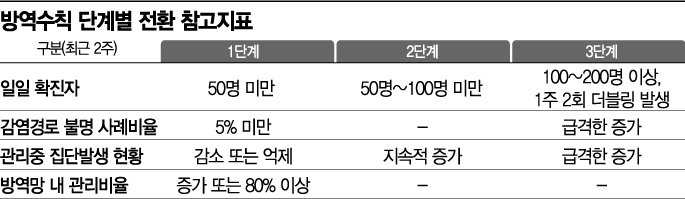
Level 3 is decided through discussions by the Living Quarantine Committee, composed of government officials and related experts, when daily new confirmed cases reach 100 to 200 or more (2-week average), doubling (daily cases doubling) occurs more than twice a week, and the proportion of cases with unknown infection routes and cluster outbreaks rapidly increase. Even if these indicators are met, a separate deliberation process is conducted due to the significant impact on society and the overall economy.
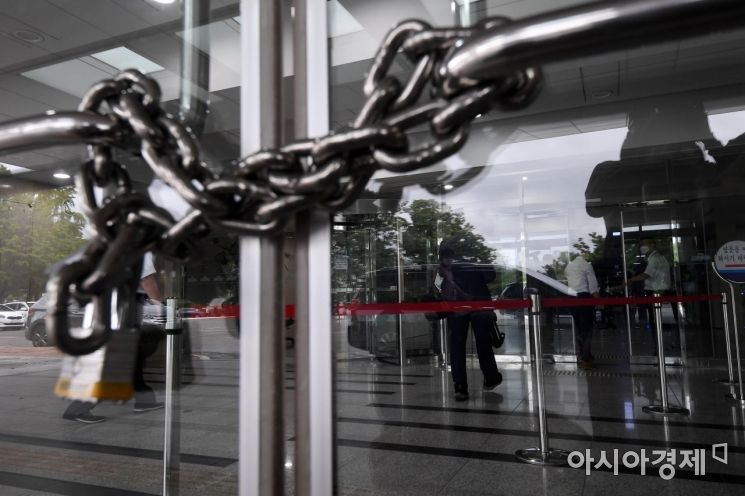 Due to a confirmed case of COVID-19 among reporters covering the National Assembly, the main building of the National Assembly was closed on the 27th, and the entrance was firmly locked. Photo by Kim Hyun-min kimhyun81@
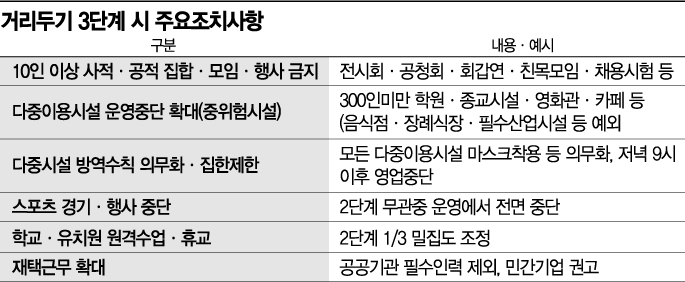
Currently, under Level 2, indoor gatherings of 50 or more and outdoor gatherings of 100 or more are prohibited, whereas under Level 3, gatherings of 10 or more people are banned regardless of indoor or outdoor settings. This applies not only to assemblies and events such as briefings, commemorations, picnics, and workshops but also to private social and family gatherings. In addition, operations of medium-risk facilities, along with high-risk multi-use facilities already under closure orders, will be suspended.
Facilities affected include academies with fewer than 300 people, game centers, arcades, amusement parks, religious facilities, wedding halls, movie theaters, model houses, cafes, and more. However, when the measures are enforced, local governments may adjust the list of facilities based on the situation. Restaurants, funeral homes, residential facilities, and essential industry facilities are considered medium-risk but are exceptionally allowed to operate. Mask-wearing and other key preventive measures will be mandatory in all multi-use facilities, including restaurants. Additionally, the number of users will be limited, and business operations will be suspended after 9 p.m., among other gathering restrictions.
Public facilities, both indoor and outdoor, must close entirely, and sports events currently held without spectators under Level 2 will be suspended. Schools and kindergartens, which are currently operating at about one-third capacity, will switch to remote classes or close temporarily. Public institutions will implement work-from-home policies except for essential personnel, and similar recommendations will be made to private companies. Violations may result in fines, criminal penalties, and claims for damages.
These measures provide a general framework, but since various confusions and issues are inevitable during actual implementation, the government is refining guidelines by sector and situation. For example, confusion and dissatisfaction arose around weddings when Level 2 was raised, and since Level 3 involves even stricter measures, there is a high possibility of dissatisfaction spreading throughout society.
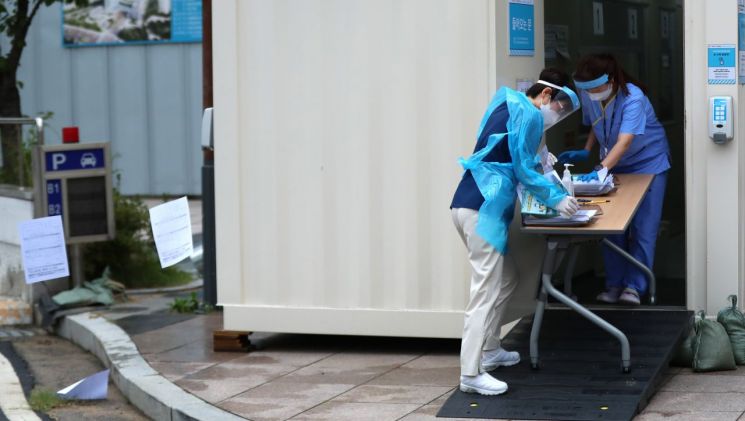 On the morning of the 27th, medical staff at the COVID-19 screening clinic of Seoul Medical Center in Jungnang-gu, Seoul, are struggling with strong winds caused by the typhoon.
 Overseas countries that implemented strong lockdowns
Effective but risk of loosening after lifting
Lockdown-like measures such as social distancing Level 3 have already been implemented in countries overseas where COVID-19 spread rapidly. Spain, which imposed strict lockdown measures in March, confirmed the initial effectiveness of such measures. The number of new daily confirmed cases, which rose to 7,000?8,000 at the end of March and peaked at around 9,000 in early April, dropped below 1,000 in May.
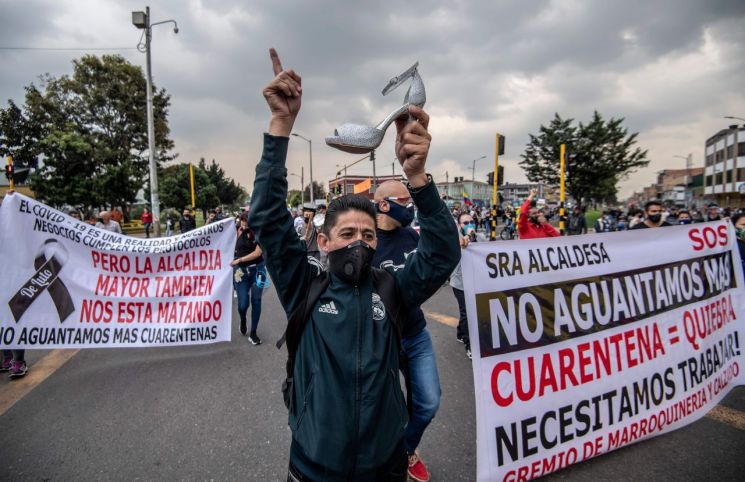 Colombian merchants are protesting against lockdown measures to prevent the spread of COVID-19 in the capital, Bogot?, on the 18th (local time).
 Similar effects were observed in European countries that closed borders and restricted travel. The German government emphasized the effectiveness of proactive lockdown policies when the UK, which started lockdown about a week later than Germany, saw a surge in cases. The United States also implemented similar measures from mid-March, but the calming effect was limited.
The problem arises after lifting the lockdown. In May, as the spread of COVID-19 slowed, countries concerned about economic conditions lifted lockdowns earlier than initially expected. As countries gradually reopened and resumed economic activities, the World Health Organization (WHO) expressed concerns about the premature easing. This was because the relaxation measures could be perceived by citizens as "it's over now." This ultimately led to a second wave of infections.
© The Asia Business Daily(www.asiae.co.kr). All rights reserved.



















