Government: "Revived Domestic Demand May Fade... Additional Budget Also a Burden"
Financial Market Stability Through Currency Swaps and RP Purchases
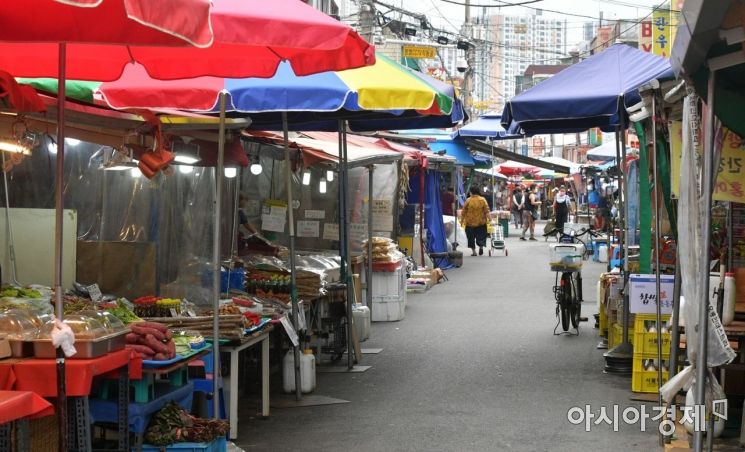 On the 23rd, when social distancing level 2 was expanded nationwide, a traditional market in Eunpyeong-gu, Seoul, showed a quiet scene. Photo by Dongju Yoon doso7@
[Asia Economy Reporter Jang Sehee] Although the number of confirmed cases of the novel coronavirus infection (COVID-19) is rapidly increasing, the government appears hesitant to raise the 'social distancing to Level 3.' While the future trend of the increase in COVID-19 cases is crucial, based on the current trend, the implementation of social distancing Level 3 is only a matter of time. Once Level 3 is enforced, it is expected to have a significant impact on the economy, including a prolonged domestic demand slump.
◆Government: "Concerned about domestic demand collapse and no fiscal capacity for supplementary budget"= Economic authorities are most worried about the 'domestic demand slump.' On the 27th, a government official said, "If the level is raised to Level 3, face-to-face service industries will be severely hit immediately, which could lead to a collapse in domestic demand." He added, "If domestic demand collapses, the living conditions of self-employed people could deteriorate." Domestic demand, which was boosted by the emergency disaster relief fund payment in April, could slump again. There is a risk of a shock similar to the large-scale lockdowns implemented in the U.S. and Europe this spring. In fact, the U.S. and Eurozone, which implemented lockdown measures, saw their Q2 growth rates decrease by 9.5% and 12.1%, respectively, while China grew by 3.2% year-on-year.
Under social distancing Level 3, gatherings and events of 10 or more people are prohibited. Restaurants, essential industrial facilities, and residential facilities may operate, but even these must close after 9 p.m. Ultimately, outdoor activities are restricted, causing face-to-face consumption to plummet. According to KB Investment & Securities analysis, if Level 3 is implemented for two weeks in the metropolitan area, the annual growth rate is expected to drop by 0.2 percentage points, and if it continues for about a month, it could fall by 0.4 percentage points. The economic shock multiplies depending on the duration and the extent of the area affected. It is also expected to impact production and consumption by around 10%.
The problem is that the damage to self-employed individuals and vulnerable groups is increasing due to the resurgence of COVID-19. Since April, the government has expanded employment retention subsidies to 90% and provided policy support such as unemployment benefits. If domestic demand collapses, mass unemployment will become visible, and it is uncertain how long this impact will last. A government official said, "The number of people who need support is increasing, but we face a complex issue of whether to implement an additional supplementary budget when revenue collection is insufficient."
◆Financial market shock from Korea? ... Safety nets like currency swaps in place= The won-dollar exchange rate closed slightly higher the previous day, ending the session at 1,186.8 won, up 1.7 won. The resurgence of COVID-19 is interpreted as exerting upward pressure on the exchange rate (depreciation of the won). So far, financial market shocks have not been prominent, but if COVID-19 spreads domestically, there is a possibility of market instability caused by foreign investors withdrawing. Especially since the stock market recently showed signs of overheating alongside the U.S. stock market surge, the escalation of social distancing to Level 3 due to COVID-19 resurgence could provide a pretext for a sharp stock market decline.
The government expects that despite the continued spread of COVID-19, the financial market shock will not be significant. It believes that the financial and foreign exchange markets have relatively well-established safety nets. A government official said, "With various measures such as repurchase agreement (RP) purchases, the establishment of special purpose vehicles (SPV), and currency swaps with the U.S. Federal Reserve (Fed), the financial market is not unstable," adding, "Since the currently implemented measures have not been fully exhausted, there is still capacity left." The Bank of Korea previously stated that it would purchase RPs without limit to supply as much liquidity as the market demands, but short-term market interest rates such as RP rates are stabilizing thanks to base rate cuts and market stabilization measures.
© The Asia Business Daily(www.asiae.co.kr). All rights reserved.

















