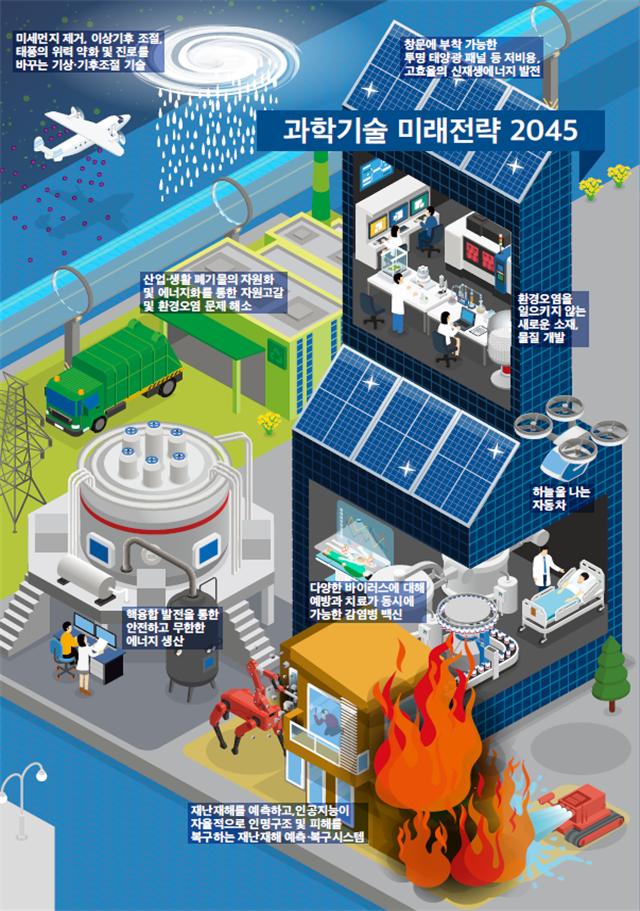
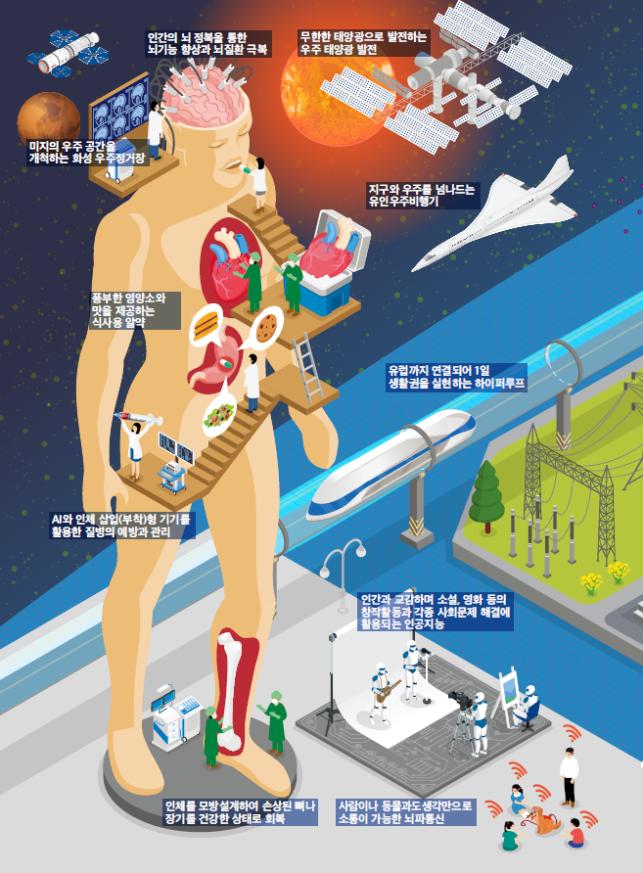
[Asia Economy Reporter Junho Hwang] Technologies are being developed to replace our body's teeth, bones, skin, blood, and organs with new ones, or to stimulate the brain with machines to maintain memory and mental state even as we age. There will also be technologies enabling manned spaceplanes to travel between Seoul and New York within two hours, or space travel using reusable space launch vehicles like the Hyperloop. Technologies to reduce fine dust through artificial rainfall, weaken typhoons, and convert waste into resources are also beginning to be developed. The National Science and Technology Advisory Council announced the 'Science and Technology Future Strategy 2045' containing these details at its 12th review meeting on the 26th.
This strategy contains the blueprint for South Korea's science and technology 25 years from now as envisioned by the government. The government has set the future vision for 2045 as a safe and healthy society, a prosperous and convenient society, a fair and discrimination-free communication and trust society, and a South Korea contributing to human society. To realize this vision, it has established eight major science and technology challenges and development directions for over 160 exemplary future technologies.
For a safe and healthy society, it proposed challenges and technological directions addressing external factors threatening human survival such as climate change, disasters, and infectious diseases, securing sustainability against environmental pollution, and realizing healthy lives through next-generation bio and medical technologies.
To build a prosperous and convenient society, it presented challenges to enhance human physical abilities, secure key resources such as food and energy, expand living spaces, and ensure safe and convenient mobility. For a fair and discrimination-free communication and trust society, it proposed establishing diverse communication methods and reliable networks, and to contribute to human society, it suggested pioneering unknown spaces such as outer space, the deep sea, and polar regions.
To solve these challenges, the government also presented mid- to long-term science and technology policy directions. First, as science and technology actors, it set mid- to long-term policy directions by sector for researchers, enterprises and industries, and the public, covering talent, national R&D systems, growth engines, and social and public issues. Additionally, as the spatial aspect of science and technology policy, it established policy directions for regional science and technology systems as innovation hubs and for global science and technology cooperation. From the policy environment perspective, it proposed directions such as a science-oriented nation where science and technology are the fundamental principles of national governance, and a future-oriented nation that continuously explores and proactively responds to the future.
The Ministry of Science and ICT stated that it plans to use 'Future Strategy 2045' as a basic guideline when establishing mid- to short-term strategies and plans every five years, such as the Basic Science and Technology Plan and the National R&D Mid- to Long-term Investment Strategy. It also added that it plans to produce promotional booklets to help the public better understand Future Strategy 2045.
© The Asia Business Daily(www.asiae.co.kr). All rights reserved.


















