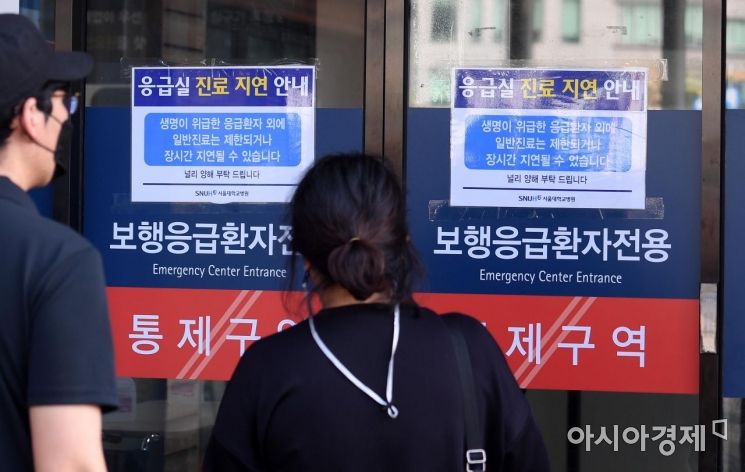
 On the 26th, when the second general strike led by the Korean Medical Association (KMA) was enforced, a notice about delayed medical treatment was posted at the entrance of the emergency room at Seoul National University Hospital in Jongno-gu, Seoul. The KMA opposed the government's policies such as expanding the quota of medical schools and entered a three-day collective strike until the 28th. Photo by Hyunmin Kim kimhyun81@
[Asia Economy Reporter Kim Heung-soon] It is the first time in six years since 2014 that the government has issued a 'work commencement order' on the 26th to residents and fellows who have gone on a collective strike (work stoppage) opposing the four major medical policies: expansion of medical school quotas, establishment of public medical schools, pilot project for coverage of Korean herbal medicine prescriptions, and promotion of non-face-to-face medical treatment. The reason for shifting to a hardline stance after conducting behind-the-scenes negotiations with the Korean Medical Association until recently and attempting to resolve the issue through dialogue is the government's judgment that the COVID-19 situation, which is rapidly spreading mainly in the metropolitan area, is that serious.
Park Neung-hoo, Minister of Health and Welfare, stated at a briefing held at the Government Complex Seoul on the morning of the same day, "The government ordered residents and fellows working at training hospitals located in the metropolitan area, including Seoul, Gyeonggi, and Incheon, to immediately return to patient care duties as of 8 a.m. today." The order targets interns, residents, and fellows affiliated with 95 training hospitals located in the metropolitan area.
Work Commencement Order Issued for the First Time in 6 Years: Legal Basis
This measure is based on Article 59 of the Medical Service Act, which states that "the Minister of Health and Welfare or the mayor/governor may provide necessary guidance and orders to medical institutions or medical personnel if necessary for health and medical policy or if there is a risk of serious harm to public health." The provision also stipulates that "if a medical personnel unjustifiably suspends medical treatment or if a medical institution operator collectively closes or suspends operations causing or likely to cause significant disruption to patient care, the Minister of Health and Welfare, mayor/governor, or mayor/county governor/district head may issue a work commencement order to such medical personnel or medical institution operator."
Minister Park said, "If the participation rate of clinic-level medical institutions engaging in collective work stoppage exceeds 10% and causes disruption to medical services as judged by local governments, the relevant public health center may issue a work commencement order," adding, "We will strictly respond to illegal acts occurring during collective actions."
The Ministry of Health and Welfare previously issued work commencement orders when the medical community went on collective work stoppage in 2000 opposing the introduction of the separation of prescribing and dispensing, in April 2002 during a strike demanding a full review of the separation system, and in March 2014 when the medical community conducted a one-day collective work stoppage opposing government medical policies such as the introduction of telemedicine and the health insurance system.
If one fails to comply with the government's work commencement order without justifiable reasons, they may face license suspension or imprisonment for up to three years or a fine of up to 30 million KRW. If penalized with imprisonment or higher for violating the Medical Service Act, it is recognized as a disqualification for medical personnel, which may lead to license cancellation.
The Ministry plans to verify work attendance starting with emergency rooms and intensive care units at metropolitan training hospitals through on-site inspections on the day. Subsequently, it plans to sequentially issue individual work commencement orders targeting essential medical departments such as surgery, delivery, and dialysis rooms in metropolitan training hospitals, emergency and intensive care units in the metropolitan area, and surgery, delivery, and dialysis rooms in non-metropolitan areas.
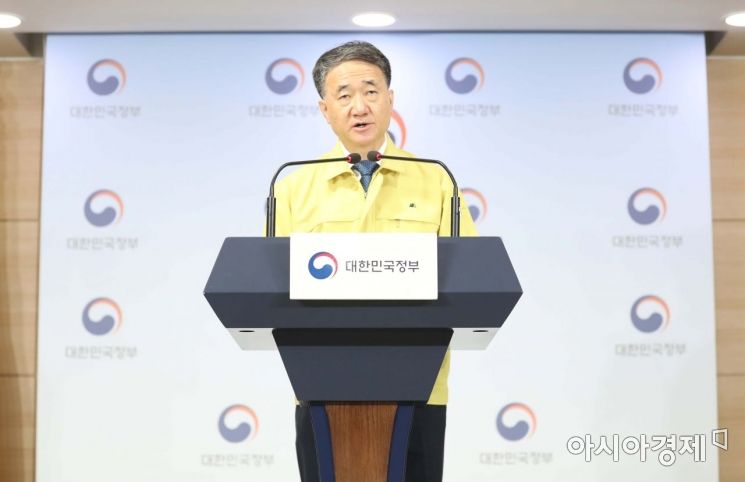 Minister of Health and Welfare Park Neung-hoo is delivering an emergency government response statement regarding the Korean Medical Association's collective strike on the 26th at the briefing room of the Government Seoul Office in Jongno-gu, Seoul. Photo by Moon Ho-nam munonam@
Reason for Shift to 'Strict Response'
Along with the work commencement order, the government plans to file complaints for violation of the Fair Trade Act and take administrative actions based on the Medical Service Act against the Medical Association that promoted the collective work stoppage. Regarding the movement to refuse the national examination by medical students, the government will strictly respond by confirming the individual's status and intention to cancel and processing the cancellation of examination applications.
Minister Park explained, "No reason can justify resolving issues by jeopardizing the lives and safety of the people," adding, "Protecting the lives and safety of the people is the government's top priority mission entrusted by the people, and the government must strictly fulfill this."
He emphasized, "In the serious situation of the spread of COVID-19, there is neither time nor room to waste energy on unnecessary conflicts," and urged, "Medical organizations must immediately stop collective actions that cause suffering to the people, maintain their respective positions in treating patients, and resolve issues through dialogue with the government once again."
Meanwhile, the Korean Medical Association continued behind-the-scenes negotiations with the government until early morning but failed to find a consensus to withdraw collective actions and will proceed with a three-day collective work stoppage until the 28th. This is the second nationwide doctors' general strike. Unlike the residents' collective work stoppage on the 7th or the first nationwide doctors' strike on the 14th, interns, residents, fellows, and even private practitioners who have already started an indefinite strike are expected to participate. According to the Ministry of Health and Welfare, among the 32,787 clinic-level medical institutions nationwide, 2,097 (6.4%) reported work stoppage on the day, 1,905 (5.8%) on the 27th, and 1,508 (4.6%) on the 28th.
The Medical Association stated, "The medical community's collective actions are to urge the government to change," and requested, "Please create a starting point to transform the long-entangled relationship into one of trust and respect. The medical community is always open to discussing all possibilities with the government."
© The Asia Business Daily(www.asiae.co.kr). All rights reserved.


















