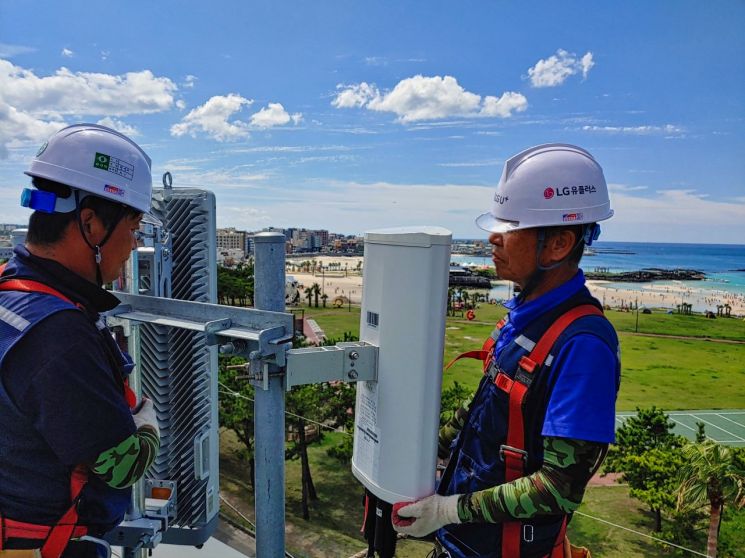
[Asia Economy Reporter Koo Chae-eun] LG Uplus announced on the 25th that it will implement countermeasures to ensure stable network operation despite facility damage caused by the northward approach of Typhoon Bavi, the 8th typhoon, and the spread of the novel coronavirus infection (COVID-19).
Typhoon Bavi, expected to affect South Korea starting from Jeju on the morning of the 26th, is a large-scale typhoon accompanied by strong winds. Due to the potential damage to communication facilities, LG Uplus has issued an emergency level “preparation stage” to strengthen monitoring of the typhoon and conducted pre-inspections in preparation for the typhoon.
In areas expected to be directly or indirectly affected by the typhoon, recovery personnel, supplies, generators, and spare parts have been prepared to enable rapid fault recovery. The operational status of emergency generators to be used in case of power outages, low fuel levels, and battery abnormalities have been checked, and safety education has been provided to on-site recovery personnel to prevent damage caused by river flooding and soil erosion.
LG Uplus is efficiently managing personnel even amid the spread of COVID-19. Strict preventive measures are being implemented, such as allowing employees to enter only when unavoidable, like for work inside base stations or fault handling.
Additionally, to ensure stable service operation, monitoring personnel who oversee network faults 24 hours a day and core network operation staff are performing their duties by dispersing their workplaces across offices in Sangam, Magok, Anyang, and Nonhyeon. This reduces unnecessary contact to prevent the spread of COVID-19 and ensures normal network operation even if a confirmed case occurs in one office. These department personnel cannot move to other workplaces and use separate routes within the office. After work, they must avoid places where many people gather.
Furthermore, field operation team members responding to service faults nationwide are working under a “direct dispatch and direct return” system, traveling directly from their homes to the fault sites.
© The Asia Business Daily(www.asiae.co.kr). All rights reserved.

















