Rising Rent Burdens for Youth Housing Near Transit Stations
Hapjeong Youth Housing: Monthly Rent Up to 840,000 KRW Even with Maximum Deposit
If Deposit Reduced to Around 30 Million KRW, Monthly Rent Reaches 1.09 Million KRW
Seoul City to Announce Measures to Reduce Rent Burden Soon
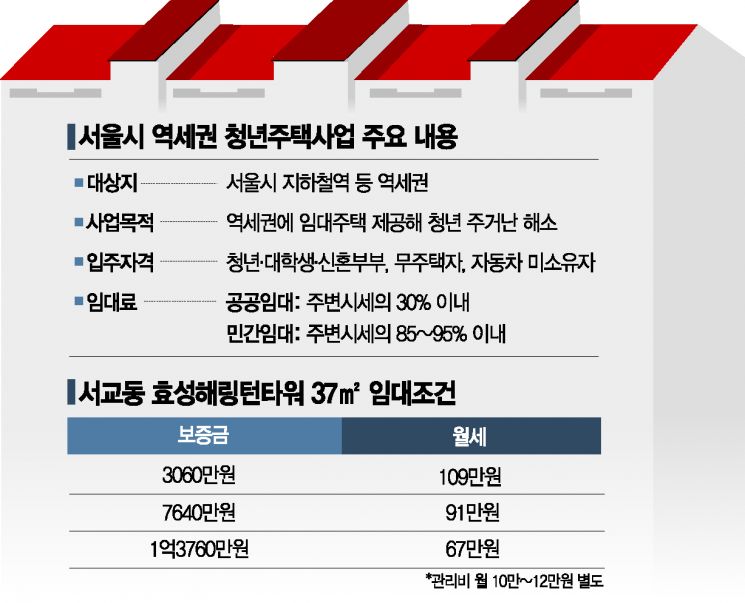
[Asia Economy Reporter Moon Jiwon] One of Seoul City's key projects, the 'Transit Station Area Youth Housing,' is being criticized for actually increasing the housing burden on young people due to high rental fees. While some argue that the high monthly rent, which can exceed 1 million KRW due to the prime location, is inevitable, analyses suggest that the policy has effectively lost its function as a welfare measure for youth. Seoul City has confirmed that, amid ongoing controversy, it is belatedly considering measures to further reduce rental burdens.
According to the housing industry on the 25th, some of the transit station area youth housing supplied this year has been shunned by young people due to high rents, leaving unsold units unleased for several months. The transit station area youth housing policy involves private developers receiving regulatory relaxations and other support from Seoul City to build rental housing (public and private) near transit stations and prioritize supply to young people.
The public rental housing type, which Seoul City purchases from the private sector and supplies, has rents set at 30% or less of the surrounding market price, making it very affordable, but it accounts for a small portion of the total units. On the other hand, the private rental housing type, which effectively comprises most of the complexes, has rents reaching 95% of the surrounding officetel market price, sparking controversy over 'high rental fees' since its introduction.
Hyosung Harrington Tower in Seogyo-dong, Mapo-gu, which conducted formal contracts in April, has been recruiting tenants on a first-come, first-served basis for remaining units since May, but about 20 units remain vacant. The reason for the slow tenant recruitment is the high rent. For a 37㎡ unit (exclusive area, 1.5 rooms), monthly rent varies between 670,000 KRW and 1,090,000 KRW depending on the deposit. Tenants typically choose a deposit of 91.7 million KRW with a monthly rent of 850,000 KRW.
According to investigations, a small and medium-sized enterprise (SME) employee, who can receive the most benefits, would still have to pay at least 840,000 KRW monthly, including loan interest, maintenance fees, and rent, even if choosing the lowest rent type ('deposit 137.6 million KRW, monthly rent 670,000 KRW'). This is because Seoul City lends about 40 million KRW interest-free, and through SME support, an additional 77 million KRW can be procured at a low interest rate of around 1%. Employees of large corporations or university students without such benefits face even greater burdens.
A 30-something office worker living in Seogyo-dong, Mapo-gu, Mr. A, said, "I gave up after hearing that the minimum rent for remaining units at Hyosung Harrington Tower is 670,000 KRW when I recently inquired," adding, "My current one-room apartment costs about 510,000 KRW monthly including rent and maintenance fees, so considering my salary in the 2 million KRW range, it's impossible despite the good location."
Similarly, 'Urbaniel Chungjeongno' in Seodaemun-gu, Seoul, which started first-come, first-served tenant recruitment for unsold units after relaxing eligibility criteria in March, has not completed tenant recruitment even after five months. This youth housing sparked controversy earlier this year for introducing a system where essential appliances like refrigerators, air conditioners, and washing machines were rented at additional costs. Although all have now been changed to essential options following Seoul City's directives, the high monthly rent of 710,000 to 810,000 KRW, including maintenance fees, remains a burden for young people.
Seoul City maintains that the transit station areas where youth housing is located are 3 to 5 times more expensive than nearby land, and that private developers' profits must be guaranteed to some extent, making high rents unavoidable. A Seoul City official said, "Rents are set based on surrounding market prices surveyed by the Korea Real Estate Board about two years before the completion date," adding, "Because the standard is from two years ago, rents are actually lower compared to current prices."
However, there are criticisms that Seoul City sets the upper limit of rents based on surrounding officetel market prices rather than young people's ability to pay, making the policy detached from reality. Online, complaints such as "How can one save money when paying 800,000 KRW monthly rent?" and "I wonder if this is truly a policy for youth" are emerging.
Considering this, Seoul City plans to finalize and announce a policy to further reduce young people's rental burdens soon. A Seoul City official stated, "Currently, the city supports up to 50% of the deposit, but since high rents continue to be controversial, we plan to increase this support," adding, "After reviewing the profitability of private construction companies and the city's financial status, we will announce the measures promptly."
© The Asia Business Daily(www.asiae.co.kr). All rights reserved.