[Asia Economy Reporter Kim Jeong-ho] History lecturer Seol Min-seok on 'The Guys Who Cross the Line - Returns' mentioned pro-Japanese collaborators and the Anti-Japanese Special Committee.
On the afternoon of the 23rd, MBC's 'The Guys Who Cross the Line - Returns' (hereafter 'Seonnyeodeul') aired, where the cast expressed anger toward pro-Japanese collaborators.
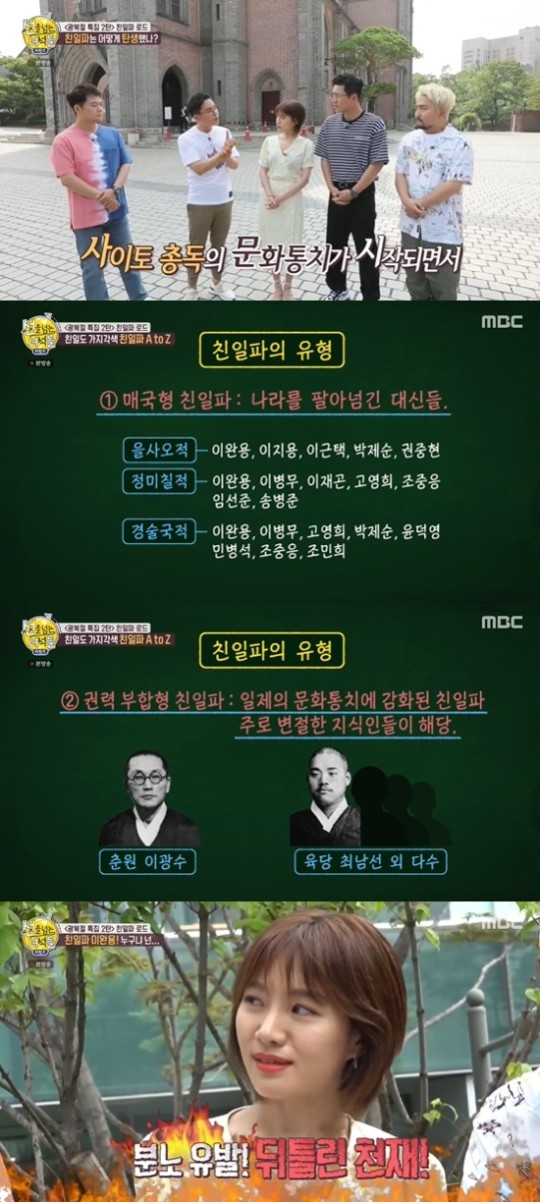
On this day, Seol Min-seok, Jeon Hyun-moo, Choi Hee-seo, Yoo Byung-jae, and Kim Jong-min revealed the pro-Japanese collaborator road as part of the Liberation Day special part 2. Seol Min-seok explained, "There are different types of pro-Japanese collaborators," categorizing them into traitorous pro-Japanese collaborators, power-aligned pro-Japanese collaborators, and war-collaborating pro-Japanese collaborators.
Seol Min-seok mentioned the process by which pro-Japanese collaborator Lee Wan-yong shifted from pro-American and pro-Russian stances to pro-Japanese. Kim Jong-min stated that Lee Wan-yong's cash assets alone are worth about 60 billion won in today's value, and he owned land eight times the size of Yeouido, which sparked viewers' anger. Additionally, Lee Wan-yong sold 98% of his land before liberation. His descendants claimed ownership of land in Bukahyeon-dong, sold the property for 3 billion won, and emigrated to Canada.
Seol Min-seok said there was a pro-Japanese collaborator even worse than Lee Wan-yong. He said, "Lee Wan-yong sold out the country and received 3 billion won in today's money. He only got 4,000 pyeong in Okindong. But that person owned much larger land. His family had mountains and ponds," arousing curiosity.
That person was Yoon Deok-young, the elder uncle of Empress Sunjeonghyo and one of the signatories of the Japan-Korea Annexation Treaty. Seol Min-seok said about Yoon Deok-young's residence, Byeoksu Mountain Villa, "In today's terms, it would be like owning 20,000 pyeong in Cheongdam," which amazed the audience.
The secret to Yoon Deok-young's rise was that he was an in-law. Seol Min-seok explained, "After Ito Hirobumi was assassinated by An Jung-geun, Yoon Deok-young proposed holding a memorial for Ito Hirobumi at Jangchungdan."
Regarding Yoon Deok-young's persistence, Seol Min-seok said, "After the Japan-Korea Annexation Treaty, Lee Wan-yong tried to persuade Emperor Gojong to greet the Japanese emperor but gave up. However, Yoon Deok-young sealed Emperor Gojong's assets and expelled the palace maids managing his belongings. When Gojong still refused to meet, Yoon Deok-young threatened him over past women issues and stayed in front of Gojong from 2 p.m. to 2 a.m. Eventually, Gojong said he would rather die than meet and sent Sunjong instead. Even the Japanese were appalled by Yoon Deok-young's persistence," he explained.
Furthermore, Seol Min-seok named Chunwon Lee Kwang-su as a representative defector. Lee Kwang-su was the drafter of the February 8th Independence Declaration.
Seol Min-seok said, "He was the greatest literary figure of the Joseon Dynasty. He went to study in Japan, sponsored by the pro-Japanese group Iljinhoe. In his youth, he had intentions for independence activism. He met An Chang-ho in Shanghai. But when he returned, Lee Kwang-su published 'Theory of National Reformation' in the Cheondogyo magazine 'Gaebyeok'." The article called for reforming the inferior national character.
Lee Kwang-su was part of the Joseon Heungsadan's Suyangdongwoohoe but completely defected after serving six months in prison. Seol Min-seok said, "After liberation, he quickly went into seclusion and wrote a work called 'My Confession,' using history to justify himself," which angered those around him.
Next, the cast headed to Baek In-je House. It was the house built by Han Sang-ryong, known as the 'Lee Wan-yong of the economic world.' Later, it became owned by Baek In-je, founder of Baek Hospital, and is now owned by the Seoul Metropolitan Government.
Han Sang-ryong was Lee Wan-yong's maternal nephew and a representative pro-Japanese collaborator who served as a director of the Oriental Development Company. Regarding this, Seol Min-seok said, "Han Sang-ryong created what would be called a traitorous fund today, invested in it, and even became president of Hansung Bank. He led the construction of monuments for the Japanese Resident-General and Governor-General. When war broke out, he gave speeches urging loyalty to the Japanese Emperor. His final fate is unknown," he said.
Later, regarding pro-Japanese collaborators, Seol Min-seok explained, "The US-Soviet military government period came to Korea, and the US military government did not care whether someone was a pro-Japanese collaborator or not. So, for efficient governance, they appointed pro-Japanese collaborators as they were. The pro-Japanese collaborators switched to being pro-American." President Syngman Rhee enacted the Anti-Japanese Collaborators Punishment Act and formed the Anti-Japanese Special Committee, but most administrative and police officials were pro-Japanese collaborators.
Seol Min-seok also said, "Then President Syngman Rhee said, 'If we punish them all now, who will protect this country?'"
Nevertheless, the Anti-Japanese Special Committee intensified efforts to arrest pro-Japanese collaborators, but when No Deok-sul was caught, police abducted Anti-Japanese Special Committee members, investigators, and special police one by one, took them to police stations, and assaulted them.
Finally, Seol Min-seok added, "The first reason the pro-Japanese collaborators were not purged was the Anti-Japanese Special Committee assault incident. The second reason was the National Assembly informant incident, where members supporting the Anti-Japanese Special Committee were arrested and tortured. How many pro-Japanese collaborators were executed? Zero," he added.
Meanwhile, 'The Guys Who Cross the Line' airs every Sunday at 9:10 p.m.
© The Asia Business Daily(www.asiae.co.kr). All rights reserved.

















