Not Temporary Earnings but Business Structure Improvement Results Achieve Both 'Growth' and 'Profitability'
China Food Business Q2 Operating Profit 3.3 Billion KRW... H1 Cumulative Operating Margin 14.2%
[Asia Economy Reporter Lee Seon-ae] Pulmuone has improved its profit structure in the U.S. and has taken the lead in the growing U.S. tofu market driven by the plant-based protein trend, embarking on full-scale profit generation.
Pulmuone USA, the U.S. subsidiary of Pulmuone, announced on the 23rd that it recorded its first profitable quarter since entering the U.S. market in 1991.
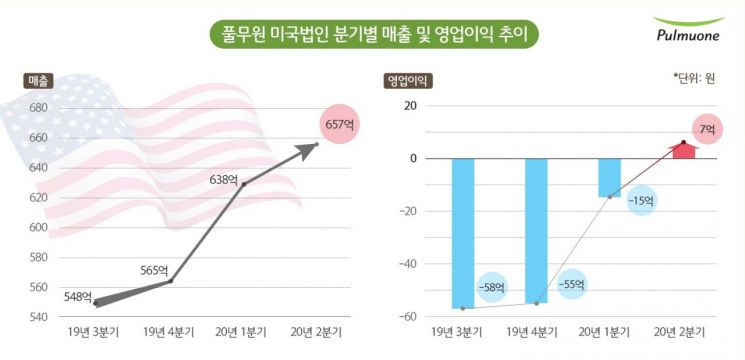
Looking at Pulmuone USA’s sales and operating profit trends over the past four quarters, it is evident that continuous growth in scale and improvement in profit structure have been achieved simultaneously. In Q3 2019, Pulmuone USA posted sales of KRW 54.8 billion and an operating loss of KRW 5.8 billion. In contrast, sales in Q2 this year reached KRW 65.7 billion, about 20% higher than Q3 last year, and operating losses were completely eliminated, turning into an operating profit of KRW 700 million.
Starting its business in the U.S. in 1991 targeting Korean expatriates, Pulmuone expanded its business significantly after acquiring Nasoya, the No.1 tofu brand in the U.S., in 2016. After 29 years in the U.S. market and 4 years since acquiring Nasoya, Pulmuone achieved a turnaround, capturing both ‘scale growth’ and ‘profitability.’
Since acquiring Nasoya, Pulmuone has invested in and streamlined operations across all areas including production, logistics, sales, and marketing to improve profitability. Additionally, by expanding its product lineup in the U.S. market to include tofu, Asian noodles, and kimchi, Pulmuone USA’s annual sales exceeded KRW 200 billion for the first time last year. As the business scale grew, efficiency also increased, marking the beginning of full-scale ‘economies of scale.’
It is no exaggeration to say that securing distribution channels is critical for overseas business survival. Pulmuone, having established distribution networks across the entire U.S. ? the world’s largest economy with a population of 330 million ? was able to create synergies across all business areas including sales, marketing, production, and logistics.
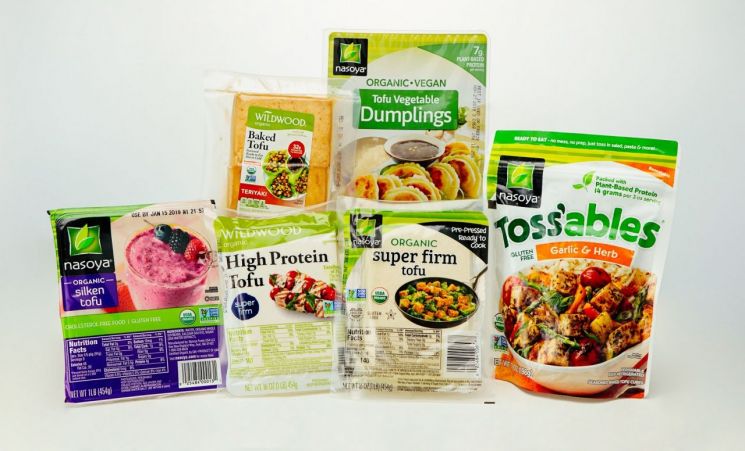
First, by acquiring Nasoya, Pulmuone was able to build a distribution network covering about 20,000 retail stores nationwide, including Walmart, Kroger, and Costco. Pulmuone began supplying high-quality tofu made with Pulmuone’s top technology to Americans across the U.S. Especially recently, with the plant-based protein boom in the U.S., tofu, the original plant-based protein food, has been reappraised. According to Nielsen in the U.S., the U.S. tofu market has shown a high annual growth rate of 7-8%, and the first half of this year saw about 50% growth compared to the previous year.
This year, demand for tofu in the U.S. has surged significantly, with all Pulmuone tofu factories in the U.S. operating at 100% capacity. The supply from U.S. production alone is insufficient, so more than 1 million tofu blocks are exported monthly from Pulmuone’s tofu factory in Eumseong, Korea. According to Nielsen, Pulmuone holds a 75% market share of the U.S. tofu market.
Next, securing distribution channels enabled bold and aggressive sales and marketing strategies. After acquiring Nasoya, Pulmuone began full-scale supply of its specialty premium fresh noodles. Starting with Korean-style Jjajangmyeon, Pulmuone expanded its Asian noodle lineup to include Teriyaki stir-fried udon, Bulgogi udon, and Kalguksu, creating its second hit product in the U.S. after tofu. In 2015, Pulmuone’s Asian noodle sales were only $5 million, but by 2019 they surpassed $30 million, achieving sixfold growth in four years. Sales in the first half of this year grew 30% compared to the same period last year.
Recently, Pulmuone expanded its business to include kimchi in the U.S. With the fresh food distribution network and know-how built through tofu and fresh noodles, Pulmuone has the capability to expand into fermented foods like kimchi. Among Korean food companies, Pulmuone is still the only manufacturer that can supply kimchi nationwide in the U.S. With the recent Korean Wave increasing interest in Korean cuisine, and Americans recognizing kimchi as a probiotic health food, this is a business with high future growth potential. According to Nielsen, Pulmuone holds a 43% market share of the U.S. kimchi market.
Finally, Pulmuone achieved logistics innovation by establishing production bases on both the East and West coasts of the U.S. The existing Pulmuone tofu factory is located in the West, while the Nasoya tofu factory is in the East. In a vast country like the U.S., concentrating production bases in a specific region inevitably lowers profitability. For example, delivering tofu by truck from Pulmuone’s Gilroy tofu factory in California to a supermarket in New York on the East Coast covers about 4,500 km, causing logistics costs to soar and profitability to deteriorate. In other words, by acquiring Nasoya, Pulmuone secured not only distribution networks but also balanced production bases on both coasts, reducing fixed costs such as logistics expenses and improving profit structure.
Lee Hyo-yul, CEO of Pulmuone, said, “Although many food companies are posting good profits this year due to COVID-19, Pulmuone’s overseas business performance is not a temporary phenomenon but a result of improved business structure. From product strategy to distribution, logistics, production, and marketing, all are organically linked to create synergy for profit generation, so we expect significant growth and profit generation in overseas markets going forward.”
Meanwhile, Pulmuone is conducting overseas business mainly in the U.S., China, and Japan, and has recorded profits for two consecutive quarters in China. The Chinese food business posted an operating profit of KRW 700 million in Q1 this year, marking the first quarterly profit in 10 years since entering China, and recorded an operating profit of KRW 3.3 billion in Q2, continuing profitability. The cumulative operating profit margin for the first half of the year is 14.2%. By product, the main product pasta sales grew 176% year-on-year in the first half, and tofu sales grew 87%. The business strategy focusing on new distribution channels such as e-commerce and O2O, based on analysis of Chinese consumer characteristics from the early stages, proved effective.
© The Asia Business Daily(www.asiae.co.kr). All rights reserved.


















