Last year, the cost per passenger was 1,440 won while the base fare was 1,250 won... Considering public services like free rides for seniors and disabled, the actual average fare per passenger is 946 won. Carrying one passenger results in a loss of about 500 won... The current base fare of 1,250 won was set in 2015 and has been frozen for 5 years... Especially after COVID-19, ridership sharply declined. Seoul Metro's transport revenue in the first half of this year (Jan-Jun) was 627.5 billion won, down 24.4% from 829.9 billion won in the same period last year...
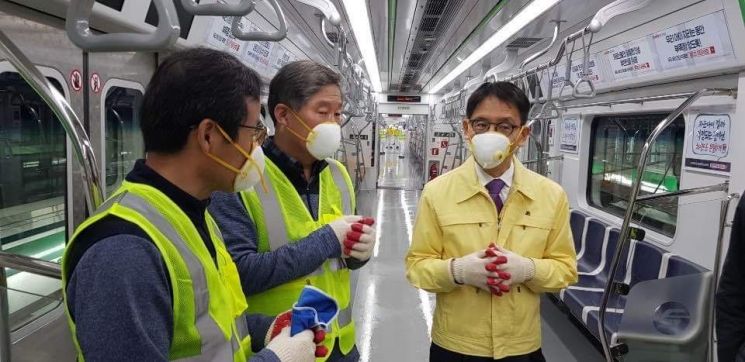 Kim Sang-beom, President of Seoul Metro (right), is visiting Gunja Vehicle Depot after his inauguration and having a conversation with officials.
[Asia Economy Reporter Park Jong-il] A losing business the more it runs.
This is what people say about the Seoul Metropolitan Subway Corporation. Although it is commonly said that "no business sells at a loss," looking at the subway fares, which are the lifeline for citizens, it does not seem to be entirely true.
This is because the average fare actually paid by passengers continues to be lower than the transportation cost, which is the cost of carrying passengers.
According to Seoul Transportation Corporation, last year the transportation cost per passenger was 1,440 won, while the basic fare was 1,250 won. Moreover, considering public services such as free rides for the elderly and disabled, the actual average fare per passenger is 946 won. This means that carrying one passenger results in a loss of about 500 won rather than making money. From the subway operator's perspective, this creates a paradoxical situation where, arithmetically, "not carrying passengers is more profitable."
◆ Basic fare of 1,250 won set in 2015... about 500 won deficit
The current fare for metropolitan area subways is 1,250 won for the first 10 km, with an additional 100 won added for every extra 5 km traveled (based on transportation card usage). For example, if you travel from Seoul City Hall to Ilsan in Gyeonggi Province by subway, you only pay 1,650 won, whereas the metropolitan bus costs 2,800 won, and a taxi ride exceeds 30,000 won. (Based on travel between City Hall and Daehwa Station, subway travel time is 1 hour 8 minutes, metropolitan bus 1 hour 16 minutes, taxi 47 minutes)
Looking at overseas subways, assuming a 10 km trip paid by transportation card, the New York subway costs $2.75 (about 3,350 won), London subway 2.4 euros (about 3,200 won), and Paris subway 1.9 euros (about 2,500 won). Even Tokyo subway in neighboring Japan is around 200 yen (about 2,200 won).
Since each country and mode of transportation has different characteristics, direct price comparisons are difficult, but it is undeniable that the fare for the metropolitan subway, which maintains punctuality and consistent intervals, is very inexpensive.
As a result, subway operators struggle with deficits every year. Among all subway operators nationwide, Seoul Transportation Corporation, the largest, recorded a net loss of 586.5 billion won last year.
◆ Significant decrease in passengers due to COVID-19 this year... estimated net loss of about 480 billion won in the first half
This year, especially due to COVID-19, the number of passengers has drastically decreased, leading to a sharp drop in transportation revenue, and consequently, the net loss is expected to increase further.
Seoul Transportation Corporation's transportation revenue for the first half of this year (January to June) was 627.5 billion won, a 24.4% decrease from 829.9 billion won in the first half of last year. The net loss for the first half of this year is expected to be about 480 billion won, nearly a 70% increase compared to the 283.6 billion won net loss in the first half of the previous year.
Operators are making every effort to overcome chronic deficits, but realistically it seems difficult. They are requesting amendments to the Urban Railway Act that require government compensation for losses caused by legally mandated free rides, but the government holds the position that it is not appropriate to pour national funds into urban railways owned by local governments and that the respective local governments should handle it. Because of this, bills to amend the Urban Railway Act to specify government compensation for free ride costs have been proposed since the 17th National Assembly but have been repeatedly discarded.
No one looks kindly on companies running deficits. In such situations, companies that find it difficult to increase revenue tend to pursue cost reductions. However, there is concern that in this process, investment in safety, which should be prioritized above all else, may be reduced or deferred. The Seoul subway alone has been in operation for over 40 years since it first opened in 1974. Therefore, there are many safety issues such as replacing aging trains, remodeling stations, and upgrading facilities.
This year alone, subway safety accidents such as derailments at Singil Station on Line 1 and Balsan Station on Line 5, and a collision at Sangye Station on Line 4 occurred consecutively. Fortunately, there have been no major casualties so far, but if investment in safety is not made, a major accident could happen anytime and anywhere.
Currently, the basic fare for metropolitan subways has been frozen for over five years since it was raised from 1,050 won to 1,250 won in June 2015. Considering this situation, it seems necessary to urgently raise fares to put out the immediate fire.
◆ Fare increase seems inevitable around the end of this year
The main business of subway operators is transportation, carrying passengers. Therefore, fundamentally, to sustain the business, it is necessary to adjust fares to an appropriate level so that losses are not incurred when carrying passengers. However, according to the Urban Railway Act, fares must be set within the range determined by the city or provincial governor, and this process always becomes a stumbling block.
No passenger likes fare increases, and elected local government heads feel burdened by opposition, so they cannot be proactive about raising fares. Then, when the operator's deficit problem worsens to a critical point, they reluctantly raise fares, but this always causes controversy due to the heavy burden.
Seoul is scheduled to elect a new mayor through a by-election in April next year, so the subway fare increase is expected to take place around the end of this year.
Most subway operators take the form of public enterprises that must balance both public interest and profitability. One way is to maintain the "loss-making fares" for public interest and inject large-scale taxes. However, first, it is hoped that a foundation for setting appropriate fares will be established so that operators can pursue more rational management and focus on improving safety and service quality.
◆ Seoul Transportation Corporation worried about paying employee salaries from November
Seoul Transportation Corporation has requested an additional budget of 16.1 billion won from Seoul City. This is known to be compensation related to COVID-19 quarantine, not operating funds.
There are rumors that due to financial deterioration, the corporation may not be able to pay employees' salaries from November. Regarding this, a Seoul Transportation Corporation official said, "We have received approval from the Ministry of the Interior and Safety to issue 365.7 billion won in corporate bonds (issuance timing and repayment conditions undecided). However, this amount also corresponds to the loss in transportation revenue caused by COVID-19."
© The Asia Business Daily(www.asiae.co.kr). All rights reserved.

















