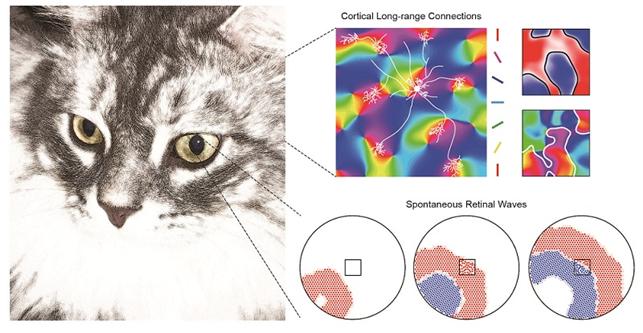
 Developmental Model of Retinal Neural Waves Forming Functional Circuit Architecture in the Visual Cortex
[Asia Economy Reporter Junho Hwang] A student enrolled in the undergraduate program at the Korea Advanced Institute of Science and Technology (KAIST) has uncovered the principles behind how long-range horizontal connections, one of the major neural network connection structures observed in the visual cortex, are formed. The related paper was selected as the cover article of the international neuroscience journal, the Journal of Neuroscience.
On the 21st, KAIST introduced the research results of Jinwoo Kim, a senior in the Department of Bio and Brain Engineering. The research team, including Jinwoo Kim, demonstrated that retinal waves caused by spontaneous activity of retinal neurons before young mammals open their eyes (early brain state) stimulate neurons in the visual cortex of the brain in specific spatial patterns, forming long-range horizontal connections.
In the visual cortex of mammals, neurons exhibit "neural selectivity," responding only to specific elements of external stimuli. Cells with similar neural selectivity are connected by special network circuits called long-range horizontal connections, even if they are far apart.
The research team modeled the neural network structure within the retina and simulated the impact of retinal wave patterns on structural formation in the visual cortex. As a result, they confirmed that the selective activity patterns formed during the transmission of spontaneously occurring retinal waves from the retinal ganglion cells to the visual cortex create the long-range connection structures within the visual cortex. Additionally, based on this model, they succeeded in reproducing the characteristic neural activity patterns of the early visual cortex observed in animal experiments.
Jinwoo Kim stated, "This research is interesting in that it provides a clear theoretical explanation based on known experimental data about how the brain learns in an unsupervised manner before it first experiences sensory information from the external world." He added, "Research in this direction is expected to greatly contribute to future studies on new forms of artificial neural networks that do not rely on data learning."
© The Asia Business Daily(www.asiae.co.kr). All rights reserved.

















