Kia Motors Ordinary Wage Ruling, Supreme Court's Good Faith Principle as a Benchmark
Impact on Ongoing Corporate Ordinary Wage Lawsuits and Wage Negotiations
Corporate Burden Increases Following COVID-19... Fairness Controversies by Company and Worker
Previous Labor-Management Agreements Undermined... Labor Unions Likely to Strengthen Litigation Stance
[Asia Economy Reporters Baek Kyunghwan and Woo Suyeon] The reason the Supreme Court sided with the union in the Kia Motors ordinary wage lawsuit, which has been ongoing for nine years, lies in its refusal to recognize the "principle of good faith" (Shinui Principle). The company's appeal that retroactively paying unpaid ordinary wages to workers could trigger a management crisis was not reflected. This could place a burden on companies struggling due to the novel coronavirus infection (COVID-19). There are also concerns about fairness issues with workers who have already withdrawn their lawsuits through labor-management agreements.
◆ Strict Application of the Shinui Principle in the Verdict = The background for not applying the Shinui Principle in Kia Motors' ordinary wage lawsuit is the court's logic that allowances must be paid as stipulated by law unless there is a situation of "significant managerial difficulty." In other words, it is an objective judgment on whether the company is actually in a difficult situation.
In fact, on the 20th, the Supreme Court emphasized, "The recognition of the ordinary wage nature of regular bonuses and the acceptance of the Shinui Principle defense regarding ordinary wages must be judged cautiously and strictly." In particular, it judged that "based on the submitted evidence alone, it is difficult to conclude that the defendant would face significant managerial difficulties or that the company's existence would be threatened due to this claim." The claim amount for this first lawsuit (based on unpaid amounts from 2008 to 2011) is about 57 billion KRW, which is not large compared to the first and second trials, but if the second and third lawsuits (unpaid amounts from 2011 to 2017) proceed, the amount could expand to over 100 billion KRW.
Additionally, a notable point in this Supreme Court ruling is that the "break time" of 10 to 15 minutes granted during regular working hours and extended working hours for production workers was considered working hours under the Labor Standards Act. Since the remaining time excluding lunch during regular working hours is 8 hours, the collective agreement and attendance management regulations assumed that the time designated as break time is also working hours.
In previous first and second ordinary wage lawsuits, the court ruled in favor of the union by stating that Kia Motors workers' bonuses, which reached 700%, should be included in ordinary wages. In the first trial, half of the total claim amount, 312.6 billion KRW, was recognized, and including delayed interest, the court ordered payment of 422.3 billion KRW. In the second trial, lunch allowances and some other allowances previously recognized as ordinary wages were excluded, slightly reducing the recognized amount.
◆ Could Become a New Benchmark for Ordinary Wages = This ruling can serve as an important benchmark to understand the Supreme Court's stance on the Shinui Principle, which recognizes managerial difficulties of companies. It is expected to act as a reference point for companies currently involved in ordinary wage lawsuits or those establishing new wage systems, causing a significant ripple effect in the business community.
In this ruling, the Supreme Court reaffirmed its position of not recognizing the Shinui Principle for Kia Motors and ordering the payment of unpaid wages to workers. This contrasts with cases where the Shinui Principle was applied to similar companies such as Korea GM and Ssangyong Motor. It appears to reflect the Supreme Court's intention that exceptions are difficult to apply unless there is an actual deficit trend shown in numbers, even if the business environment is difficult due to COVID-19 and other factors.
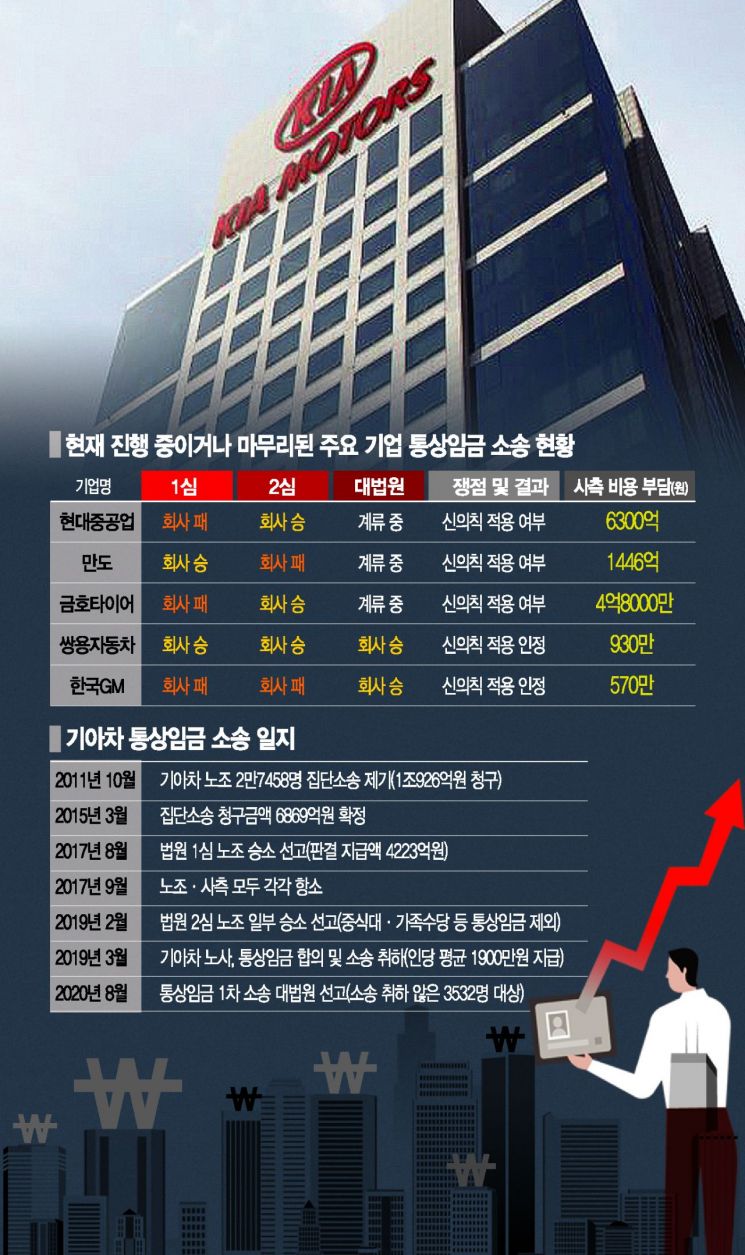
There are also claims that this ruling could raise fairness issues among companies regarding ordinary wage lawsuits. As in the cases of Korea GM and Ssangyong Motor, lawsuit outcomes may vary depending on company performance, and even Hyundai Motor, an affiliate of Kia Motors, obtained opposite lawsuit results due to a single enforcement rule. In Hyundai Motor's case, the company's enforcement rule stating "bonuses will not be paid to workers who worked less than 15 days in two months" led to an interpretation that the bonus lacked fixity, resulting in a victory for the company.
Fairness issues with workers who received unpaid wages through labor-management agreements after the second trial ruling are also raised. After the partial union victory in the second trial ruling last year, Kia Motors labor and management reached a separate agreement on the application of bonuses as ordinary wages and the settlement of unpaid amounts. Through this, most workers withdrew their lawsuits and received an average of 19 million KRW in unpaid wages per person, concluding the matter.
However, by siding with workers who did not withdraw their lawsuits until the end, the court diminished the significance of the labor-management agreement. Although it may be irreversible for workers who have already received unpaid wages, the labor sector views this ruling as a precedent prioritizing lawsuits over labor-management agreements. The Kia Motors union is already respecting the Supreme Court's ruling and pressuring for the prompt payment of unpaid wages. They plan to leverage this first lawsuit victory to win the second and third lawsuits as well.
Park Jisoon, Dean of the Graduate School of Labor Studies at Korea University (Professor at the Law School), said, "If workers dissatisfied with labor-management agreements file lawsuits each time, the agreements effectively lose meaning," adding, "From the perspective of labor relations development and fairness among workers, a broader application of the Shinui Principle might have been a more reasonable decision, which is regrettable."
© The Asia Business Daily(www.asiae.co.kr). All rights reserved.

















